
Blog article
Career transitions: when an AI coach earns its place
DDI and McKinsey research shows development risk concentrates at four career transitions, from first-time manager to executive. Here is where an AI coach fits in each one.


Picture a new manager's one on one that ends ten minutes early. The report goes quiet halfway through, the manager fills the space with project updates, and both of them walk away without anyone saying what went unsaid. (The scene is an illustration.) Problems like this repeat from one new manager to the next, and the person living them usually can't see them yet, which puts a ceiling on any coaching that waits for the manager to name the problem.
A talent development leader at a global software company with about 14,000 employees described the challenges first-time managers face as close to identical from person to person. In the same conversation, that leader added that a new manager often lacks the self-awareness and the experience to see that a development need exists at all. That pairing explains why first-year problems are easy to predict and still hard to coach.
The common traps are familiar to anyone who has run a new manager program:
Each of these tends to be visible to the people around the manager well before the manager notices it, which is what makes the first year so expensive to learn by trial and error.
Organizational psychologist Tasha Eurich and her team ran 10 investigations with nearly 5,000 participants, which she described in Harvard Business Review in January 2018. They found that 95% of people believe they are self-aware, and about 10% to 15% actually are.
Her research separates two kinds of self-awareness. Internal self-awareness is how clearly you see your own values, reactions and goals, and external self-awareness is how well you understand the way other people see you. The two were barely related in her data, so knowing yourself well says little about how your team experiences you. Eurich studied working adults in general. A first-time manager carries an extra gap on top of that, since there is no track record in the role yet to check their own view against.
Coaching often opens with some version of the same question: what do you want to work on? That approach depends on the person naming the problem. A first-time manager often can't name the problem that matters most, so it stays off the agenda and the sessions work on whatever the manager already knows about.
Senior leaders get a lot from a human coach they can confide in, and they usually arrive with years of feedback to draw on. New managers have far less of that history, so the coaching has to bring its own evidence about what happened.
For new managers, the most useful feedback starts from a specific moment: a particular meeting, a particular one on one, the point where a conversation went quiet. It arrives close to the moment, while the manager still remembers it, and it is small enough to try the next day. The same talent development leader believes there is a large return on small, specific fixes for first-time and early career managers.
A simple way for L&D teams to map this:
| Trap | What the manager tends to notice | What someone in the room would notice | Support that catches it |
|---|---|---|---|
| First hard feedback | The conversation felt awkward | The message was softened until it was unclear | Feedback on the actual wording, the same day |
| Managing former peers | Things feel a little strained | The old team dynamic still runs the meeting | Prep before one on ones with former peers |
| Doing the work | Long hours, deadlines met | Reports waiting on the manager for decisions | A weekly look at what was handed off |
| Drifting meetings | Meetings run long | No owner and no decision at the end | A short debrief after recurring meetings |
| Avoided conversations | A vague sense that something is off | The same issue raised week after week | A nudge tied to the specific pattern |
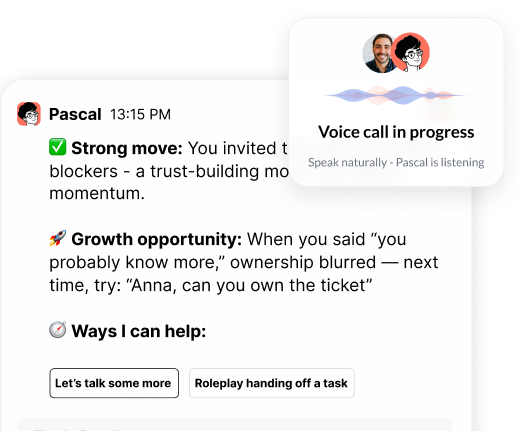
Pascal, Pinnacle's AI coach, joins real meetings and sees a manager's actual interactions. That lets it point out patterns and behaviors a manager may not recognize in themselves, and reflect back how the manager actually comes across in the room. First-line and first-time managers are often the first group a company starts with, because they benefit significantly from coaching support that is easy to reach. Each person's coaching conversations with Pascal stay private. HR and executives see aggregated, anonymized insights, and only for groups large enough to protect anonymity.
For CHROs and heads of L&D, the practical test for any new manager program is how it learns about a problem the manager has not named yet. The programs that pass that test give new managers support that sees the work, because the coach has to see the work to coach the work.



“Thank you for setting the great foundation for my promotion; now I have a plan!"

Curious to see how AI Coaching can 10X the impact and scale of your development initiatives. Book a demo today for:

