
Blog article
Managers are already using public AI for hard conversations. Governance needs to catch up
Managers are already using public AI to prepare for hard conversations. Here's what the data says about the coaching gap behind it.


In DDI's 2019 Frontline Leader Project, their research showed that the average age people first become managers is 36, and the average age they first take a leadership course is 40, four years later.
How common is this scenario? Someone is promoted on a Friday and runs their first one on one as a manager on Monday, with little or no training.
In the same research, 84% of frontline leaders said taking their first leadership job stressed them and only 10% said they felt well prepared. Development risk and payoff both concentrate at a few moments in a career, and those moments are where an AI coach earns its place.
A leadership development leader at a large multinational recently described their next development plan as centered on three moments: new managers, director level moves and executive moves. DDI and McKinsey have studied first-time manager and executive moves, and their numbers explain why a talent team would plan around these moments. Work in a steady role comes with routines, peers who have done the job and a manager who knows it well. A new role takes most of that away at once, so the person learns the job while doing it in front of a new team.
Each transition has its own way of going wrong, and each one is common enough to plan for.
The support each transition needs is frequent, specific and close to the work. In DDI's 2021 transitions research, leaders estimated it took them about three months on average to get up to speed, and DDI notes that organizations often wait too long to start developing people in a new role. A new manager needs to prepare for the first hard conversation, hear how real meetings went and get a guide to how things work on a new team. A new director needs help resetting how they delegate, and someone moving across the company needs help reading a new culture quickly. An AI coach can be present for each of those moments for every person making a move that quarter.
Human coaching stays valuable for senior leaders, who benefit from a person who holds emotional space and keeps them accountable. For an executive stepping into a large new role, a skilled human coach is a sound investment. An AI coach reaches everyone else making a move, and the context it gathers can give a human coach better material to work with. McKinsey's 2018 article notes that tailored executive coaching and customized assimilation plans have been shown to double the likelihood of a successful transition, and that 32% of organizations use them.
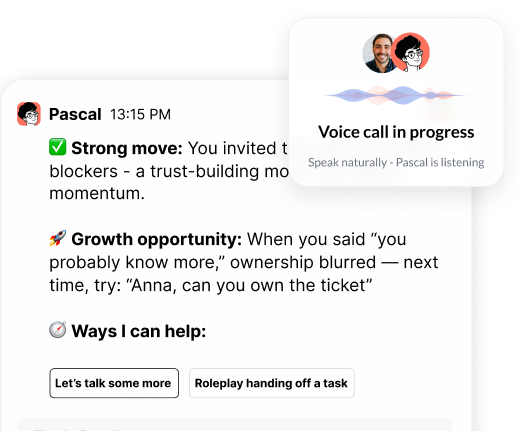
Pascal, Pinnacle's AI coach, is built for the weeks when a role is new. People use it to prepare for important conversations, reflect on how meetings went and work through difficult situations. Before a hard conversation it offers talking points and plays the other person in a practice run, and afterward it gives feedback on how it went. For new hires it can act as a combination buddy and guide, and it coaches their managers on how to support each specific person as the working relationship develops. Each person's coaching conversations with Pascal stay private. HR and executives see aggregated, anonymized insights, and only for groups large enough to protect anonymity.
For CHROs and heads of L&D, the near-term task is to list the transitions their company runs on, count how many people make each move in a year and note when support arrives for each group. The transitions where help arrives late are the place to start, because DDI notes that organizations often wait too long to start developing people in a new role.



“Thank you for setting the great foundation for my promotion; now I have a plan!"

Curious to see how AI Coaching can 10X the impact and scale of your development initiatives. Book a demo today for: