In October 2026, three companies announced AI coaches within two weeks, and each one described its coach as drawing on organizational context. But pay attention: when every AI coach claims context, the question you should ask is how much context each one holds and where it comes from.
What does context mean for an AI coach?
Context is everything a coach knows about a person, their team and their company that lets its advice fit the situation. The same question from two managers deserves two answers, because their people, teams and organizations differ. Pinnacle's guide, Why context matters for AI coaching, describes three levels of context: foundational, relational and behavioral.
Context a coach is told and context a coach observes
Some context arrives as files and profiles, and some can only be gathered by being present in the work. The first kind covers values, role, goals and review history, and it is only as current as the last update. The second kind covers how a 1:1 went, how a team works together and how a person tends to react. A coach that holds only the first kind leaves the manager to explain every situation from scratch, from their own point of view. A request for feedback advice shows the gap:
- Context the coach was told: "Here's how to give feedback."
- Context the coach observed: "Here's how to give feedback to Sarah, knowing she's been struggling with remote work and that your last conversation about timelines didn't land well."
The second answer is only possible for a coach that was there for the last conversation.
Three levels of context set the quality of coaching
- Foundational context: company culture, values, competencies, policies and processes, role information, goals and performance reviews. It enables coaching aligned with the company's own approach to leadership and management. In our view, this is where many AI coaches stop.
- Relational context: team dynamics, relationship patterns, and who a person works with and how those interactions usually go. It enables coaching that spots patterns a manager might miss and connects challenges across situations.
- Behavioral context: notes from meetings, communication patterns and how conversations unfold in real time. It enables coaching grounded in what happened, with specific feedback on observed moments.
Which questions test a coach's context?
Five questions turn a context claim into something a buyer can check:
- Which levels of context does the coach hold today, and who chooses what goes in?
- Does it sit in the conversations where work happens, such as meetings and its own Slack or Teams conversations?
- What does it remember from last month, and how does it use that memory?
- Who can see what it knows about one person?
- Which of these capabilities are live today, and which are planned?
An extra test is to ask each provider to answer one request for two different managers, since the answers should differ.
A one-page checklist covers all three levels
Nine lines, each with a yes or no answer from the provider:
- ☐ Foundational: the coach knows each person's role, goals and review history without being told.
- ☐ Foundational: company values, competencies and leadership principles shape its advice.
- ☐ Foundational: your own uploaded training materials and processes are part of what it draws on.
- ☐ Relational: it knows who a person works with and how those working relationships tend to go.
- ☐ Behavioral: it learns from the actual meetings and conversations it is part of, and it is consent-driven in meetings (it announces itself, and anyone can pause or remove it).
- ☐ Behavioral: it remembers earlier conversations and builds on them.
- ☐ Timing: you can set it to remind you before reviews.
- ☐ Governance: each person's conversations stay private, and no one else sees a person's individual context without their explicit consent.
- ☐ Status: each capability is live today, and the provider confirms it in writing.
Pascal's context comes from the workday itself
At Pinnacle, we believe Pascal is the most embedded and context-rich AI coach on the market, because he draws on all three levels and learns the deepest ones from the meetings and conversations he is part of. Three scenes show what that looks like.
- Foundational, set up once. Pascal, Pinnacle's AI coach, sits in Slack or Teams and connects to the calendar. He is customized to the company's competencies, values, processes and training materials and personalized through role, performance reviews and goals.
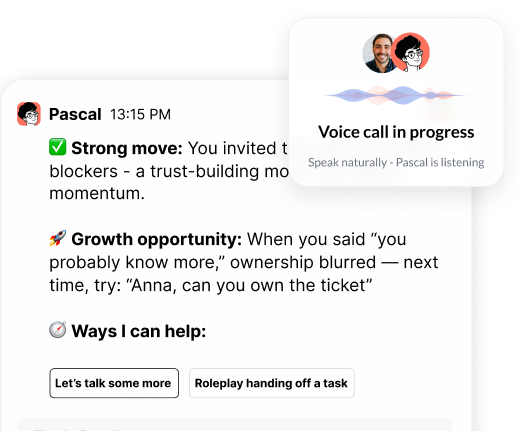
- Behavioral, after a meeting. Pascal joins meetings, and afterward he can send a private note such as: "Strong move: You invited the team to surface blockers, a trust-building move that keeps momentum. Growth opportunity: When you said 'you probably know more,' ownership blurred. Next time, try: 'Anna, can you own the ticket.'" The note names a moment, a person and a next step.
- Relational, over weeks. Pascal remembers conversations, such as the delegation conversation a manager had with their team last week. The manager skips the backstory, and the next coaching conversation picks up where the work is.
Each person's coaching conversations with Pascal stay private. HR and executives see aggregated, anonymized insights, and only for groups large enough to protect anonymity.
For CHROs and heads of L&D, the near-term task is to add the checklist to the AI coach evaluation scorecard and ask every provider to answer each line in writing, with a before and after on a real request from your own managers.