Blog article
Comparing Pinnacle (Pascal) and EZRA (Cai)
Comparing Pinnacle (Pascal) and EZRA (Cai) for AI coaching in 2026. Learn how these two platforms differ, and which is the right fit for your organization.

Not all AI coaches are built the same. Some help individuals reflect. Others are designed to change how your organization actually operates.
This guide breaks down where Valence (Nadia) fits, where it falls short, and why Pinnacle and its AI Coach, Pascal, are a fundamentally different category of AI coaching.
Before diving into the comparison, here's what to look for when choosing an AI coach for your organization:
Does it show up in the flow of work? The best coaching doesn't live in a separate app. It's embedded where leadership actually happens, in meetings, in Slack, in the moments between decisions.
Does it know your people, or just what they type? Most AI coaches only know what employees tell them. That means managers start from scratch every conversation, and the coach only ever gets one side of the story. Look for a platform that builds context over time.
Does it drive behavior change, or just reflection? Insight is a starting point. The real question is: can the platform show you that leadership habits are actually shifting?
Does it align with your culture, or just generic best practices? Your leadership principles aren't the same as everyone else's. Your coaching platform should reinforce the specific behaviors your organization cares about.
Is it proactive, or does it wait to be asked? A coach that only helps when someone opens the app will always be limited by who remembers to show up. The most impactful platforms reach out with feedback and guidance without the user having to initiate.
.png)
Valence built Nadia for organizations that want to give every manager a structured development journey. Nadia works as a conversational coach: managers interact with her through a dedicated portal, and over time she accumulates profile data, from HRIS integrations, working-style assessments, goal-setting sessions, and documents managers share, to personalize coaching and surface relevant nudges.
Nadia’s “context engine” is best understood as a profile-building layer: it logs and aggregates data points over time rather than actively observing work as it happens. This is a meaningful distinction. The coaching Nadia delivers is informed by accumulated inputs, it’s not grounded in what she witnessed in a specific meeting.
Valence often resonates with teams that are earlier in AI coaching adoption, where individual reflection and structured skill journeys are the primary goals.
Valence performs well when:
As coaching programs mature, the portal model creates a structural ceiling. Behavior change requires coaching to reach the manager, not wait to be remembered.
Usage patterns for tools that require a deliberate login and don’t have in-depth context drawn from real observation tend to have high initial adoption, steep drop-off, 10–20% sustained utilization.
Three specific gaps emerge as organizations scale Nadia:
Pinnacle treats AI coaching as a performance system, not a reflective tool. Where other AI ask, "What are you thinking?", Pascal asks, "Here's what happened in your latest meeting, let's work on it."
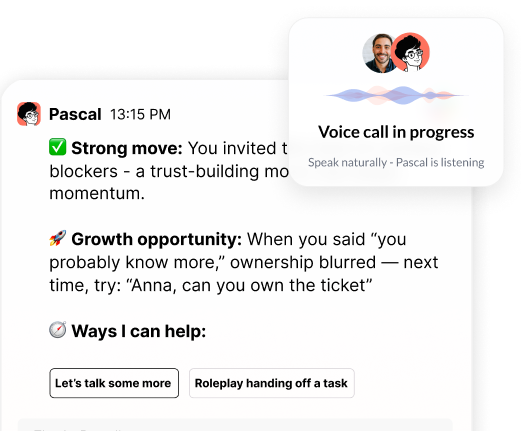
Pascal is a coach and leadership companion. He joins real meetings, 1:1s, team conversations, and builds a complete picture of each leader's challenges and strengths without requiring constant manual input. This means Pascal knows how a manager's last 1:1 actually went, not just how they remember it. He sees team dynamics, communication patterns, and decision-making in real time.
Pascal lives in Slack, Zoom and Teams, so coaching surfaces where managers already work, not in a separate tool they have to remember to open.
Most AI coaches only know what employees tell them. Pascal is built on a proprietary knowledge graph that maintains persistent memory across all conversations and channels.
Pascal operates across three layers of context:
Over time, Pascal learns about each manager. He remembers the delegation conversation from last week, the pattern of rushed project handoffs, individual communication styles across contexts, and the goals they're working through. Managers never start from scratch.
Pascal is also proactive by design - he doesn't wait to be asked. After meetings (or on a daily or weekly basis), he offers proactive feedback tied to each leader's unique goals. After an important conversation, Pascal reaches out with specific observations on what went well and what could improve next time.
Pinnacle tends to be the stronger choice when:
Valence helps individuals reflect. Pinnacle helps organizations perform.
If your goal is self-awareness, Valence is a reasonable starting point. If your goal is measurable behavior change, cultural alignment, and coaching that shows up where leadership actually happens, Pinnacle is built for that.

.png)
.webp)
“Thank you for setting the great foundation for my promotion; now I have a plan!"

Curious to see how AI Coaching can 10X the impact and scale of your development initiatives. Book a demo today for: