Managers are already using public AI for hard conversations. Governance needs to catch up
Close to 3 in 4 managers, 72%, say public AI tools help them prepare for hard conversations. Only 45% of their organizations have a written policy governing how those tools get used. That gap is not a footnote. It is the whole story.
The Predictive Index surveyed 399 managers and 208 CEOs and business leaders across industries, surveyed 399 managers and 208 CEOs and business leaders across industries. Of the managers who found public AI useful, 44% had already entered employee names and performance details into those tools, a level of exposure most organizations reported concern about without actually governing it. Managers are already doing the work of finding support. Leadership has not caught up with a way to govern it.
Managers know what they're missing
The instinct to blame managers for weak feedback conversations misses what the data shows. Only 1 in 5 managers surveyed said they preferred to prepare on their own rather than use a framework, a coaching guide, or input from HR. Most managers want structure. They are actively seeking it out, even when the only structure available is a public chatbot with no context on their team, their history, or their company's policies.
Anthony Belluccia, an I/O psychologist at PI, put it plainly: "what our research shows is that trusting a manager and knowing they're set up for a specific hard conversation are two different things." He added that "managers are more aware of where they need support than their leaders are, and addressing those needs starts with understanding what's driving them." That distinction matters. A CHRO can trust a manager's judgment and still be wrong about whether that manager has the tools to act on it in the moment.
Managers said they struggle most with delivering constructive criticism, anticipating an employee's reaction, and staying objective during the process. Those challenges live in the moment itself, the point where theory meets a real person's reaction. A manager can understand feedback theory completely and still freeze up when the actual conversation starts. The hard part is staying grounded while delivering hard truths to someone who might get defensive, upset, or quiet in ways no training module anticipated.
The feedback problem predates AI
This problem predates AI. Only 1 in 5 organizations surveyed for a WTW report released last year said their managers effectively provide feedback. That statistic describes a skill gap that has existed across performance management for years, one that training programs, competency frameworks, and annual review cycles have not closed.
What changed is that managers found a workaround. When in-house support isn't fast enough or specific enough, a public AI tool is available at 11 p.m. the night before a tough conversation, and it will answer. The workaround reveals the underlying need more clearly than any survey question could: managers want guidance that's real-time and situation-specific, the kind a training module completed eight months earlier can't deliver in the moment it's actually needed.
Governance is the part getting skipped
Many employers now direct managers to use AI tools to gather information about workers and draft initial reports, but experts have cautioned employers to watch for the biases AI could amplify and the legal exposure that comes with using the technology this way. That caution applies just as much to the informal use happening outside any sanctioned process. When 44% of managers are already typing employee names and performance details into a public tool, the risk is active and happening without oversight in the vast majority of organizations.
Closing the policy gap matters, though policy alone leaves a real question open. A written policy tells managers what they can't do, but leaves the harder question, what to do instead, unresolved. Organizations that stop at policy end up with managers who are compliant and still unprepared for the actual conversation they have to walk into.
How Pascal is designed to close that gap
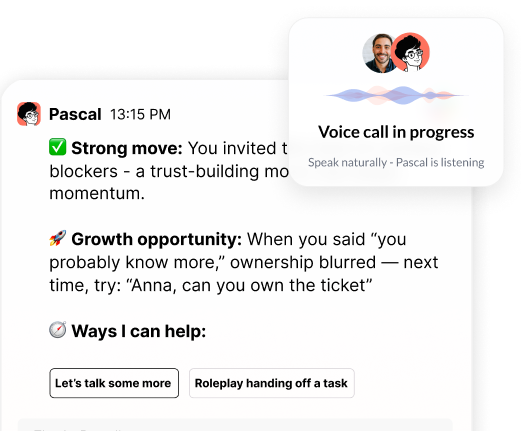
Pascal, Pinnacle's AI performance coach, is designed to ensure that closing the coaching gap doesn't come at the cost of privacy or legal exposure. That design shows up in a few specific commitments.
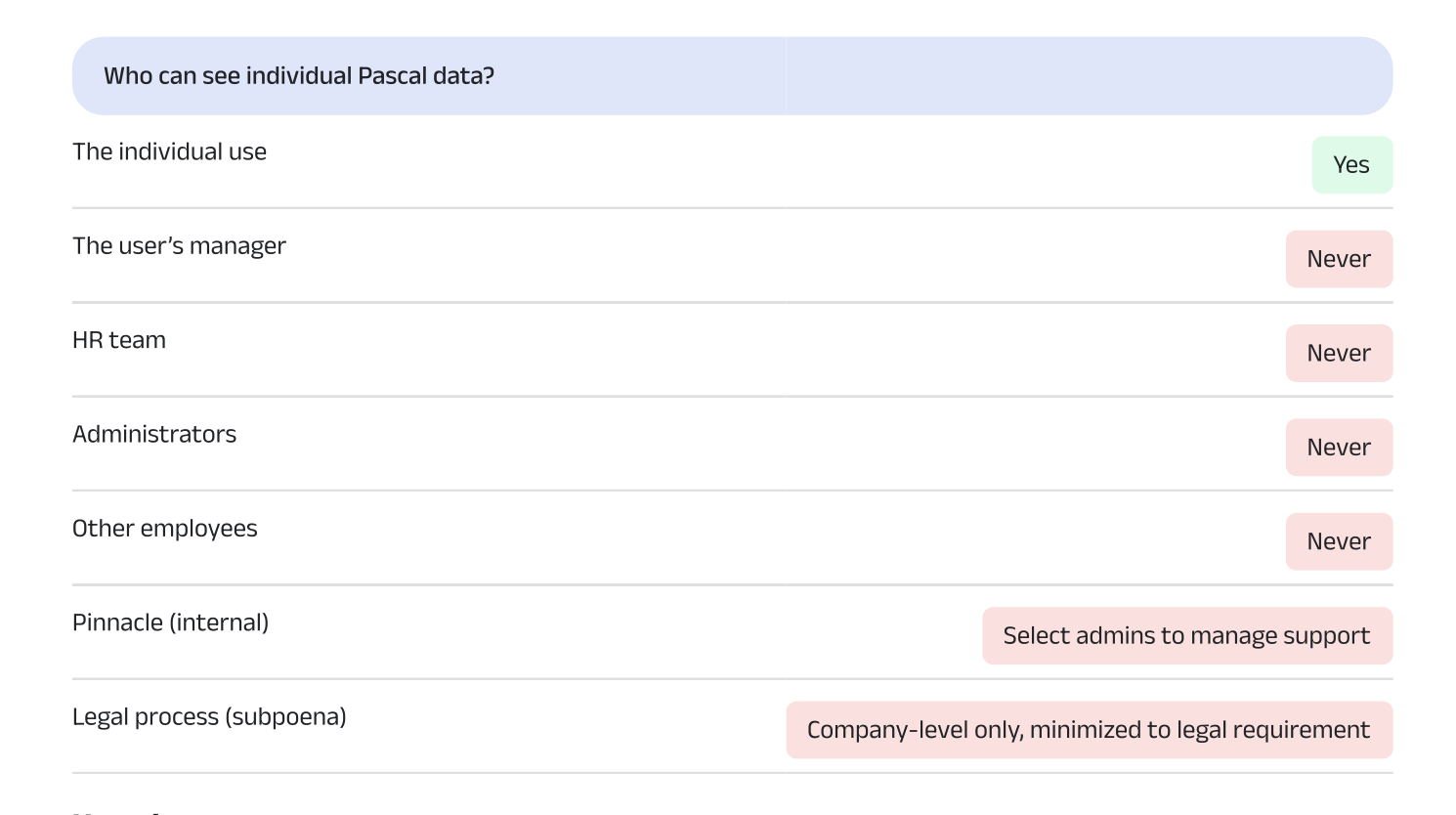
User privacy is structurally enforced. All individual data, including chats with Pascal and meeting transcripts, stays confidential to the user, and Pinnacle never shares it with managers, HR teams, administrators, or any third party. What reaches organizational stakeholders is aggregated and anonymized, and only for organizations with 50 or more licenses, so no individual can be identified in a report.
Retention is configurable down to zero-day for transcripts, and deletion is a true, permanent delete across primary and backup systems.
Pinnacle does not train its models, or any third-party provider's models, on customer data.
Every insight Pascal generates is advisory. A person reads it, decides what to do with it, and takes the action, so Pascal never functions as an automated employment decision.
The system is backed by SOC 2 Type 2 certification and built to align with current AI-employment-law frameworks, including the EU AI Act, Colorado's ADMT Act, and California's ADMT regulations.
The choice ahead for CHROs
There has never been a better time for CHROs to invest in AI coaching, and the data explains why. Managers are already reaching for it on their own, whether or not their organization has decided what that should look like.






.png)
.webp)