In a September 2026 survey of 1,500 U.S. employees, TalentLMS found that 41% say their company tracks whether they completed training and 36% say it checks whether they use what they learned. In the same survey, 34% say it assesses whether they understood the material. Everyone surveyed had been trained on a new tool or way of working in the past 12 months. A manager program can show completion on day one, and the evidence that behavior changed has to be planned before the first cohort starts.
Completion is the measure L&D teams track most
Work-Learning Research published its Global Research on Workplace Learning Evaluation (GROWLE) 2026 report, written by Will Thalheimer, PhD, on April 29. Of the 381 L&D professionals surveyed, 86% said attendance or completion is measured on more than half of their programs, and 21% said the same of learning transfer, meaning whether job performance changed. The sample came through professional networks and the report says it cannot claim strict representativeness, so the figures describe the people who responded. They still show where the surveyed teams put their measurement effort, and the gap between the two numbers is large.
Completion comes straight from the learning system, which makes it easy to defend in a budget cycle. The question that follows from finance is whether managers do something different on Monday, and answering it takes evidence from the work itself. An L&D team that wants an answer has to decide what to look at before the program starts.
Adoption runs higher where managers use the change
The TalentLMS report also looks at what happens after training. Only 41% of employees consistently use the new way of working, 52% use it and sometimes fall back, and 8% keep working as before. In addition, 42% say they still use tools or processes their manager thinks have been replaced, and 65% say letting go of an old habit is harder than learning a new one. Consistent use is more than twice as common when managers use the new way too, at 49% versus 22% otherwise.
A manager program is the training and also the model for the team. Measuring the manager's behavior therefore measures the program and gives an early signal of whether the team is adopting the change.
Name the behaviors before the launch date
Evidence of changed behavior starts with a short list written before the program launches. A short list keeps the measurement honest, because every behavior on it needs a definition that two observers would read the same way. Four steps give an L&D team something to measure:
- Choose three to five behaviors taken from the framework the program teaches.
- Write what each behavior looks like at a strong, middling and weak level in real work, as a rubric a second person could apply.
- Take a baseline before the first session, from observed work and from the manager's team where the culture supports it.
- Measure again at fixed dates, such as three and six months, for each cohort.
Each step is a planning task for the L&D team, and the rubric from step 2 is what makes the second measurement comparable to the first. In Pinnacle's view, observed behavior at two points in time measures movement in the work itself, beyond what an engagement survey or course rating shows.
There’s a better way to measure: actual interactions can be scored against your rubric
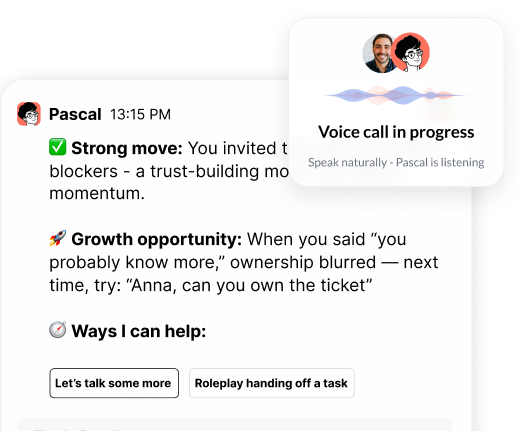
In one example, a manager program ends its second month, and the L&D team defined five behaviors and a rubric for each one before launch. Pascal, Pinnacle's AI coach, scores interactions against that rubric and tracks behavior trends over time and across cohorts. For a program, Pinnacle can compare a group at the start and six months later, behavior by behavior, which gives leadership development a measure that finance teams can follow. The L&D team can then see which behaviors moved in each cohort.
Pascal can also be customized to reinforce an organization's leadership frameworks, competency models, values and cultural behaviors, including feedback models such as SBI. Each person's coaching conversations with Pascal stay private. HR and executives see aggregated, anonymized insights, and only for groups large enough to protect anonymity.
The second measurement needs a date
Finance is likely to ask for the second number in the next budget round, and a team that wrote its measures before launch can answer with data from its own cohorts. Completion will still be on the dashboard, and the behavior data will sit beside it. For CHROs and heads of L&D, the near-term task is to write down, before the next manager cohort launches, the behaviors the program should change, what each one looks like in real work, and the date of the second measurement.