

To measure the ROI of leadership coaching, define the behaviors the program should change, score them before coaching starts, track them continuously, and compare cohorts over time. Pair that behavior data with adoption metrics and the business outcomes leaders already watch. Behavior change gives finance teams a concrete measure they can understand.
Leadership coaching often gets judged on attendance and satisfaction. Those numbers show that people showed up and liked the experience. They say little about whether managers lead differently afterward.
Engagement surveys help, and they arrive slowly. A yearly or twice yearly survey makes it hard to connect a change in team sentiment to a specific program, and many other things change in the same period.
The missing piece is a direct view of behavior. When an organization can see how managers actually run 1:1s, give feedback and handle hard conversations, it can tell whether coaching is working and where to invest next.
Start with the behaviors the business wants to see more of. These usually come from the company's leadership principles, competency model or a current priority such as better feedback or clearer delegation.
Keep the list short and specific. "Gives specific, timely feedback" is easier to see in real work than "strong communicator." For each behavior, write a rubric that describes what weak, solid and excellent look like.
This step also aligns coaching with strategy. When the organization sets the priorities, every coaching conversation can reinforce them, and the measurement shows whether those behaviors are actually appearing.
ROI needs a starting point. Score the chosen behaviors for the coaching group before the program begins, using the same rubric you will use later.
Record the baseline in a format you can repeat, so the second measurement uses the same rubric, the same kinds of interactions and the same scoring approach. Where possible, also identify a comparable group that starts later. Comparing the two groups over the same period helps separate the effect of coaching from changes happening across the whole company.
The strongest coaching measurement scores real interactions against the rubric and tracks trends over time and across cohorts. That gives a continuous, behavior based view of progress, which complements engagement surveys.
For a program, compare the group at the start and again after six months. Look at the overall trend, at which behaviors improved most and at which ones stayed flat. Flat behaviors often point to where the program needs different content or more practice.
Behavior change only happens when people use the coaching. Track who is active, how usage changes over time and how adoption varies by level or function. Low adoption in one group is a signal to fix rollout before judging results.
Aggregated themes add useful context. Seeing what managers commonly struggle with across teams shows HR where to focus training and support. These insights should stay aggregated and anonymized, and only appear for groups large enough to protect each person's privacy.
Finance teams want to see coaching linked to outcomes the business already tracks. Choose the few that the target behaviors should influence, such as team engagement scores, internal promotion readiness or the quality of performance reviews.
Report the results in a simple chain: the program, the change in adoption, the change in scored behaviors and the movement in those business outcomes. Be clear about what the data shows and where other factors may play a part.
A practical checklist for a coaching ROI report:
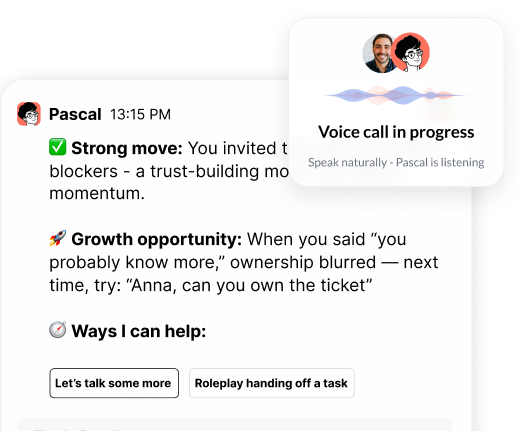
Pascal is an AI coach for every manager: a leadership companion who accompanies them in their meetings and work, and coaches from what actually happened. He sits in Slack or Microsoft Teams, connects to the manager's calendar and joins their meetings.
Organizations can define the behaviors they want to measure and the rubric for each one. Pascal scores interactions against that rubric and tracks behavior trends over time and across cohorts, so a program can compare a group at the start and six months later. Because he works from real meetings, his scores reflect how managers actually lead day to day.
Administrators see a dashboard with engagement metrics such as who is active, usage levels and adoption by level or function. Pascal can also surface aggregated, anonymized themes about what people are struggling with, and he reinforces company priorities in every coaching conversation.
Each person's coaching conversations with Pascal stay private. HR and leaders see aggregated, anonymized insights, and only for groups large enough to protect anonymity. Administrators never see individual conversation content or personal coaching details.



“Thank you for setting the great foundation for my promotion; now I have a plan!"

Curious to see how AI Coaching can 10X the impact and scale of your development initiatives. Book a demo today for: