U.S. employee engagement fell to 29% in the third quarter of 2026, down 2 points from the previous quarter and the lowest level since 2011, according to Gallup's quarterly workforce study of 21,648 U.S. adults. Jim Harter, Gallup's Chief Scientist for Workplace, published the findings on October 28, and HR Dive covered them on November 3. The sharpest declines came among remote and hybrid employees in AI-integrated organizations. Gallup reads the pattern as suggesting that AI adoption may be outpacing the communication and manager support needed to make it effective, and at Pinnacle, we see manager support as the second half of an AI rollout.
The decline was steepest in AI-integrated remote and hybrid teams
Gallup split its results by work arrangement and by whether an organization has integrated AI. From the second quarter to the third, engagement among exclusively remote employees in AI-integrated organizations went from 38% to 33%, and among hybrid employees in those organizations it went from 37% to 33%, in samples of 1,511 and 2,998 respondents. Hybrid employees outside AI-integrated organizations (those without AI integration, or unsure of it) moved from 29% to 30%. One quarter of survey data points to an association, and Gallup frames its finding as a question about whether communication and manager support are keeping pace with AI.
Clarity of expectations and feeling cared about fell together
Gallup asks employees whether they strongly agree that they know what is expected of them at work and that someone at work cares about them as a person. In the third quarter, 46% strongly agreed with the first statement, down from 49% in the first half of 2026 and well below the 61% high of 2015. For the second the figure was 37%, down from 40% and well below the 47% peak of March 2020.
Gallup's earlier research found that from 2020 to 2023, clarity of expectations declined about twice as much among hybrid and fully remote employees as among on-site employees in remote-capable jobs, which raises the possibility that physical distance can contribute to psychological distance. Pinnacle reads these two items as the part of the job a manager supplies.
Managers and employees read engagement through different signs
The American Management Association (AMA) adds the manager-side view in its 2026 Management Survey, fielded in May 2026 with 1,088 respondents across seven world regions (75% managers, about 270 employees, per the full report). Of the managers, 62% say their own engagement increased in the past 12 months. Of the employees, 51% say their manager's engagement stayed constant and 20% say it decreased.
Employees name communicating openly and regularly (53%), clear direction and expectations (42%) and listening to concerns and feedback (37%) as the signs of an engaged manager. AMA's own reading is that managers and employees may be looking at different parts of the job, so both perceptions can be valid. AMA measures how people perceive manager engagement and Gallup measures employees' own engagement, so the two surveys are separate facts about different groups. Pinnacle's reading is that two of the signs employees name, clear direction and listening, sit close to the two Gallup items that fell, knowing what is expected and feeling cared about.
Manager support is the condition most associated with engagement
Managers matter. This should surprise no one.
Gallup's July 2026 analysis of 43,262 U.S. employees found that people who say their manager actively supports their team's AI use are engaged at 48%, compared with 30% for the rest, an 18-point difference and the largest gap Gallup reported among the AI conditions it compared. A clear plan for integrating AI is associated with a 15-point difference, and AI adoption by the organization with 6 points, which Gallup notes may partly reflect which industries adopted early. When frequent AI use, a clear plan and manager support are all present, engagement reaches 53%.
Gallup's AI indicator, as of May 2026, shows how far manager support has spread: 36% of employees in AI-integrating organizations strongly agree their manager supports their team's use of AI, and 25% of U.S. employees say their organization has communicated a clear plan for integrating AI.
Managers turn an AI plan into expectations for each role
Gallup's third-quarter analysis names three priorities for leaders:
- Clarify AI expectations by role, so employees know how AI applies to their work and how their performance will be evaluated.
- Equip managers to support AI use, particularly those leading hybrid and remote employees.
- Track AI's impact alongside employee engagement.
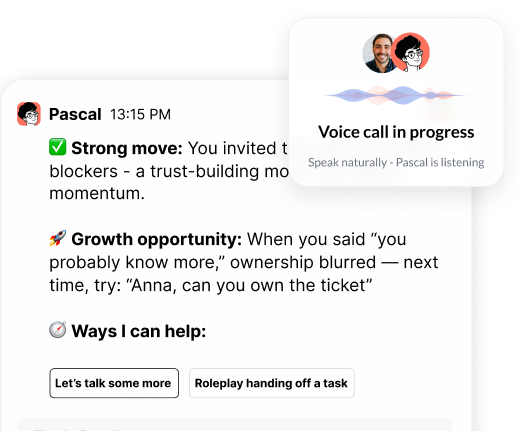
Pascal, Pinnacle's AI coach, can be rolled out to individual contributors as well as managers: employees use it for career development and managing up, and managers also use it for structured conversations with their teams. At Pinnacle, we see the management layer as the place where AI-enabled people succeed or stall: AI tooling arrives first, the manager conversations that turn it into clear expectations for each role tend to follow later, and a manager's own sense of how they show up benefits from outside evidence drawn from real behavior.
For CHROs and heads of L&D, the near-term task is building manager enablement into the AI rollout plan: define what AI means for each role, give managers of hybrid and remote teams a regular conversation format about AI, and read engagement alongside AI use each quarter. Starting with managers of hybrid and remote teams puts the effort where the third-quarter declines were steepest.