Blog article
From tool to teammates: why every employee needs director-level skills
Multi-agent AI is turning tools into teammates. Here is why judgment and systems thinking now matter in every role, and how HR can build them.


Practitioners from 79 organizations across 19 sectors spent five working sessions in 2026 testing one framework for AI adoption, and their discussions filled about 220,000 words of transcripts. The sessions were run by the HR Strategy Forum's AI Collaboratory, which published the framework in October 2026 as the working paper The People Strategy for AI Adoption (version 2.4). The findings are striking, and they give CHROs and L&D leaders a practical way to answer a question they hear all the time, which is how far along their company is with AI.
The framework defines AI adoption maturity as "the organization's demonstrated ability to redesign work, make decisions, develop people, and govern AI to create sustainable value." In plain terms, maturity is about what people do differently with AI, backed by proof. Two companies with the same AI tools can sit at very different points, because what has to change is human. A team counts at a stage when it can show the practices working in its daily work, and when the gains still hold after you count the time people spend checking and fixing AI output, the rework, and the effects on staff.
Maturity is measured for one function or one workflow, such as recruiting or customer support, because teams move at different speeds. One company commonly has engineering at Stage 3 (AI built into whole workflows), HR at Stage 2 (AI used reliably in everyday tasks) and legal at Stage 1 (people still experimenting). A regulated team such as legal can sit at Stage 1 for good reason, and that is a sound choice. The framework calls these reasons context modifiers: regulation, data sensitivity, contracts with outside parties and company size, the factors that set how fast a team can safely move.
Progress also moves in a cycle. A group report-out at the first Collaboratory session put it this way: "It's really a circle more than a linear path. And I think we have to look at different groups maybe at different stages at different points in time." New tools, a change of leadership or a shift in costs can send a team back a stage, so leaders need to check again as conditions change.
The first step, labeled "start here" in the framework, is to decide what AI is for, and the framework offers two options. The Optimizer option keeps output the same at lower cost, and it measures cost per outcome, headcount avoided and spend reduced. The Expander option keeps the same people and uses AI to take on work that was out of reach before, and it measures new capacity, new offerings, revenue and quality.
Most organizations will do some of each, cutting cost in some workflows and expanding in others. What matters is that each function's goal is stated out loud, that employees hear it, and that decisions about the time AI frees up match what leaders said. Practitioners reported that where leaders framed AI as expanding capacity, more people leaned in, and where the agenda was efficiency alone, fear of job loss led people to hide their use and underreport the time they saved. A breakout participant at the second Collaboratory session put that fear in one sentence: "If I invest in this, am I going to be able to pay my mortgage?"
In practice this step comes down to three moves. Agree with each function's business leader whether AI is for lower cost, more capacity or growth, tell employees in plain terms what was decided and what is still uncertain, and decide in advance where freed-up time will go.
Each stage has a core question a team should be able to answer with confidence, a type of value to expect and a set of measures that fit it.
| Stage | Core question | Value to expect | What to measure |
|---|---|---|---|
| 1. Experimenting | What can AI do | Time saved by individuals | Active use, learning and early value |
| 2. Operationalizing | How do we use AI reliably | A function that runs faster and cheaper | Task time, quality and rework |
| 3. Integrating | How does AI change how we run the business | Gains that cross teams | Workflow outcomes and cost per outcome |
| 4. Reinventing | How does AI redefine our business model | New products, services and revenue | New capacity, revenue and business value |
Matching the measure to the stage avoids a common trap, which is asking for productivity or headcount gains from a team that is still experimenting. In Stage 1, people try AI on their own work, use is voluntary and starts from the bottom up, and practitioners called it "let a thousand flowers bloom." The result to expect is learning and wider use. A team is ready to move on when, for most roles, it can name a few concrete tasks where AI clearly helps.
In Stage 2, the organization takes over from volunteers. Leaders pick standard tools and set rules for safe use, each function writes down the specific tasks AI is used for and who owns each one, training is tailored to each role, and costs become visible. The main risk is that time spent reviewing and fixing AI output eats the time AI saves. A team is ready to move on when it starts asking whether it is only automating steps or redesigning how the work flows.
In Stage 3, work is redesigned so it flows across steps and teams, with clear agreements on what AI does and what people do. The biggest risk is adding faster tools while keeping the same approval steps and job boundaries. In Stage 4, AI changes the business model itself. Few organizations in the Collaboratory had reached it, so real examples are thin.
Context modifiers make the rules for good practice stricter at every stage without lowering a team's stage. At every stage, each measure of AI use should be paired with a measure of teamwork and workload, because people using AI on their own can quietly cut down on collaboration and add review work for others.
The stages say where a team is. The seven human systems are the parts of the organization that have to change for it to move up. Version 2.4 of the framework added two systems, Motivational Drivers and Economics & Value, because practitioners raised motivation and cost more often than almost any other topics. Economics & Value is owned jointly by HR and Finance.
| System | The question it asks |
|---|---|
| Work Design | How do we redesign work so people's roles, skills, and workload improve alongside AI |
| Workforce Capability | Do people have the skills and judgment to use AI well and to question its output |
| Decision & Governance | Who decides and who is accountable, with people able to step in and fix mistakes |
| Leadership & Culture | How do leaders build trust, invite challenge, and take responsibility for how AI affects their people |
| Motivational Drivers | What makes people want to use AI, and how are they rewarded for using it well |
| Operating Model | How do we organize so ownership is clear, teams coordinate, and people keep a voice |
| Economics & Value | What value does AI create, and how do we count the effect on people as part of it |
Here is one finding from the sessions for each system:
Practitioners across the Collaboratory called the move from Stage 2 (using AI reliably) to Stage 3 (building it into whole workflows) the hardest. A breakout participant at the first Collaboratory session said: "The jump to stages two to three, I think it's the hardest. Because sometimes there's defined use cases, and you just put an agent in and plug it in and it works." In Stage 2, AI speeds up tasks people already do. Stage 3 asks a bigger question, which is whether the whole workflow produces a better result.
Faster AI-generated proposals create little value if approval becomes the bottleneck. A participant at the third Collaboratory session described the pattern: "Companies often introduce faster tools, but they keep the same approval chains, they keep the same role boundaries, the same way of thinking." Redesigning the workflow touches every system, so all seven have to move together.
The most important leadership behavior for this move is bringing people from different functions together to redesign a workflow they share, and owning the result together. The motivation question changes too, because people now need a reason to change how they work together. Five things answer it: a clear and believable goal from the organization, a real benefit to the people involved, a say in how the work changes, shared commitment and accountability, and attention to what holds people back, such as fears of becoming obsolete or overloaded.
The signs that Stage 3 is taking hold are specific. The whole workflow gets better results without pushing delays or extra review onto the next team, employees can explain how their part of the work has changed, and the new way of working holds up beyond a single champion or pilot team.
For a leadership team, the framework comes down to seven decisions:
It is normal for the systems to sit at different stages, and two common patterns show one system holding the rest back. In the first, tools run ahead of trust, so people use AI while hiding the time it saves or keeping what they know to themselves. In the second, executives run ahead of managers, so enthusiasm at the top is strong and managers are unsure what is expected of them.
Two of the most telling warning signs suggest a team is claiming a higher stage than its practices support. One is using usage targets or AI usage volume as the main measure of success after Stage 1. The other is treating a policy document as proof that AI is well governed.
The framework treats AI adoption as a people strategy, and the work is shared well beyond HR. The CEO and executive team decide what AI is for. The CFO owns the full cost of the work, counting payroll, contractors, computing, tools, training and review time together. The CHRO and HR own how jobs are designed, skill building, the terms of employment, rewards and the rules for employee data, and HR should go first by redesigning its own work with AI. "The expertise around change management and helping people adopt new behaviors really sits within HR," says Alexei Dunaway, CEO of Pinnacle.
Managers and the owners of each workflow carry the day-to-day work across all seven systems: clear expectations for each role, protected time to learn, results for the workflow and a say for employees when work is redesigned. Practitioners found that support from senior leaders reaches the early adopters, and that adoption spreads once frontline managers know specifically what to do. Research shared at the third Collaboratory session found a 28-point gap between how supported executives feel and how supported employees feel.
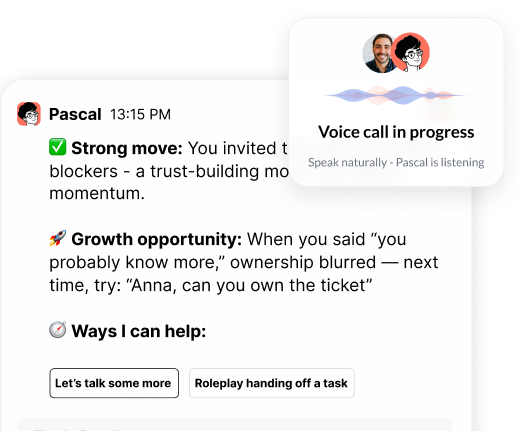
Pascal, Pinnacle's AI coach, joins managers' meetings and coaches them after important conversations, including the ones where they lead their teams through change. Each person's coaching conversations with Pascal stay private. HR and executives see aggregated, anonymized insights, and only for groups large enough to protect anonymity.
The Collaboratory placed practices at each stage by sorting themes from the session transcripts, and the evidence is strongest for Stages 1 and 2. Stage 3 and Stage 4 practices came up more often as goals than as things teams were already doing, and statistics from research presentations are reported as they were presented in the sessions. The working paper's cover labels it a "Draft for taskforce and co-creator reviews," and a companion self-assessment tool and workshop guide are in development.
For CHROs and heads of L&D, the near-term task is to pick one function, decide what AI is for there, place each of its seven systems at a stage with evidence, and choose two or three moves for the next 90 days.
Source: the HR Strategy Forum's AI Collaboratory, The People Strategy for AI Adoption (working paper, version 2.4, October 2026).



“Thank you for setting the great foundation for my promotion; now I have a plan!"

Curious to see how AI Coaching can 10X the impact and scale of your development initiatives. Book a demo today for: