
Blog article
AI-generated “Workslop” is undermining productivity
AI-generated “workslop” looks polished but wastes time, erodes trust, and costs millions in lost productivity.


For a generation, juniors learned by proximity. You sat in on the hard client call. You drafted the deck someone senior tore apart, and you got feedback in the hallway ten minutes after the meeting, while it still stung.
AI removed most of that. The drafting, the summarizing and the first-pass analysis now take minutes, and the seat in the room that came with them went too. Leaders are taking their questions to AI as well, which thins out the conversations juniors used to overhear and join. Meanwhile, the jobs keep growing. In PwC's 2026 AI Jobs Barometer, the companies most exposed to AI grew headcount 52.2%, against 35.7% for the least exposed, and the upgraded entry-level roles inside them grew 35%. Companies are hiring juniors and expecting more from them at the exact moment the old training ground is disappearing.
Critical thinking, judgment and experience share one trait: you build them by making a call, watching what happens and adjusting. Reading about pushback does little. Handling it badly, then better, does almost everything.
That's why the training budget is the wrong lever. Only 26% of L&D leaders are highly confident they can deliver the skills workers need. The fix is to rebuild the rep around the real conversation. Take Marcus, a junior account manager with a client check-in coming up. With Pascal, Pinnacle’s AI coach, his week runs differently. The day before the check-in, he rehearses with Pascal, which sat in on the previous client meeting and knows this client has pushed on scope twice, so the practice targets that exact objection. After the call, Pascal flags what it saw: he held the line on scope, then gave away the timeline. Three weeks later it catches him holding both in a different meeting and tells him.
A dozen coached reps in a quarter, each tied to a real person and a real conversation. That's what the hallway used to provide.
Begin with the roles where senior skills show up first: client-facing juniors, first-time project leads, and anyone coordinating across functions without formal authority. Pick one or two skills per person, such as handling pushback or giving a peer hard feedback, because narrow practice compounds faster than broad programs. Put the coaching where the work happens, in and around real meetings, so every important conversation doubles as practice.
Then watch the pattern across teams. If your juniors are getting busier without getting sharper, your pipeline is thinning, whatever the headcount chart says.
The junior roles of 2027 will demand skills that used to take a decade of proximity to build. Companies that rebuild the apprenticeship now will have a leadership bench ready when today's seniors move on. Everyone else will be hiring that bench from outside, at a premium, and wondering why their own juniors never grew into it.
How junior employees build judgment when AI writes the first draft
For decades, junior employees built judgment the slow way. They drafted the memo, took the red pen from a manager, sat in on the meeting where a senior colleague talked a client down, and absorbed the reasoning behind decisions long before anyone asked them to make one. That path depended on two things: entry-level work to practice on, and senior people thinking out loud nearby.
Both are thinning out at the same time. AI now writes the first draft of the memo, the code, and the analysis, which removes many of the reps that used to teach the basics. Meanwhile, plenty of leaders take their half-formed questions to an AI assistant before they take them to a colleague, so the reasoning juniors once overheard now happens in a private chat window.
The risk for People leaders is a cohort of employees who can produce polished output without developing the judgment to know when that output is wrong.
The fuller picture is more hopeful. Guests on Lenny's Podcast have described how junior development works when AI handles routine work, and their answers point to a faster path to judgment.
Dan Shipper, cofounder and CEO of Every, frames early-career work as a management problem from day one. “You’re effectively learning how to be one level above the entry level from the beginning,” he said. “When you look at what skills are going to be valuable in the AI era, one big group of skills are the skills of managers. Today they’re human managers, tomorrow everyone’s a model manager.”
Directing an AI agent well calls on the same instincts as directing a person: scoping the task, judging the output, and stepping into the work to raise its quality. Shipper also recognized the resistance that shows up when people first try to delegate to AI: “There’s a big complaint that it’s like, well, how can I have AI do this? I can’t trust that they’re going to do it well. So I should just do it myself. That’s exactly what every first time manager says.”
Inbal Shani, chief product officer of GitHub, sees AI giving juniors back the time they used to spend learning syntax. “If now there is an AI assistant that is helping them write code, they can spend more time from the get-go understanding the system, understanding the environment that they are building or understanding that product that they’re building, which today they don’t have time for because they are still learning how to code.”
Her point extends well beyond engineering. A junior marketer who spends an afternoon on a first campaign brief, instead of a full week, can use the rest of that week to learn why the segment matters, how sales uses the leads, and what the last campaign got wrong.
Alexander Embiricos, product lead for OpenAI’s Codex, offered the most direct advice for the individual: “Be a doer of things.” He added that “what you can do as even someone in college or a new grad is just so much more than what that was before.”
Speed brings its own risk, and Elizabeth Stone, Chief Product And Technology Officer at Netflix, named it clearly. “We are still hiring junior people and they’re really important to our talent strategy,” she said, pointing to Netflix’s intern and new grad programs. She was equally firm that the quality bar holds: “Mastery of the craft is still very important. I’m responsible for the quality of code that I am submitting for production. I’m responsible for the quality of products that I’m building, how they’re designed, what that user consumer experience is. None of that is going away.”
That accountability is where judgment gets built. A junior who submits an AI draft owns every line of it, which means they need enough knowledge to defend it, edit it, and spot what it missed.
Stone also expects learning to flow in both directions: “I can guarantee you that earlier career talent is going to be teaching older folks like me many new things too.”
Molly Graham, who ran culture at Facebook, pointed to the one capability that keeps compounding. “What you know today is way less valuable than what you can learn by tomorrow,” she said. “If you’re inside of a company where the growth curve is like this, what you know today is, like, irrelevant.”
Lenny shared a story with her about a young PM named Zevi, who joined Wix believing he had to be a “10x PM” from his first day. After a rough first meeting, Zevi realized the expectation was to be a “10x learner,” and that shift is what earned his colleagues’ respect. Graham connected it to grit, soft skills, and a genuine love of learning as the anchors that hold when roles change this fast.
Every guest above assumes juniors still have access to senior judgment, and that assumption is where many organizations are exposed. When a leader works through a hiring dilemma or a pricing call with an AI assistant, the decision may well improve, while the junior colleague who once would have been asked for input (or simply overheard the debate) misses the lesson entirely.
People leaders can rebuild that loop on purpose:
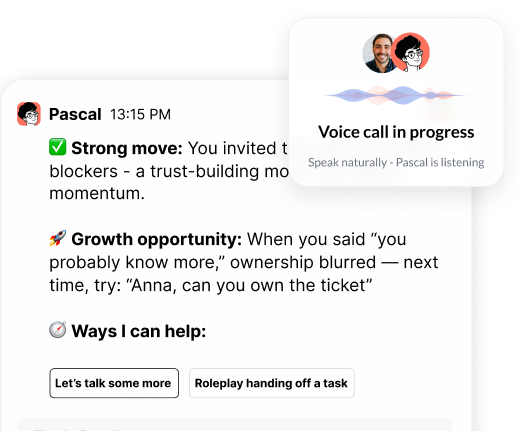
Contextual AI coaching can support managers in this work too. At Pinnacle, Pascal joins managers in meetings, building a complete picture of their leadership challenges and strengths, so guidance on how they develop their teams arrives close to the moment it matters.
The goal across every one of these conversations is the same: junior employees who reach their first big decision having already practiced judgment many times, with a thoughtful person close enough to show them how it’s done.



“Thank you for setting the great foundation for my promotion; now I have a plan!"

Curious to see how AI Coaching can 10X the impact and scale of your development initiatives. Book a demo today for: