
Blog article
AI took the reps: how juniors now build judgment, critical thinking and experience
AI writes the first draft now. Five leaders from Lenny’s Podcast share how junior employees can still build judgment and real skills.


The share of large organizations developing or implementing multi-agent systems rose to 25% in the third quarter of 2026, up from 6% in each of the two quarters before, according to the KPMG AI Quarterly Pulse Survey of 314 U.S. C-suite and business leaders at organizations with $1 billion or more in revenue. In its first-quarter 2026 survey of 237 U.S. C-suite and business leaders, KPMG found that 57% expect people to primarily manage and direct AI agents within two to three years. AI that works alongside other AI needs someone to direct it. When AI becomes a team, directing that team becomes work for everyone, individual contributors included.
When chatbots first came out, AI was a way to speed up your own capacity. You told it what to do and it moved fast. Then agents arrived that carry a piece of work through on their own, and the relationship changed. Now you delegate work to a teammate.
OpenClaw, an open-source personal agent that runs on your own hardware and works through your chat apps, was the spark in January 2026. Hermes Agent, another open-source agent from Nous Research, followed in February. In June, Claude Tag from Anthropic let anyone in a Slack channel tag @Claude and hand off work the way they would to a colleague.
Grok Bot (August 2026) and Team Bots (September 2026) give people always-on AI teammates with their own computer, and a Team Bot can be shared by a whole team. OpenAI dots (September 2026) work around the clock through ChatGPT, Slack and Teams. Claude Duet, a research preview since October 2026, sends a morning brief and keeps working after you log off, and Viktor works as an AI employee in Slack and Microsoft Teams.
The next step is teammates in the plural, and the makers say it in their own words:
Once AI teammates coordinate with each other, the open question is what limits the work. Managers and directors have always been that bottleneck for their teams, says Alexei Dunaway, CEO of Pinnacle. When a leader micromanages every decision, the leader limits what team members can accomplish on their own, and people have solved that problem before.
With AI teammates the pattern repeats. An operations lead quoted in the Grok Bot launch post describes "checking in on them every 15 minutes and micromanaging the Bots" when starting out. Directing AI well takes the habit that directing people takes, which is handing over authority along with the goal.
As a result, scarce skills become judgment and the ability to think in systems, both architecturally and from an organizational development angle. A human stops being the bottleneck when teams of AIs can work toward an end goal on their own, which happens as increasing authority over what work gets done passes to AI managers that run teams of specialist AIs. Humans then direct those managers, which is the position directors hold today, thinking about how a team functions, whether it is aligned and how its systems fit together.
BCG's June 2026 survey of close to 12,000 frontline employees, managers and leaders, AI at Work: Strategy Matters More Than Tools, found that 72% say expectations for the skills they need have shifted, and 36% feel they have received adequate upskilling. BCG also reports that half of all respondents say their companies lack clear governance for managing teams with people and AI.
HR already knows what makes teams function, including direction, alignment, delegation and coaching, and that knowledge now applies to every role. Now everyone needs to learn to work jointly with teams of humans and AIs, and these traditionally "softer" skills are becoming the primary driver of productivity.
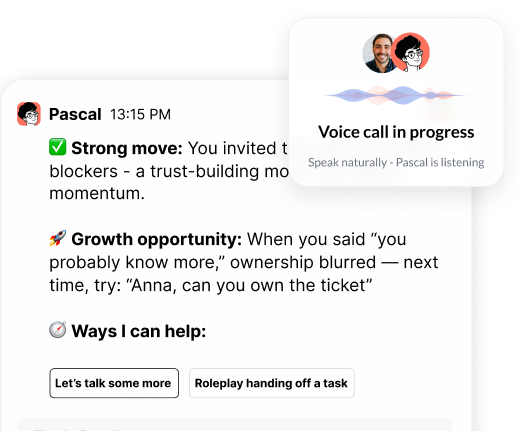
Pascal, Pinnacle's AI coach, can be rolled out to individual contributors as well as managers: employees use him for career development and managing up, and managers also use him for structured conversations with their teams. For CHROs and heads of L&D, the near-term task is to build director-level skills for every role in the flow of work.



“Thank you for setting the great foundation for my promotion; now I have a plan!"

Curious to see how AI Coaching can 10X the impact and scale of your development initiatives. Book a demo today for: