A large financial services company rolled out a new manager training program and already had an AI coach. An L&D leader there described three problems with it: "the user has to initiate all the interaction," it was "living in a separate platform," and it was "not feeling like tailored enough to people's roles or, like, really understanding their work context." Asked how they measure behavior change, the same leader said they hadn't gotten far yet.
Those four gaps share one root. An AI coach can only measure the behavior it sees, and a coach that lives in a chat window sees what managers type into it. Most AI coaches only know what you tell them. How a manager runs a one-on-one, opens a hard conversation or gives feedback in a team meeting all happens somewhere else. Each of the four reasons below comes back to that, and each one is something a buyer can test before signing.
Reason 1: the manager has to start every conversation
When managers have to open the coach and start every conversation, the coach competes with the inbox, the next meeting and the deadline, and the urgent work usually wins. New managers are learning the job while doing it, so their spare attention is thin. A coach that waits to be asked gets forgotten, which is why the question of whether an AI coach should wait to be asked or reach out first matters so much for adoption.
Reason 2: the coach lives in a separate platform
In Gallup's February 2026 survey of 23,717 U.S. employees, among those whose organizations provide AI tools, 88% of employees who strongly agree their workplace AI fits the systems they already use work with it a few times a week or more, compared with 55% of those who do not strongly agree, according to Gallup's April 2026 analysis of AI adopters and holdouts by Andy Kemp. Fuel50 asked 258 senior HR leaders at organizations with 1,000 or more employees what most increases adoption of AI career tools, and ease of access and integration with daily tools like Teams, Slack and email tied for first at 36.4% each. Both studies cover AI tools in general and describe associations, and they point the same way for coaching.
Reason 3: the advice is generic
In the same Fuel50 research, 16.7% of senior HR leaders named recommendations that felt irrelevant or impersonal as a top reason employees stop using career and development tools. Advice that could fit any manager gives a new manager little to use in the next one-on-one. A coach needs the manager's role, team, goals and the meeting at hand, which is the case for an AI coach built for coaching from the ground up.
Reason 4: the coach can't show behavior changed
In our view, the fourth gap is the one that decides renewals. If the coach only sees typed questions, the most it can report is usage and what managers say they did: logins, messages, sessions and self-reports. Usage tells L&D that people opened the tool, and a program team that wants to prove its training worked needs evidence of how managers run their one-on-ones and team meetings.
How Pascal solves all four
Pascal, Pinnacle's AI coach, solves all four.
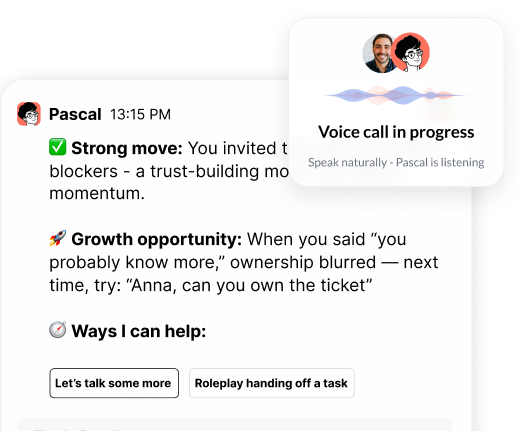
Pascal starts the conversation. It sends a beginning-of-day preview of the calendar with preparation suggestions for specific conversations, so a manager walking into a hard one-on-one gets help without asking for it.
Pascal works where managers already are. Pascal works in Slack or Microsoft Teams and connects to the calendar, so managers meet it in tools they already open every day. Managers who live in chat can see how in-chat AI coaching works in Slack and Teams.
Pascal knows the job. It joins Zoom, Google Meet or Microsoft Teams meetings with the manager, so its feedback after a meeting is tied to what happened in it and to the manager's own goals. It coaches against the company's own leadership behaviors.
Pascal measures behavior change. Because it is in the meetings where managing happens, it can score behaviors as gap, proficient or strength over time against the company's own rubric. Each person sees their own progress, and L&D gets cohort-level before and after evidence for the program.
Each person's coaching conversations with Pascal stay private. HR and executives see aggregated, anonymized insights, and only for groups large enough to protect anonymity. Pinnacle is SOC 2 compliant.
For CHROs and heads of L&D choosing an AI coach for newly trained managers, run all four tests in the trial. Ask who starts the conversation, where managers meet the coach, whether the advice names their role and meeting, and what evidence of behavior change the coach can show at six months.