

I work for Pinnacle, which builds Pascal, an AI coaching platform. This analysis draws from our customer data and interviews with CHROs.
Managers learn concepts in workshops, then face real problems months later without support. A March training on difficult conversations doesn't help when you're sitting across from an underperforming employee in July. You're starting from scratch.
AI coaching delivers guidance during the actual conversation. Not four months earlier.
This isn't about replacing human coaches. It's about filling the gap between learning and doing. Traditional training teaches concepts. AI coaching helps managers apply those concepts when it matters.
Key Takeaways:
• Timing beats content quality. Guidance during a performance review changes behavior. Training from last quarter doesn't.
• Behavior change requires practice with feedback. One workshop doesn't create new habits.
• AI coaching costs $30-100 per person annually. Human coaching costs $3,000-$10,000 and reaches only executives.
• Purpose-built platforms trained on your company's culture give contextually appropriate advice. Generic chatbots don't.
You complete a module on delegation. Three weeks later, you're drowning in work and still doing everything yourself. The training didn't fail because the content was wrong. It failed because you learned a concept without practicing the behavior.
Traditional training operates on "learn then apply." Attend the workshop, complete the module, remember the content weeks later when you face the actual problem. This doesn't work for skill development. We lose 50-80% of new information within days without reinforcement (Ebbinghaus, 1885; Murre & Dros, 2015).
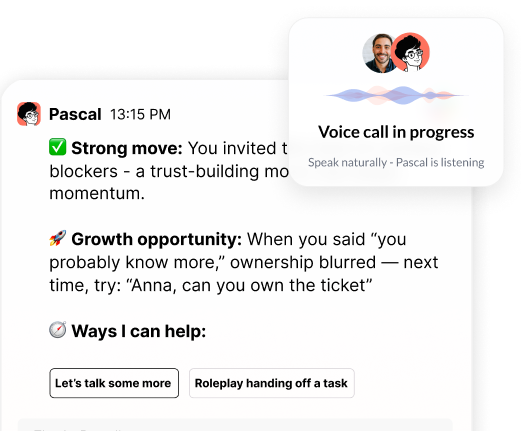
AI coaching operates on "learn while doing." You're drafting a performance review. The system suggests making your feedback specific: instead of "needs to improve communication," try "missed three project deadlines without alerting the team." You revise the review and practice giving specific feedback in a real situation with immediate consequences.
The workflow integration matters. Pascal lives in Slack and Teams where managers already work. LMS platforms require logging into a separate system, searching for relevant content, and translating generic lessons to your specific situation. Most managers don't bother.
Melinda Wolfe, former CHRO at Bloomberg, Pearson, and GLG, describes the value: "It makes it easier not to make mistakes. And it gives you frameworks to think through problems before you act."
Feedback attached to specific moments changes behavior. When you receive guidance on how you handled a team conflict right after the conflict, you adjust your approach for the next interaction. Generic advice about conflict resolution skills you might need someday doesn't change anything.
Our customer data (47 companies, 6-month measurement period) shows managers engage with Pascal 2.3 times per week on average. The system surfaces guidance proactively during moments that matter. You're running a tense project retrospective and receive a private message: "You've been talking for 8 of the last 10 minutes. Consider asking the team what they're seeing." You adjust in the moment.
This creates a feedback loop. You try a new approach, see the result, adjust. Traditional training provides feedback weeks after the behavior occurred, when you've already moved on to different challenges.
You don't learn to give better feedback by watching a video. You learn by giving feedback, getting coaching on that specific feedback, and trying again.
AI coaching costs $30-100 per person annually and reaches every manager. Traditional one-on-one coaching costs $3,000-$10,000 per person and remains accessible only to senior executives. A company with 200 managers would spend $600,000-$2,000,000 annually to provide human coaching to everyone versus $6,000-$20,000 for AI coaching.
AI Coaching vs. Traditional Coaching: Cost Comparison
Data Breakdown:
• Approach: AI Coaching | Cost Per Person (Annual): $30-$100 | Total Cost (200 Managers): $6,000-$20,000 | Reach: 100% of managers
• Approach: Traditional Human Coaching | Cost Per Person (Annual): $3,000-$10,000 | Total Cost (200 Managers): $600,000-$2,000,000 | Reach: 1-5% of workforce (executives only)
• Approach: Combined Approach | Cost Per Person (Annual): $50-$150 (blended) | Total Cost (200 Managers): $10,000-$30,000 + selective human coaching | Reach: All managers (AI) + senior leaders (human)
The coaching industry reached $6.25 billion in 2024 (ICF Global Coaching Study), but most organizations provide coaching to only 1-5% of their workforce. The other 95% of managers receive no coaching at all.
This cost difference frees budget to invest in human coaching for top leaders where strategic thinking and executive presence matter most. Our customer data (31 companies) shows 20% average improvement in direct report satisfaction scores when organizations implement AI coaching alongside selective human coaching for senior leaders.
Pascal is trained by ICF-certified coaches (International Coaching Federation, the industry's primary credentialing body). These coaches developed the coaching methodology, reviewed outputs, and continue to refine the system.
Generic AI tools provide theoretically correct advice that may conflict with your company's approach. A manager at a consensus-driven organization needs different guidance on decision-making than one at a move-fast startup.
Purpose-built platforms integrate company-specific culture, values, and competencies. Pascal connects with HRIS systems, performance management data, and competency frameworks. A manager preparing for a performance conversation receives guidance aligned with your performance review process, your feedback framework, and your cultural norms around directness.
Here's where this gets complicated: the system analyzes communication patterns in Slack, email metadata, and calendar data to understand team dynamics. This raises legitimate privacy concerns. We're SOC2 compliant and never use customer data to train models, but "compliant" doesn't mean "comfortable."
The trade-off: more context produces better guidance but requires more data access. Organizations implementing AI coaching should be transparent with employees about what data the system accesses and why. Some companies limit data access to calendar and public Slack channels. Others provide full access to improve guidance quality. This is a real limitation that may disqualify the product for privacy-conscious organizations.
Our customer data (47 companies, 6-month measurement period) shows 83% of managers receive positive feedback from direct reports on specific behaviors: feedback quality, communication clarity, decision-making speed, and team engagement. This metric comes from direct report surveys, not manager self-assessment.
The most effective implementations don't require managers to remember to use the tool. The AI coach surfaces guidance when managers face actual decisions.
Before a difficult conversation with an underperforming team member, a manager practices different approaches. They type out what they plan to say. The system suggests making the feedback specific and actionable. They revise. They enter the conversation more confident because they've already practiced.
Between meetings, managers use the platform for preparation and role-play. The learning happens when it matters—attached to real stakes and immediate application.
AI coaching works for tactical management challenges: preparing for difficult conversations, structuring feedback, navigating team conflicts. It doesn't replace strategic thinking, executive presence development, or the relationship-building that happens in human coaching.
The system can give bad advice. When it does, managers need judgment to recognize and ignore it. Organizations should train managers on when to override AI guidance and escalate to human coaches or HR partners.
The technology works best as a complement to human development, not a replacement. Traditional training provides foundational knowledge and relationship building. Human coaching provides strategic guidance for senior leaders. AI coaching fills the gap between initial training and daily application.
Traditional training also does things AI coaching can't: it creates shared language across teams, builds relationships between managers, and establishes foundational frameworks that everyone understands. A workshop on feedback creates a common vocabulary. AI coaching helps managers apply that vocabulary to specific situations.
The future of manager development isn't choosing between AI and human coaching. It's using both strategically: AI coaching scales continuous support to every manager, human coaching provides strategic guidance to senior leaders, and traditional training establishes foundational knowledge.
Organizations implementing this approach see measurable improvements in manager effectiveness and team engagement. The economic case is clear: AI coaching reaches 100% of managers at a fraction of traditional coaching costs, making development accessible beyond the executive suite.
The technology is new. The underlying principle isn't: people learn by doing, not by watching. AI coaching makes "learning by doing" scalable.
See how Pascal works inside Slack to deliver real-time coaching for your managers.
Header photo by Vitaly Gariev on Unsplash

.png)
.webp)
“Thank you for setting the great foundation for my promotion; now I have a plan!"

Curious to see how AI Coaching can 10X the impact and scale of your development initiatives. Book a demo today for: