

AI coaching works best for new managers, high-performing individual contributors, and distributed teams. These groups make frequent, high-stakes decisions where real-time feedback creates measurable improvements within weeks.
New managers, sales professionals, and distributed team leaders show measurable improvements within 90 days. Their roles require continuous decision-making where immediate feedback compounds over time. Gallup research shows that managers account for 70% of team engagement variance, making their development critical.
New managers (0–2 years in role) make dozens of people decisions weekly, yet 60% report feeling unprepared for the role. Half receive zero training before their first leadership position. They shift from managing projects to managing people—an entirely different skill set—with minimal support.
High-performing individual contributors transitioning to leadership need support during their most vulnerable learning period. The move from technical expert to people leader requires new skills, and quarterly training programs miss the moments when these leaders need guidance most.
Distributed team leaders managing remote teams lack informal coaching moments that happen naturally in offices. They can't read body language in hallways or catch concerns during casual conversations. AI coaching provides consistent feedback regardless of location.
Sales professionals navigate high-stakes conversations where AI coaching offers pre-call preparation and post-call analysis. Role-playing difficult scenarios and receiving immediate feedback on actual client interactions accelerates skill development beyond traditional training.
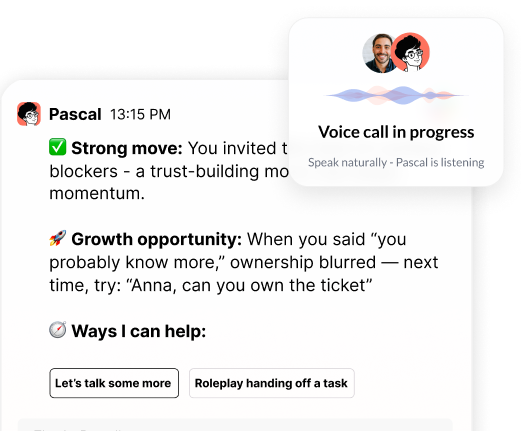
The challenge: most AI coaching tools can't observe actual work. They rely on self-reported scenarios and hypothetical situations. Purpose-built solutions like Pascal join meetings via Zoom and Teams, observing real interactions and providing feedback on specific moments—not generic advice three months later.
Employees in transition moments—new roles, new teams, new responsibilities—engage with AI coaching at higher rates. The key differentiator isn't demographics; it's situational receptivity.
Transition triggers that drive adoption include the first 90 days in a new role, taking on direct reports for the first time, moving from technical to leadership track, joining a new team or company, and navigating organizational change. During these periods, employees recognize they need support and actively seek resources.
Personality factors matter less than you'd expect. Growth mindset individuals, early technology adopters, and those who previously sought coaching show higher sustained usage. However, situational context often overrides personality traits—even skeptical employees engage when struggling with real challenges.
Organizational context drives adoption more than individual factors. Companies with supportive HR cultures and clear development expectations see higher adoption than those positioning AI coaching as remedial. When leadership frames AI coaching as a performance accelerator rather than a fix for underperformers, engagement increases.
Data Breakdown:
• Receptivity Factor: Situational Context | High Engagement: First 90 days in role, new direct reports, organizational change | Low Engagement: Stable role, established routines, no immediate challenges
• Receptivity Factor: Organizational Culture | High Engagement: Development positioned as growth opportunity, leadership support visible | Low Engagement: AI coaching seen as remedial, minimal executive endorsement
• Receptivity Factor: Individual Factors | High Engagement: Growth mindset, previous coaching experience, comfortable with technology | Low Engagement: Coaching-averse, technology skeptical
The pattern: people engage with AI coaching when they face real challenges and the organization frames it as a resource for high performers, not a remediation tool.
AI coaching makes professional development accessible beyond the executive suite, while human coaching remains superior for complex career transitions and sensitive interpersonal situations. The optimal approach combines both: AI for continuous, contextual guidance; humans for strategic inflection points.
Traditional executive coaching costs $3,000–$15,000 per person annually, limiting access to the top 5% of leaders. This economic reality means most managers never receive professional coaching support, despite being responsible for the majority of employee engagement and performance outcomes.
AI coaching delivers support at a fraction of traditional coaching costs, making it feasible for entire manager populations. The cost structure changes what's possible—organizations can now provide coaching to every manager, not just senior leaders.
Effectiveness comparison reveals clear strengths for each approach:
Data Breakdown:
• Coaching Type: AI Coaching | Best For: Real-time feedback, consistent methodology, immediate availability, scalable support | Limitations: Complex career decisions, sensitive conflicts requiring human judgment
• Coaching Type: Human Coaching | Best For: Executive presence development, strategic thinking, nuanced interpersonal situations | Limitations: Cost, availability, scalability constraints
The hybrid model works best. Companies use AI coaching for daily manager support while reserving human coaches for senior leadership and critical transitions. This approach matches the right resource to the right situation.
"If we can finally make coaching specific, timely, and integrated into real workflows, we solve one of the most chronic issues in the modern workplace." — Melinda Wolfe, former CHRO at Bloomberg and Pearson
The limitation of most AI coaching: it can't see your actual work. Generic chatbots rely on you describing situations accurately and providing full context. Purpose-built tools observe real interactions, building understanding of your working relationships and communication patterns over time.
Mid-market organizations face the "scaling gap"—too large for informal mentorship, too small for dedicated coaching budgets. AI coaching becomes the only economically viable way to support manager development at scale.
The mid-market challenge creates a perfect storm. Lean HR teams (often 1 HRBP per 100–150 employees) struggle to provide individualized support. Rapid growth creates first-time managers faster than training can scale. Limited L&D budgets ($1,200–$1,500 per employee annually according to ATD research) force difficult trade-offs. High expectations for manager effectiveness exist without corresponding support infrastructure.
Why AI coaching fits this segment:
• Replaces underutilized LMS platforms (typical engagement: 12–18%) with tools employees actually use
• Reduces HRBP burden for routine manager questions, allowing HR teams to focus on strategic initiatives
• Provides consistent development framework across distributed locations
• Scales instantly as headcount grows without requiring proportional increases in HR staff
Industry-specific adoption shows tech, professional services, and life sciences companies moving fastest. Their knowledge workers expect modern tools and their managers face complex people decisions daily. These industries also tend to have distributed teams and rapid growth, amplifying the need for scalable coaching solutions.
The economic reality: mid-market companies can't afford $10,000 per person for executive coaching, but they can't afford to leave managers unsupported either. AI coaching solves this constraint.
Roles involving frequent stakeholder interactions, ambiguous decision-making, and measurable performance outcomes generate the clearest results because AI can observe actual work and provide contextual feedback that drives immediate behavior change.
High-impact role characteristics include:
• Frequency of decisions: Managers making 20+ people decisions weekly versus quarterly strategic choices
• Observable interactions: Roles with regular meetings, presentations, or client conversations where AI can provide feedback
• Clear performance metrics: Sales, customer success, project delivery roles where coaching impact shows in KPIs
• Stakeholder complexity: Matrix organizations, cross-functional leaders, client-facing roles
Lower-impact scenarios include individual contributor roles with minimal collaboration, highly specialized technical work with limited people interaction, and senior executives needing strategic counsel versus tactical guidance. These roles can still benefit from AI coaching, but the timeline extends and the impact becomes harder to measure.
The context advantage separates purpose-built AI coaches from generic chatbots. Tools that join actual meetings and observe real interactions build understanding of each person's working relationships and communication patterns—context that generic chatbots can't access.
"Real learning and value come from in-context coaching—solving problems in the moment, not in a classroom." — Jeff Diana, former CHRO at Calendly and Atlassian
Observable behavior creates feedback loops. When AI coaching can see how managers run meetings, handle difficult conversations, and communicate decisions, it can provide specific, actionable feedback. This observation-feedback cycle accelerates skill development in ways that traditional training—based on hypothetical scenarios—cannot match.
Organizations ready for AI coaching share three characteristics: they have a clear manager effectiveness gap, they've tried traditional solutions without success, and they have leadership willing to model adoption. The readiness question isn't about technology infrastructure—it's about organizational commitment to manager development.
The manager effectiveness gap shows up in engagement surveys, retention data, and performance metrics. If your managers are struggling and traditional training isn't working, you're ready. If you're promoting high-performing individual contributors into management roles without adequate support, you're ready. If your HRBP team spends most of their time answering routine manager questions instead of strategic work, you're ready.
Tried traditional solutions means you've run quarterly training programs with low engagement, invested in LMS platforms that sit unused, or piloted human coaching programs that couldn't scale beyond senior leaders. Organizations that have experienced these limitations understand why a different approach is necessary.
Leadership modeling matters more than you'd expect. When executives and senior leaders visibly use AI coaching tools and share their experiences, adoption accelerates. When it's positioned as "something for struggling managers," engagement stalls. The companies seeing fastest results treat AI coaching as a performance accelerator for everyone, not a remedial tool.
Technical readiness is actually the easiest part. If you use Slack, Teams, or Zoom for meetings, you have the infrastructure needed. The harder work is cultural—creating an environment where seeking coaching is seen as strength, not weakness.
• New managers and distributed team leaders see measurable results within 90 days because their roles involve continuous decision-making where real-time feedback compounds advantage
• Employees in transition moments (first 90 days in role, new direct reports, organizational change) engage with AI coaching at higher rates than those in stable roles
• Mid-market companies (200–4,000 employees) benefit from AI coaching because it solves the scaling gap—too large for informal mentorship, too small for dedicated coaching budgets
• Roles with frequent stakeholder interactions and observable behaviors generate clearest results because AI can provide contextual feedback on actual work, not hypothetical scenarios
• The hybrid model works best: AI coaching for continuous, contextual guidance; human coaches for complex career transitions and strategic inflection points
AI coaching isn't replacing human development—it's making professional coaching accessible to every manager, not just executives. The organizations succeeding with AI coaching start with high-impact populations (new managers, distributed teams), prove value quickly, then expand across the organization. Tools like Pascal that observe real work and provide context-specific feedback deliver better results than generic chatbots that rely on self-reported scenarios.
See how Pascal works inside Slack to deliver real-time coaching for your managers, or explore our approach to AI coaching to understand how purpose-built solutions differ from generic chatbots.
Header photo by Amy Hirschi on Unsplash

.png)
.webp)
“Thank you for setting the great foundation for my promotion; now I have a plan!"

Curious to see how AI Coaching can 10X the impact and scale of your development initiatives. Book a demo today for: