

Programs that build manager coaching skills teach managers to help their people think through problems: asking open questions, listening closely, and letting the employee arrive at the answer. Good programs keep the instruction short and spend most of the time on practice in real one-on-ones, with feedback on how the manager coached.
The core skills are asking open questions, listening closely, and letting the employee arrive at the answer. These skills help people think through their own problems, which builds their judgment over time. A program that names these skills clearly gives managers a shared language for what good coaching sounds like.
Managers tend to default to telling, especially when they were promoted for being the expert. Giving the answer feels fast and helpful in the moment, so the habit is hard to change in a single session. The habit changes through many repetitions in actual conversations, with feedback after each one.
A useful structure is a brief workshop on a coaching model, followed by weeks of applying it in real one-on-ones. A peer group or coach then reviews what happened, so each manager hears how the conversation went and what to try next time. Keeping the instruction short leaves most of the program time for practice, which is where the habit forms.
Teams comparing options can also read how to choose a manager development program for broader selection criteria. The same practice test applies to any program on that shortlist.
With Pinnacle, Pascal can sit inside such a program. Companies can load the program materials into Pascal and set coaching others as an organization-wide priority, and each manager can also choose coaching others as one of their own skills.
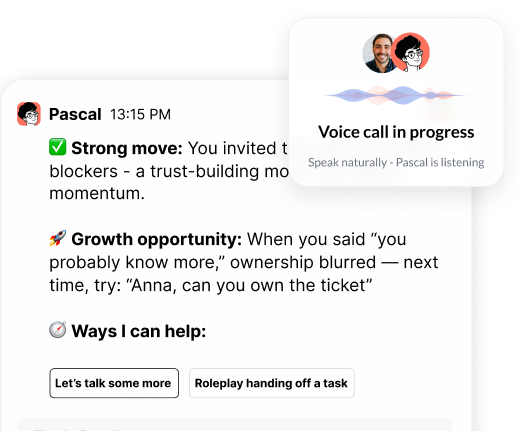
Pascal is an AI coach for every manager: a leadership companion who accompanies them in their meetings and work, and coaches from what actually happened. Pascal's feedback after meetings, usually within a few minutes, then covers how well the manager used questions to coach.
Each person's coaching conversations with Pascal stay private. HR and executives see aggregated, anonymized insights, and only for groups large enough to protect anonymity.



“Thank you for setting the great foundation for my promotion; now I have a plan!"

Curious to see how AI Coaching can 10X the impact and scale of your development initiatives. Book a demo today for: