

Choose a manager development program by asking how each option gets new skills used on the job, because traditional manager training fails when content stays in the classroom and managers return to a full calendar. Strong programs meet managers in their real work at the moment a skill is needed. This post covers what to look for and what to ask each vendor.
Strong programs share four traits, and each one helps a new skill carry into daily work. A buying team can use the list below as a checklist when it reviews each option.
Traditional manager training often ends when the session ends. Managers return to a full calendar, and the new skill has little chance to show up in the next 1:1 or team meeting. A program that plans for the return to work gives each skill a place to be practiced and reinforced.
The same reasoning explains why the four traits above matter together. Support in real work gives managers a place to practice, a short time commitment keeps the program realistic, and measurement shows whether the practice is working.
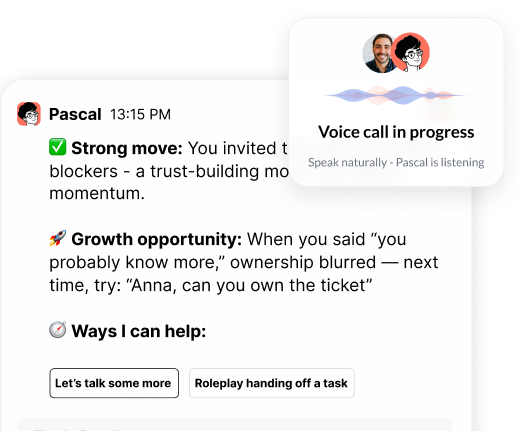
Many companies now pair a short structured program with an AI coach for ongoing practice. One option for that practice is Pascal, who reinforces the language and frameworks from a program by accompanying managers in their meetings and giving feedback tied to them, usually within a few minutes of each meeting. Because he joins the meetings, his feedback refers to what was said in them.
Pascal is an AI coach for every manager: a leadership companion who accompanies them in their meetings and work, and coaches from what actually happened.
Each person's coaching conversations with Pascal stay private. HR and executives see aggregated, anonymized insights, and only for groups large enough to protect anonymity.
Pinnacle's team can also check whether the program moved behavior by scoring the same group at the start and again months after the program began. That before-and-after view gives a buyer evidence about behavior change, which sits alongside attendance in a complete picture of a program.
A buying team can ask for this kind of check up front. Agreeing on the measure before the program starts makes the results easier to read when the second score arrives months later.
Whatever you shortlist, ask each vendor to show how a skill taught in the first week shows up in a manager's meetings a month later, and how you would know. A vendor with a clear answer can describe the moment of practice, the feedback that follows and the measure that confirms the change. That answer gives a buying team a fair way to compare vendors on the same terms.



“Thank you for setting the great foundation for my promotion; now I have a plan!"

Curious to see how AI Coaching can 10X the impact and scale of your development initiatives. Book a demo today for: