

HR and IT need to share ownership of AI coaching. HR defines the coaching strategy. IT handles security and integration. When both teams collaborate, coaches embedded in Slack, Teams, and meetings get used consistently. Standalone portals that require separate logins see much lower engagement.
Where your AI coach lives changes how managers use it. If managers must log into a separate portal, remember to ask for help, and navigate unfamiliar interfaces, they won't. Coaches that sit inside existing tools eliminate this friction.
Placement affects three things: how fast managers start using it, whether they keep using it, and whether you can measure behavior change. Organizations that treat AI coaching like email or calendar (infrastructure, not optional learning tool) see higher usage than those that position it as professional development.
The signal matters. Putting your coach in an HR portal says "this is optional development." Putting it in Slack says "this is how we work."
HR owns the platform, budget, and metrics. The coach integrates with your HRIS, performance management system, and learning platforms. This works when coaching goals align with talent programs like leadership pipelines or succession planning.
The risk: Managers see it as "HR's thing" instead of essential infrastructure. Even when HR leads rollout, the coach must embed in Slack or Teams. Companies that treat AI coaching like another learning platform see engagement plateau at 20-30% within three months.
IT owns procurement, security review, and technical integration. The coach sits alongside productivity tools like Microsoft 365 or Google Workspace. This enables faster enterprise-wide deployment because IT already has distribution capabilities and vendor relationships.
The risk: Coaching becomes generic without HR's expertise in manager development and organizational culture. IT teams excel at infrastructure but lack the people science knowledge that makes coaching effective.
Best practice: Joint ownership. IT handles infrastructure. HR defines coaching content and competencies.
Individual departments (Sales, Engineering, Customer Success) own their coaching instances. This creates customized guidance for role-specific challenges like sales coaching, technical leadership, or customer escalation. It works for companies with autonomous business units or distinct functional cultures.
The tradeoff: You get immediate relevance but organizational fragmentation. When Engineering runs one coaching platform and Sales runs another, you lose enterprise-level insights and create vendor management complexity.
HR, IT, and business leaders share ownership and treat coaching as enterprise capability. This requires executive sponsorship (CHRO + CIO or COO) and clear governance. It's the most complex model but drives the strongest adoption and cultural integration.
This model works for organizations that view manager effectiveness as competitive advantage.
Which model fits your organization size?
• 200-500 employees: HR-owned with IT partnership for integration
• 500-1,500 employees: Cross-functional with HR lead, IT infrastructure support
• 1,500-4,000 employees: Business unit-embedded with enterprise governance layer
Start by diagnosing three factors: your current manager effectiveness gaps, your organization's change adoption patterns, and where coaching conversations already happen.
Assess your manager pain points. If managers struggle with real-time feedback and difficult conversations, you need workflow-embedded coaching in Slack or Teams. If the gap is strategic leadership capability, HR-owned program integration works.
Evaluate your change adoption velocity. Fast-moving tech companies deploy cross-functional infrastructure models with executive sponsorship. Regulated industries start with HR-owned pilots before expanding.
Map where coaching happens today. If managers already use Slack for quick HR questions, that's where your AI coach should live. If they rely on scheduled 1:1s with HR business partners, integrate coaching into those existing rituals. Meet managers where they already work instead of asking them to adopt new behavior before experiencing value.
Consider your compliance requirements. Some companies can't record meetings due to regulatory constraints. AI coaching can still deliver value through messaging integration, organizational knowledge, and individual development data without requiring audio or video capture.
Test integration depth. Shallow integrations create friction. Deep integrations create habits. The difference comes from connecting to multiple data sources (performance data, messaging platforms, calendar systems) instead of deploying a surface-level chatbot.
Cross-functional ownership delivers the highest ROI. HR defines coaching strategy and competencies. IT ensures security, integration, and scalability. Single-department ownership creates adoption barriers.
The HR-IT partnership model: HR owns coaching content, manager development strategy, and success metrics (behavior change, engagement lift, performance improvement). IT owns security review, technical integration, data governance, and enterprise deployment. This mirrors how organizations deploy other people technology like HRIS or performance management platforms.
Why IT involvement matters: AI coaching platforms require SSO integration, data security review (SOC2 compliance), API connections to HRIS/Slack/Teams, and enterprise-grade uptime. HR teams rarely have bandwidth or expertise for this infrastructure work.
Why HR leadership matters: Generic AI tools lack the coaching expertise, organizational psychology, and manager development frameworks that drive behavior change. HR brings the people science that makes coaching trusted and effective.
The business leader role: Department heads (VP Sales, VP Engineering) provide use case validation and adoption accountability. They ensure coaching addresses real manager pain points and drive usage within their teams.
Jeff Diana, former CHRO at SuccessFactors and Calendly, emphasizes that HR leaders must shape how AI transforms work or watch other functions make those decisions.
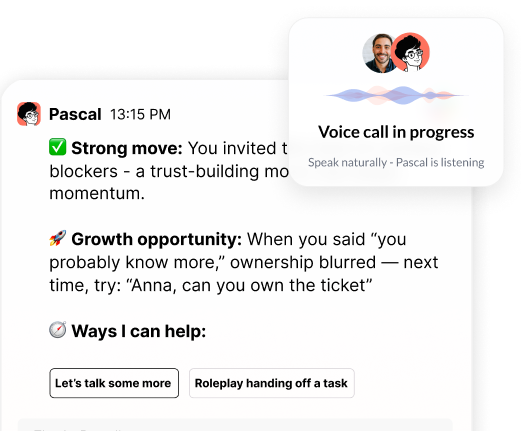
Coaches embedded in Slack, Teams, and meetings get used more than standalone portals. Integration eliminates the friction of context-switching and remembering to seek help. Managers receive guidance at decision moments instead of reactive support when they remember to ask.
The portal trap: Standalone coaching platforms require managers to log in, navigate to the right section, explain their situation, and wait for guidance. Each step adds friction. Even excellent coaching content fails when buried behind login screens.
The integration advantage: When coaching lives in Slack or Teams, managers ask questions in the same interface they use for daily work. The coach already knows organizational context, individual goals, and recent interactions. Response time drops from minutes to seconds. Usage becomes habitual instead of intentional.
Effective AI coaches need four layers of context: individual employee data (role, goals, performance history), organizational knowledge (values, competencies, culture), real-time work patterns (meeting dynamics, communication style), and calendar awareness (performance review cycles, goal-setting seasons). Without this foundation, coaching remains generic advice managers ignore.
Individual-level personalization: Integration with performance reviews, 360 feedback, and personality assessments helps the coach understand each manager's development areas. This eliminates the need for managers to repeatedly explain their situation.
Organizational customization: Purpose-built platforms incorporate company competencies, leadership frameworks, and cultural values. Whether you use SBI feedback models or other frameworks, the coach reinforces your specific approach. Generic AI tools provide textbook answers that don't align with how your organization operates.
Real-time observation: Meeting companions observe actual manager behavior (how they run 1:1s, deliver feedback, handle conflict). This creates coaching grounded in reality instead of self-reported challenges. Managers receive specific guidance on conversations that just happened, not generic tips for hypothetical situations.
Calendar awareness: Coaches that understand your performance review cycle, goal-setting seasons, and organizational rhythms provide timely guidance. They surface relevant coaching during performance review prep, remind managers about goal check-ins, and address seasonal challenges.
Success metrics vary by placement model but should always include adoption rates, engagement patterns, behavior change indicators, and business outcomes. HR-owned models emphasize learning completion and competency development. IT-managed models track system usage and integration health. Cross-functional models measure manager effectiveness and team performance.
Leading indicators: Track weekly active users, average interactions per manager, time-to-first-value, and feature adoption.
Behavior change metrics: Measure observable improvements in manager effectiveness: feedback frequency, 1:1 quality, performance review consistency, and difficult conversation handling.
Business outcomes: Connect coaching to retention, promotion readiness, team engagement, and performance. Companies using embedded AI coaching see faster manager ramp time, higher quality feedback conversations, and improved performance review consistency.
Efficiency gains: Calculate time saved on manager development, HR support requests, and performance management processes.
• Cross-functional ownership between HR and IT drives higher adoption than single-department models, with HR defining coaching strategy and IT ensuring security and integration
• Coaches embedded in Slack, Teams, and meetings get used more than standalone portals requiring separate logins
• Four data layers determine coaching effectiveness: individual employee data, organizational knowledge, real-time work patterns, and calendar awareness
• Purpose-built platforms with coaching expertise outperform generic AI tools by delivering guidance managers trust enough to apply immediately
• Success metrics should span adoption rates, behavior change indicators, and business outcomes like manager effectiveness and team performance
Pascal delivers AI coaching where your managers already work (no separate logins, no behavior change required). Explore how Pascal embeds in your workflow to drive manager effectiveness at scale.
Header photo by Vitaly Gariev on Unsplash

.png)
.webp)
“Thank you for setting the great foundation for my promotion; now I have a plan!"

Curious to see how AI Coaching can 10X the impact and scale of your development initiatives. Book a demo today for: