

AI coaches work when they're embedded in managers' existing workflows—Slack, Teams, meetings—not siloed in HR portals. Placement determines whether your coach becomes a daily habit or unused software.
AI coaching fails when managers must change behavior before experiencing value. Coaches that live where work happens get used. Coaches that require separate logins don't.
The placement question has three parts: who owns it (which function champions and measures success), where it lives technically (your technology stack), and how managers interact with it (their daily workflow). Each impacts adoption independently. Together they determine ROI.
Three Dimensions of AI Coach Placement
Data Breakdown:
• Dimension: Champion | HR-Owned Standalone: HR leadership | IT-Owned Portal: IT infrastructure | Cross-Functional Embedded: Business leaders + HR
• Dimension: Technical home | HR-Owned Standalone: Separate learning portal | IT-Owned Portal: Enterprise systems | Cross-Functional Embedded: Native to Slack/Teams/Zoom
• Dimension: Manager interaction | HR-Owned Standalone: Scheduled platform visits | IT-Owned Portal: Reactive help desk | Cross-Functional Embedded: Proactive guidance in workflow
• Dimension: Typical adoption | HR-Owned Standalone: 10-20% after 3 months | IT-Owned Portal: 30-40% sustained | Cross-Functional Embedded: 70-85% sustained
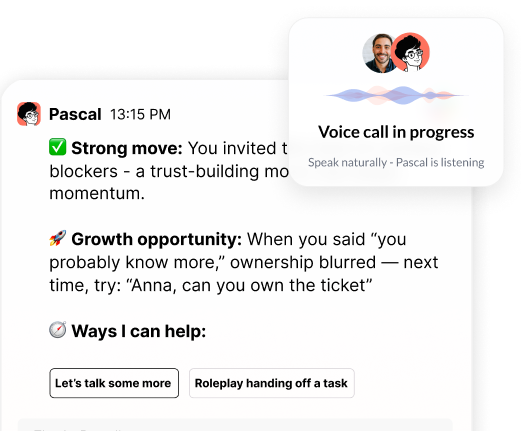
Embedded coaching observes real work, understands team dynamics, and provides guidance when decisions happen—not hours later. Pascal by Pinnacle accompanies managers to meetings, sits in Slack or Teams, and integrates across your tech stack to pull real-time signals.
Embedded coaching delivers three capabilities standalone portals can't. First, contextual awareness: the coach knows what happened in this morning's 1:1, understands team dynamics from Slack conversations, references past feedback when suggesting next steps. Second, proactive engagement: the coach surfaces guidance when it detects moments that matter (a difficult conversation brewing, a performance review approaching, a team member showing disengagement signals) rather than waiting for managers to ask. Third, workflow integration: managers receive coaching without leaving the tools they already use.
HR should own strategy, vendor relationships, and success metrics. But the best implementations create shared ownership with business leaders who benefit from stronger managers. When functional leaders (CTO, VP of Sales, Head of Customer Success) champion AI coaching within their teams, managers see it as a performance tool, not an HR initiative.
A tech company with 500 employees saw adoption double when engineering leadership positioned Pascal as "your technical leadership advisor" rather than "the new HR tool." The difference wasn't features. It was framing and ownership.
HR-led ownership works best when you're implementing coaching as part of broader leadership development, HR has strong credibility with business leaders, you need consistent standards across functions, or your culture values centralized people programs.
Cross-functional ownership works best when business leaders are already experimenting with AI tools, you want faster adoption within specific high-impact teams, different functions have distinct coaching needs (sales vs. engineering), or your culture rewards decentralized innovation.
IT partnership is required regardless because AI coaching needs technical integration, data security protocols, and platform maintenance. SOC2-compliant platforms like Pascal address security upfront, but IT must still approve integrations with Slack, Teams, Zoom, and your HRIS (Human Resources Information System—your system of record for employee data).
The best implementations establish a steering committee with HR leadership, IT partnership, and business function representation. This ensures coaching aligns with organizational priorities while maintaining security standards.
Managers using coaches embedded in Slack or Teams engage 5-7 times per week. Standalone portal adoption drops to 10-20% of users within three months. The difference is friction. When coaching requires opening a separate app, remembering credentials, and navigating to the right section, managers won't do it consistently enough to build new habits.
Embedded vs. Standalone AI Coaching Platforms
Data Breakdown:
• Dimension: Adoption rate | Embedded (Slack/Teams): 70-85% sustained usage | Standalone Portal: 10-20% after 3 months
• Dimension: Engagement frequency | Embedded (Slack/Teams): 5-7x per week | Standalone Portal: 1-2x per month
• Dimension: Context awareness | Embedded (Slack/Teams): Full access to conversations, meetings, team dynamics | Standalone Portal: Limited to manual user input
• Dimension: Time to value | Embedded (Slack/Teams): Immediate (no new login) | Standalone Portal: 2-3 weeks (requires habit formation)
• Dimension: Proactive coaching | Embedded (Slack/Teams): Surfaces guidance based on detected moments | Standalone Portal: Reactive only (waits for user visit)
• Dimension: Integration complexity | Embedded (Slack/Teams): Moderate (requires Slack/Teams API access) | Standalone Portal: Low (standalone deployment)
Pascal's embedded approach means managers receive coaching without changing workflow. When a difficult conversation emerges in Slack, Pascal offers real-time guidance. Before a performance review, Pascal surfaces relevant frameworks. During a meeting, Pascal observes dynamics and provides feedback immediately after.
Melinda Wolfe, former CHRO at Bloomberg, Pearson, and GLG, notes: "It makes it easier not to make mistakes. And it gives you frameworks to think through problems before you act." That preventive guidance only works when coaching meets managers at the moment of decision, not hours later when they remember to log into a separate platform.
An AI coach disconnected from your technology ecosystem provides generic advice managers could get from ChatGPT. One integrated with your HRIS, performance management system, engagement surveys, and communication platforms delivers personalized guidance grounded in organizational context.
Four integration layers separate effective AI coaching from chatbots: individual employee data (HRIS information including role, function, level, performance reviews, engagement survey results), organizational knowledge (values, competencies, culture documents, training materials, company goals), real-time work patterns (Slack/Teams conversations, meeting attendance, calendar patterns, communication frequency), and temporal context (upcoming reviews, recent team changes, current company priorities).
Pascal integrates across these layers to eliminate the friction of repeatedly explaining situations. When a manager asks for help preparing for a difficult conversation, Pascal already knows the team member's role, recent performance feedback, and relevant company policies. This contextual awareness transforms coaching from generic advice into specific, actionable guidance.
Managers need coaching at three moments: before high-stakes conversations (performance reviews, difficult feedback, compensation discussions), during real-time interactions (team meetings, 1:1s, conflict resolution), and after key events (post-meeting reflection, feedback on communication patterns, development planning).
Traditional coaching addresses only the "before" moment through scheduled sessions. Embedded AI coaching covers all three. Pascal joins meetings to provide real-time observations, surfaces relevant frameworks before difficult conversations, and offers reflection prompts after key interactions.
This continuous support model drives behavior change that episodic training can't achieve. When managers receive immediate feedback on communication patterns during team meetings, they adjust in real-time rather than weeks later. When Pascal reminds a manager about a direct report's career development conversation before their 1:1, that conversation happens instead of getting postponed.
The placement question determines whether coaching becomes infrastructure that strengthens every leadership interaction or another tool managers need to remember to use. Organizations seeing ROI from AI coaching have made the placement decision deliberately, with clear ownership, technical integration, and workflow embedding that meets managers where work already happens.
• Embedded AI coaches drive higher adoption than standalone portals by eliminating separate logins and new workflows—managers engage 5-7 times per week when coaching lives in Slack, Teams, or Zoom.
• Organizational ownership should be shared between HR and business functions, with HR leading strategy and measurement while functional leaders champion adoption within their teams to position coaching as a performance tool.
• Technical integration determines contextual relevance—AI coaches connected to HRIS, performance systems, and communication platforms deliver personalized guidance grounded in organizational context.
• The three critical coaching moments are before, during, and after high-stakes interactions—embedded AI coaching covers all three through proactive guidance, real-time observations, and post-event reflection.
• Successful implementations establish cross-functional steering committees with HR leadership, IT partnership, and business representation to ensure coaching aligns with organizational priorities while maintaining security standards.
Ready to see how embedded AI coaching transforms manager effectiveness? Discover how Pascal works inside Slack, Teams, and meetings to deliver coaching at the moments that matter most.
Header photo by Vitaly Gariev on Unsplash

.png)
.webp)
“Thank you for setting the great foundation for my promotion; now I have a plan!"

Curious to see how AI Coaching can 10X the impact and scale of your development initiatives. Book a demo today for: