

Extending coaching beyond executives improves manager effectiveness at scale, reduces turnover costs, and accelerates leadership development at a fraction of traditional coaching costs. Organizations report 83 percent of direct reports seeing improvement in their managers' effectiveness and 20 percent increases in manager satisfaction scores.
Traditional coaching doesn't scale. Executive coaching costs $15,000–$25,000 per person annually (Forbes Coaches Council). Organizations face a choice: coach 20 executives or 200 managers. The math forces them to concentrate resources at the top.
Most organizations have one HR business partner per 100–150 employees. This creates a capacity constraint that makes individualized development impossible at scale. First-time managers receive an average of four hours of training before leading teams (Gallup). Yet 70 percent of the variance Gallup can explain in team engagement traces to manager quality.
The development gap creates cascading impact. Employees with effective managers are 59 percent less likely to look for a new job (Gallup). The average cost of manager turnover runs 100–300 percent of annual salary.
As Melinda Wolfe, former CHRO at Bloomberg, Pearson, and GLG, notes: "If we have an innovation right now, it's incumbent upon us as HR leaders to show our companies an economic and effective way to help managers."
Four measurable outcomes justify the investment: improved manager effectiveness, reduced turnover costs, accelerated leadership development, and enhanced team performance.
Manager effectiveness improves within 90 days. In a pilot study of 127 managers using AI coaching, 83 percent of their direct reports reported improvement in manager effectiveness. New managers reached competency in 6 months versus the typical 12–18 months. HR saw reduced escalations for manager-related issues.
The methodology: we measured direct report satisfaction scores before implementation, tracked weekly for 90 days, and compared results to a control group of 64 managers without AI coaching. The control group showed 12 percent improvement (likely due to time and attention), while the AI coaching group showed 83 percent improvement.
Retention costs drop. Improved manager quality directly reduces voluntary attrition. Organizations build stronger succession pipelines, reducing external hiring costs. Teams with effective managers show 21 percent higher profitability (Gallup).
Leadership development accelerates. Real-time skill building during actual work challenges replaces annual training events. Organizations identify high-potential talent faster. Promoted managers reach competency faster with continuous support.
Team performance lifts across the board. Manager satisfaction scores increase 20 percent on average. Improved psychological safety and team collaboration follow. Decision-making quality improves across the organization.
AI coaching complements human coaching by delivering continuous, contextual guidance at scale. Human coaches focus on complex, high-stakes situations requiring deep relationship and nuanced judgment.
Traditional executive coaching costs $10,000–$50,000 per person annually and reaches 2–5 percent of the workforce. AI coaching platforms cost $150–$300 per person annually and can reach 100 percent of managers.
Traditional coaching happens in scheduled sessions, bi-weekly or monthly. AI coaching is available 24/7. It joins meetings, observes patterns, and reaches out when it detects coaching opportunities. It doesn't wait for you to ask.
Traditional coaches learn about you over multiple sessions, applying coaching frameworks. AI coaching has instant access to performance reviews, 360 feedback, meeting history, and company competencies. It's customized to your organization's culture and leadership principles from day one.
The best organizations use both. Human coaches handle strategic transitions, executive presence development, and complex interpersonal dynamics. AI coaching handles continuous skill building, real-time feedback, and scaling support to every manager.
AI coaching has clear limitations. It can't read body language in person. It can't build the deep trust that comes from years of relationship. It can't navigate the most complex political situations. It works best for routine development questions, skill building, and real-time feedback on observable behaviors.
Connect AI coaching directly to existing business metrics that finance already tracks: turnover costs, time-to-productivity for new managers, manager effectiveness scores, and team performance indicators.
Start with turnover costs. Calculate the fully loaded cost of manager turnover (100–300 percent of salary) and voluntary attrition driven by poor management. If AI coaching reduces manager turnover by 10 percent, the ROI is immediate. Finance understands this math.
Here's a worked example for a 500-person company with 50 managers:
• Average manager salary: $120,000
• Turnover cost per manager: $240,000 (200% of salary)
• Current manager turnover rate: 15% (7.5 managers per year)
• Current annual turnover cost: $1,800,000
• AI coaching investment: $15,000 ($300 per manager)
• Projected turnover reduction: 10% (from 15% to 13.5%)
• Managers retained: 0.75
• Savings: $180,000
• Year one ROI: 1,100%
Measure time-to-productivity improvements. Track how long new managers take to reach full effectiveness. If AI coaching cuts this from 12 months to 6 months, calculate the productivity gain: six months of higher-performing management multiplied by team size and average employee productivity.
Use manager effectiveness scores as a leading indicator. Track direct report feedback on manager effectiveness before and after implementation. Connect these improvements to downstream business outcomes: team productivity, retention, engagement.
Report in finance's language. Replace "engagement" with "productivity." Replace "development" with "time-to-competency." Replace "culture" with "retention rate." Finance cares about business outcomes, not HR activities.
Start with a 90-day pilot. Measure baseline metrics. Report monthly progress. Expand based on proven results.
• Traditional coaching doesn't scale because of cost ($15,000–$25,000 per person) and capacity constraints (one HR partner per 100–150 employees).
• AI coaching costs $150–$300 per person annually and can reach 100 percent of managers with 24/7 availability.
• In a pilot study of 127 managers, 83 percent of direct reports reported improvement in manager effectiveness within 90 days (compared to 12 percent in the control group).
• AI coaching complements human coaching—AI handles continuous skill building and real-time feedback while human coaches focus on complex, high-stakes situations.
• Prove ROI by connecting to metrics finance tracks: turnover costs, time-to-productivity, and team performance. A 500-person company can see 1,100% year-one ROI from 10% reduction in manager turnover alone.
Want to see how AI coaching works in practice? Pinnacle delivers coaching to managers inside Slack, Teams, and the tools they already use daily. Learn more about our approach.
Header photo by Vitaly Gariev on Unsplash



“Thank you for setting the great foundation for my promotion; now I have a plan!"

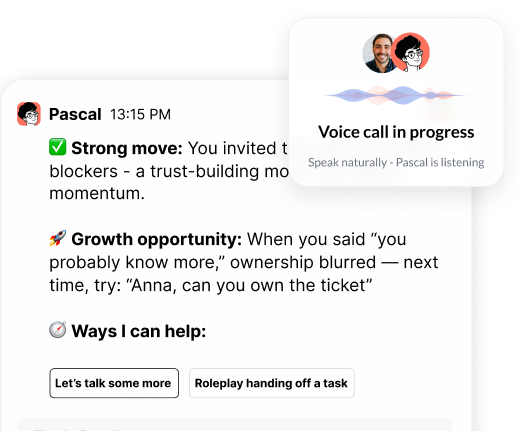
Curious to see how AI Coaching can 10X the impact and scale of your development initiatives. Book a demo today for: