

AI coaching integrates organizational context, behavioral data, and coaching frameworks to deliver personalized leadership guidance in the flow of work. Chatbots respond to queries with generic advice. AI coaches understand your people, culture, and the moments when guidance matters most.
The confusion between AI coaching and chatbots costs organizations millions in failed implementations. Companies deploy generic tools without understanding capability differences. AI coaching represents a category shift—a different approach to scaling manager development.
Traditional executive coaching costs $3,000–$15,000 per person annually and reaches only senior leaders. Learning management systems see utilization rates below 20%. AI coaching delivers comparable guidance at lower cost while scaling to every manager.
AI coaching helps leaders think clearly, act decisively, and grow through real situations—at organizational scale. The system observes work patterns, understands organizational context, and delivers guidance at moments of maximum impact.
Core capabilities:
Contextual awareness integrates with HRIS, performance data, meeting transcripts, and communication platforms to understand individual work patterns and team dynamics. The system knows who reports to whom, what projects are in flight, and where tensions exist.
Coaching methodology builds on frameworks like the GROW model and Socratic questioning rather than generic conversational AI. The system asks questions that lead to self-discovery instead of providing answers.
Longitudinal learning maintains records of interactions, goals, and progress over time. The system remembers past conversations and tracks development arcs. When a manager struggles with delegation in March, the AI coach references that context in June when similar patterns emerge.
Proactive intervention identifies coaching moments before managers ask. The AI surfaces guidance at the point of need, not days later when the moment has passed.
Cultural alignment trains on organization-specific values, competencies, and leadership principles. A company emphasizing direct feedback receives different coaching than one prioritizing consensus-building.
Data Breakdown:
• Method: Executive Coaching | Cost per Manager: $3,000–$15,000/year | Scalability: Limited to senior leaders | Contextual Awareness: High (1:1 sessions) | Availability: Scheduled sessions
• Method: LMS/Training | Cost per Manager: $50–$200/year | Scalability: High | Contextual Awareness: None | Availability: On-demand modules
• Method: AI Coaching | Cost per Manager: $30–$100/year | Scalability: Unlimited | Contextual Awareness: High (integrated data) | Availability: 24/7 in workflow
Chatbots are reactive conversational interfaces designed to answer questions using pattern matching and large language models. They excel at information retrieval but lack the structured frameworks, contextual awareness, and behavioral change mechanisms required for effective coaching.
Why chatbots fail as coaching tools:
They have no memory or context. Each conversation starts from zero. Chatbots don't remember your goals, team dynamics, or past challenges. You constantly re-explain background information.
They provide generic advice. Responses come from broad training data, not your organization's culture, values, or leadership principles. The guidance sounds polished but feels disconnected from your reality.
They're reactive only. You must remember to ask. Chatbots don't identify coaching moments or surface guidance when you need it most.
They offer no accountability. Chatbots don't track progress, follow up on commitments, or measure behavioral change.
Modern LLM-based assistants (ChatGPT with memory, Claude Projects, custom GPTs) have addressed some of these limitations. They can maintain conversation history and adapt to user preferences. But they still lack organizational context, proactive intervention, and integration with workplace tools.
The observation gap: A therapist only knows what you tell them. A chatbot only knows what you manually input. If the tool had actual data about how you communicate and behave in real situations, the guidance would be more accurate. This is why context-aware AI coaching—which observes actual interactions—delivers different value.
The functional gap between AI coaching and chatbots spans five dimensions: proactivity, perception, personalization, integration, and protection.
Proactivity vs. Reactivity
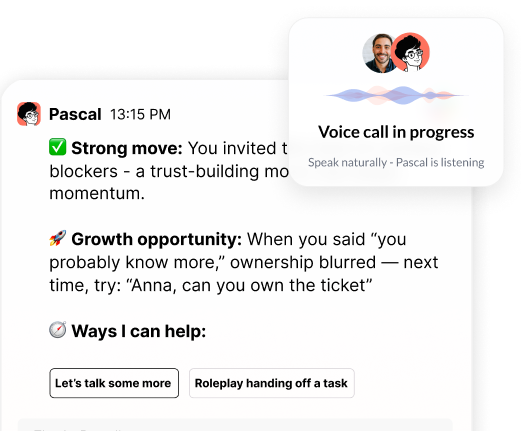
Chatbots wait for user queries and require managers to remember to seek help. AI coaching can join meetings, observe interactions, and deliver post-meeting feedback automatically. The system identifies coaching moments without manager action required.
Contextual Perception
Chatbots have no awareness of organizational structure, team relationships, or individual work patterns. AI coaching maintains records connecting people, projects, goals, and interactions. Managers receive guidance based on their last three 1:1s rather than generic delegation advice.
Personalization Depth
Chatbots deliver one-size-fits-all responses based on prompt engineering. AI coaching adapts to individual communication styles, organizational values, and role-specific competencies. A manager at a company that values direct feedback receives different guidance on the same conversation than a manager at a company emphasizing consensus-building.
Workflow Integration
Chatbots exist as standalone interfaces requiring managers to leave their workflow. AI coaching embeds in Slack, Teams, email, and calendar—delivering guidance where work happens. Tools requiring managers to visit separate platforms see 10–15% utilization. Workflow-embedded coaching achieves higher engagement.
Privacy and Governance
Chatbots often train on user inputs with limited organizational controls. AI coaching platforms can be SOC2 compliant, never train on customer data, and include moderation flags and sensitive topic escalation. Organizations maintain control over what data flows into the system and how insights are aggregated.
Start with the coaching foundation, not the AI capabilities. Look for evidence of structured coaching frameworks—GROW model, Socratic questioning, behavioral change principles—embedded in the system design.
Demand proof of contextual awareness. Ask vendors: "How does your system know what happened in my manager's last three 1:1s?" If the answer involves manual input or self-reporting, it's a chatbot with better marketing. True AI coaching integrates with meeting platforms, communication tools, and HRIS systems.
Test the proactivity mechanism. Schedule a demo where the vendor shows you how the system identifies coaching moments without manager prompting. If the demo requires the manager to remember to ask for help, you're looking at reactive technology.
Verify cultural customization. Ask: "How does your system adapt to our specific leadership competencies and values?" Generic responses about "customizable prompts" indicate surface-level personalization.
Examine the privacy architecture. Request documentation on data governance, model training practices, and compliance certifications. Organizations handling sensitive leadership conversations need SOC2 compliance, clear data residency policies, and guarantees that customer data never trains the underlying models.
AI coaching drives behavior change through three mechanisms: contextual feedback loops, accountability structures, and pattern recognition across time.
Contextual feedback loops deliver guidance immediately after observed behaviors. When the system notices a manager interrupting direct reports three times, the feedback arrives within hours while the interaction is still fresh. Managers can adjust their approach in the next meeting, not weeks later after a training module.
Accountability structures track commitments and follow up on progress. If a manager commits to delegating a project, the AI coach checks in two weeks later. This persistent accountability drives action in ways that one-time advice cannot.
Pattern recognition across time identifies recurring challenges and suggests targeted development. When a manager struggles with the same delegation scenario across multiple quarters, the AI coach surfaces deeper frameworks and recommends specific skill-building rather than repeating surface-level advice.
Generic AI tools create three categories of risk: privacy exposure, cultural misalignment, and accountability gaps.
Privacy exposure occurs when managers input sensitive information into tools that train on user data. A manager describing a performance issue with a direct report may inadvertently expose confidential information if the underlying model incorporates that conversation into future training.
Cultural misalignment happens when generic AI provides advice that contradicts organizational values. A company emphasizing psychological safety receives different coaching than one prioritizing radical transparency. Generic tools lack the cultural training to navigate these nuances.
Accountability gaps emerge when tools provide advice without tracking whether managers act on it. Generic chatbots offer suggestions but don't follow up, measure progress, or adjust recommendations based on outcomes.
The cost of these risks extends beyond individual managers. When organizations deploy generic tools without proper safeguards, they undermine trust in AI-powered development and make future implementations more difficult.
• AI coaching integrates organizational context, behavioral data, and proven frameworks to deliver personalized guidance; chatbots provide generic responses disconnected from your culture and people
• AI coaching costs less than traditional executive coaching while scaling to every manager with 24/7 availability in workflow tools like Slack and Teams
• The five critical differentiators are proactivity (joins meetings), perception (knowledge graphs), personalization (cultural alignment), integration (workflow embedding), and protection (SOC2 compliance)
• Evaluate vendors on coaching foundation first, AI capabilities second—look for evidence of structured frameworks like GROW model and Socratic questioning
• Generic AI tools create privacy exposure, cultural misalignment, and accountability gaps that specialized platforms mitigate through design
The gap between AI coaching and chatbots determines whether your managers develop sustainable habits or abandon the tool within weeks. Choose platforms built for coaching, not conversation.
See how Pascal works inside Slack to deliver real-time coaching for every manager on your team.

.png)
.webp)
“Thank you for setting the great foundation for my promotion; now I have a plan!"

Curious to see how AI Coaching can 10X the impact and scale of your development initiatives. Book a demo today for: