

Responsible scaling requires five foundational elements: purpose-built coaching expertise grounded in people science, architectural safeguards that make data leakage technically impossible, contextual awareness of your people and culture, proactive engagement that drives sustained adoption, and clear escalation protocols for sensitive topics. Organizations that prioritize these factors unlock coaching access for every manager while protecting both people and business.
Quick Takeaway: Scaling AI coaching responsibly means combining purpose-built expertise with architectural safeguards and clear escalation protocols, not deploying generic AI tools and hoping for the best. Organizations that integrate these five elements see measurable manager improvement, sustained engagement, and business outcomes that justify the investment while protecting employees from unnecessary risk.
The promise of AI coaching is straightforward: extend expert guidance to every manager at a fraction of traditional coaching costs. The challenge is equally clear: scaling without safeguards turns innovation into organizational liability. In our work building Pascal and implementing AI coaching across organizations from 200 to 5,000 employees, we've learned that the difference between transformative adoption and expensive experiments comes down to specific design choices made before deployment, not after problems emerge.
Direct Answer: Scaling AI coaching responsibly means combining purpose-built coaching expertise, architectural data safeguards, and clear escalation protocols—not deploying generic AI tools and hoping for the best.
Purpose-built systems trained on 50+ leadership frameworks and behavioral research deliver guidance managers trust and apply, unlike generic AI that provides lowest-common-denominator advice. When ChatGPT compiles the world's information, the result is the lowest common denominator of that knowledge. When it comes to coaching methodology, the devil is in the details: nuance of the individual human dynamics at play in any given situation is what matters.
Data isolation at the user level prevents cross-account leakage; encryption and SOC2 compliance should be standard, not premium add-ons. Moderation systems proactively identify sensitive topics like harassment, terminations, and mental health concerns, escalating them to HR while continuing to support managers on routine challenges. Organizations can customize escalation triggers based on risk tolerance, industry regulations, and company policies rather than accepting vendor defaults.
"We haven't had the people power to provide this level of guidance. Now we finally do and it's scalable."
Direct Answer: Contextual awareness—integrating performance data, team dynamics, and company culture—drives 57% higher engagement compared to generic platforms that require managers to re-explain situations each time.
AI coaches that integrate with HRIS, performance management systems, and communication tools understand each manager's role, their team's composition, recent feedback, and career goals. When Pascal joins meetings and observes actual team dynamics, managers receive coaching grounded in reality rather than theoretical frameworks. Organizations using contextually aware AI coaching see managers averaging 2.3 sessions per week with 94% monthly retention, proving that consistent engagement drives behavior change.
This contextual depth transforms coaching from generic advice into practical guidance managers can immediately implement in their next one-on-one. Rather than asking a manager to explain their team's composition and dynamics, the system already knows. Rather than providing general delegation tips, Pascal offers specific guidance on whether to delegate to Sarah based on her career goals and current workload. This relevance eliminates friction that kills adoption with generic tools.
Direct Answer: Establish clear escalation protocols, data privacy policies, and cross-functional alignment before deployment, not after problems emerge.
Define escalation triggers covering performance documentation, terminations, mental health concerns, harassment and discrimination, and major employment decisions. Implement SOC2 compliance, GDPR adherence, and user-level data isolation where conversations remain confidential between employee and AI coach. Create seamless handoffs where escalation feels like continuation, not failure; the AI coach explains why human expertise matters and helps prepare for that conversation.
Establish clear ownership for different escalation categories with defined response timeframes: same-day response for performance guidance, immediate response for harassment or mental health concerns. Monitor escalation patterns through anonymized insights to identify emerging team health issues before they become crises. This visibility gives HR teams the signal to intervene proactively rather than reactively, transforming the AI coach into a strategic intelligence tool for your people function.
Direct Answer: Proactive systems that surface guidance after meetings and interactions achieve 2-3x higher engagement and 94% monthly retention compared to reactive tools requiring managers to remember to seek help.
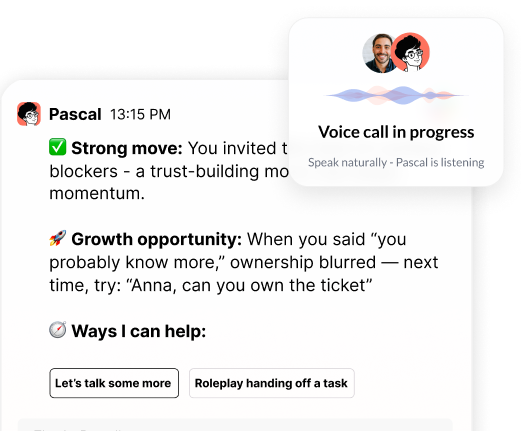
After every team meeting, Pascal delivers real-time feedback on communication patterns, delegation opportunities, and team dynamics while context is fresh. Proactive coaching creates consistent habits rather than crisis-only support, enabling managers to implement new behaviors immediately. Weekly check-ins on development goals and personalized microlearning ensure support arrives when it's most relevant and actionable.
83% of colleagues report measurable improvement in their managers when using purpose-built AI coaching with proactive engagement. This outcome flows directly from consistent practice. When managers receive feedback after every meeting rather than waiting for quarterly reviews, they develop new communication patterns through repetition. The behavior change compounds over time, creating the sustained improvement that justifies coaching investment.
Direct Answer: Organizations implementing AI coaching with appropriate guardrails see measurable improvements in manager ramp time, feedback quality, review consistency, and sustained behavior change.
Faster manager ramp time reduces the cost of turnover and accelerates team performance through consistent, expert guidance from day one. Higher quality feedback conversations improve retention and engagement when every manager receives coaching on delivery, goal-setting, and development planning. Improved performance review consistency lowers legal risk and improves talent decisions across the organization.
Organizations like HubSpot embedded AI into onboarding within the first two days and saw 98% of employees use AI on the job, with 84% feeling comfortable doing so. Organizations report 20% average lift in Manager Net Promoter Score among highly engaged users, proving that coaching relevance translates to team perception of manager effectiveness.
| Business Outcome | Measurement | Impact on Organization |
|---|---|---|
| Manager Ramp Time | Reduced 30-40% | Lower turnover costs; faster team productivity |
| Feedback Quality | 83% see measurable improvement | Higher retention; improved engagement |
| Manager NPS Lift | +20 points average | Team performance; reduced attrition |
| Monthly Retention | 94% platform engagement | Sustained behavior change; proven ROI |
Direct Answer: Organizations succeeding at scale run focused 1-2 month pilots with clear success metrics tied to business outcomes, then expand deliberately based on evidence.
Measure leading indicators like weekly active users and coaching sessions per manager to show adoption trends before behavioral outcomes become visible. Track lagging indicators like manager effectiveness scores, direct report engagement, and retention rates to prove ROI, but recognize these take quarters to materialize. Cross-functional alignment with Legal, IT, and senior leadership matters as much as technology selection; establish guidelines for data privacy and intervention thresholds before deployment.
Jeff Diana, four-time CHRO and Pinnacle advisor, emphasizes that CHROs should analyze tasks before implementing tools, ensuring you understand what coaching moments matter most before scaling support. Pinnacle brought on three veteran CHROs—Jeff Diana, Shelby Wolpa, and Barb Bidan—as strategic advisors to guide Pascal's development and support HR leaders in adopting AI, demonstrating commitment to understanding enterprise needs.
The organizations getting responsible AI coaching right recognize that purpose-built coaching platforms grounded in people science deliver measurably better outcomes than repurposed chatbots. They prioritize change management alongside technology selection. They measure outcomes that matter for business performance, not just adoption metrics. And they choose vendors who share their commitment to employee privacy, ethical AI development, and proven business results.
The path forward requires moving beyond the question of whether to adopt AI coaching toward the more important question of how to adopt it responsibly. That means selecting vendors based on the criteria that actually drive effectiveness and safety rather than surface-level features or cost alone. It means establishing clear governance that balances innovation with protection. It means providing managers with tools that meet them in their workflow rather than expecting them to change their habits. And it means choosing systems with the contextual awareness and expert foundation that builds trust rather than erodes it.

.png)
.webp)
“Thank you for setting the great foundation for my promotion; now I have a plan!"

Curious to see how AI Coaching can 10X the impact and scale of your development initiatives. Book a demo today for: