

An AI coach that knows nothing about your organization delivers generic advice managers ignore within weeks. An AI coach that integrates your company's values, competency frameworks, and actual team dynamics delivers guidance that feels relevant and actionable. The difference comes down to what data the platform accesses and how it uses that information to understand your culture.
Quick Takeaway: An AI coach learns your culture by integrating four layers of organizational context: your stated values and competency frameworks, how people actually communicate in meetings, performance data that reveals what success looks like in your environment, and temporal patterns tied to your business cycles. Without this foundation, coaching remains generic and irrelevant.
At Pinnacle, we've learned that selecting an AI coaching vendor requires looking beyond surface-level features to understand what truly drives manager effectiveness and organizational impact. We've seen firsthand that the most critical factors are the coach's foundational expertise, its contextual awareness of your people and their work, and its integration into your daily workflow. The difference between an AI coach that becomes a trusted daily resource and one that gathers digital dust comes down to whether the platform understands how your organization actually defines leadership success.
An AI coach learns your culture by integrating four layers of organizational context: your stated values and competency frameworks, how people actually communicate and interact in meetings, performance data that reveals what success looks like in your environment, and temporal patterns tied to your business cycles and decision-making rhythms.
Culture isn't what's on your website. It's what happens in real meetings, one-on-ones, and team interactions. Culture Amp's AI Coach draws from 1.5 billion workplace datapoints (2014–2025) to deliver context-aware guidance calibrated to each organization's culture and performance goals. This scale of data integration enables the platform to recognize patterns that individual organizations might miss while remaining specific enough to reflect how your teams actually work.
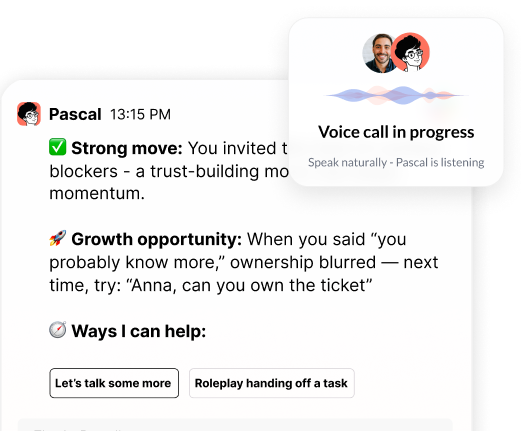
Purpose-built AI coaches like Pascal observe actual team dynamics through meeting transcripts and communication patterns rather than relying solely on what managers report happened. Generic AI tools provide advice disconnected from how your organization actually defines leadership success. When a manager asks for feedback coaching, generic AI offers templates. Pascal references specific moments from your company's actual interactions and suggests improvements grounded in observed behavior and your cultural values.
Effective AI coaches integrate directly with your existing systems rather than requiring manual data entry or operating in isolation. This integration eliminates friction while ensuring the platform has access to the contextual information needed for relevant guidance.
Pascal joins your Zoom and Google Meet meetings to observe real team dynamics, then synthesizes that with performance review data and company documentation. Data integration happens automatically; managers don't need to upload information or explain their situation repeatedly. Organizations can customize what data informs coaching by uploading competency frameworks, values statements, and leadership principles specific to your culture.
The technical architecture matters enormously. Pinnacle has secured funding to expand Pascal's capabilities to deliver coaching at the moments it matters most, including real-time guidance during virtual meetings based on actual communication patterns. This integration approach differs fundamentally from platforms that require separate logins or manual context-setting before each conversation.
Culture-blind AI tools provide universal leadership advice that applies equally to any manager in any company. Culture-aware platforms tailor guidance to reflect your specific values, communication norms, and definitions of success.
AI can provide up to 90% of day-to-day coaching functions when informed by organizational context, but only 29% of coaches report using company data directly in AI-driven sessions. This gap reveals why so many AI coaching implementations disappoint. When a manager asks for feedback coaching, generic AI offers templates. Culture-aware AI references specific moments from your company's actual interactions.
Companies like HubSpot, Zapier, and Marriott succeeded by embedding AI into existing workflows and making clear that technology augments rather than replaces human judgment. Culture alignment determines whether coaching reinforces your leadership expectations or introduces conflicting approaches that confuse managers. When guidance conflicts with organizational norms, managers face an impossible choice: follow the AI's advice and violate cultural expectations, or ignore the tool entirely. Most choose the latter.
Reactive AI waits for managers to ask questions. Proactive AI observes actual work interactions and surfaces culture-aligned feedback before managers realize they need help, creating consistent development habits rather than episodic advice.
Pascal joins meetings and delivers real-time feedback grounded in what actually happened, not what someone reported happened. Proactive coaching drives 34% time savings per employee monthly (45 hours) by eliminating friction in seeking development resources. 94% monthly retention with an average of 2.3 coaching sessions per week demonstrates sustained engagement when coaching meets managers in their workflow. Culture-aware feedback creates learning moments tied to your organization's actual communication norms and decision-making patterns.
Purpose-built AI coaching platforms recognize when situations require human expertise and escalate appropriately, protecting both your organization and employees while ensuring sensitive cultural issues involve HR expertise.
Pascal includes moderation systems that identify when conversations touch harassment, discrimination, mental health concerns, or terminations. Organizations can customize escalation thresholds based on their culture and risk tolerance. Escalation protocols ensure HR involvement for sensitive employee topics while the AI continues supporting managers in preparing for those conversations. Three veteran CHROs joined Pinnacle as strategic advisors specifically because they recognized that purpose-built platforms with proper context, guardrails, and organizational alignment deliver measurably better outcomes.
Leading platforms isolate data at the user level, never train AI models on customer information, maintain enterprise-grade encryption, and give employees transparency and control over what the system knows about them.
User-level data storage makes cross-account leakage technically impossible. Coaching conversations remain confidential even when multiple people at your organization use the platform. SOC2 compliance and explicit policies against training on customer data protect confidentiality while enabling personalization. Transparency builds trust. Employees should understand what data informs coaching and have visibility into their profile.
| Data Source | Coaching Value | Privacy Safeguards |
|---|---|---|
| Performance reviews and goals | Personalizes feedback and development planning | User-level isolation, no model training |
| Team structure and role information | Enables team dynamics awareness | Aggregated, non-identifying |
| Company values and competencies | Aligns coaching with organizational culture | Organization-wide visibility, no individual risk |
| Meeting transcripts and communication patterns | Identifies coaching moments and behavioral patterns | Encrypted storage, user-level separation |
The business case for culture-aware AI coaching becomes clear when you examine the outcomes that matter to CHROs: faster manager ramp time, higher quality feedback conversations, improved performance review consistency, and measurable behavior change from training programs.
Organizations implementing culture-aware AI coaching report significant improvements across these metrics compared to both traditional learning platforms and generic AI tools. 83% of direct reports see measurable improvement in their managers when those managers engage regularly with contextual coaching. 20% average lift in Manager Net Promoter Score among highly engaged users reflects the consistent coaching quality that contextual AI enables across managers with varying skill levels and experience.
These improvements stem from relevance. When guidance addresses a manager's actual situation within their actual culture, they implement it immediately rather than trying to translate generic advice into their context. A tech company using Pascal estimated saving 150 hours across 50 employees in their initial rollout. These time savings come from eliminated redundant training content, reduced need for managers to search for relevant resources, and decreased escalations to HR for routine management questions that contextual coaching handles effectively.
"So much of the real learning and value that comes from this comes from in-context coaching in the moment to drive performance and to solve problems in the moment."
Culture-aware coaching also enables measurement of what matters. Pascal provides aggregated, anonymized insights to people teams about where managers struggle most, which competencies need development, and how coaching engagement correlates with team performance. You can finally answer the question that matters most: "Is our management development investment actually working?"
The difference between generic AI advice and coaching grounded in your organization's actual culture, values, and team dynamics comes down to whether the platform integrates your company data thoughtfully. Pascal combines purpose-built coaching expertise with deep organizational context, proactive engagement in your daily tools, and appropriate guardrails for sensitive topics. The result is coaching that managers trust because it reflects how your organization actually works.

.png)
.webp)
“Thank you for setting the great foundation for my promotion; now I have a plan!"

Curious to see how AI Coaching can 10X the impact and scale of your development initiatives. Book a demo today for: