

People teams need five data layers from AI-powered learning tools: adoption metrics (who uses it and how often), engagement depth (quality of interactions), skill development tracking (competency growth), behavioral outcomes (real-world application), and organizational insights (trends across teams). These layers reveal whether learning changes behavior—something completion rates never show.
Traditional LMS platforms track completions. AI learning platforms track behavior change. The difference determines whether you know someone watched a video or whether they actually manage better.
Adoption metrics show whether the tool becomes part of daily work. Daily and weekly active users reveal routine integration versus one-time experiments. Feature utilization rates expose which capabilities drive value. Time spent in platform indicates depth, not just frequency. Consistency across departments shows where adoption succeeds and where it stalls.
Engagement depth separates meaningful interaction from clicks. Conversation length and complexity reveal whether users trust the platform for substantive challenges. Follow-up question patterns show whether guidance lands or confuses. Application of coaching in real scenarios proves the tool influences decisions. Return usage after initial interaction signals sustained value.
Skill development tracking connects learning to capability growth. Progress against defined competencies (feedback quality, delegation, conflict resolution) shows whether managers improve. Before-and-after behavioral assessments quantify improvement. Improvement velocity reveals how quickly people apply new skills.
Behavioral outcomes provide proof. Observable changes reported by direct reports validate that learning translates to better management. Manager effectiveness scores track impact on team performance. Performance review quality improvements demonstrate skill application in high-stakes moments. Reduction in HR escalations signals that managers handle challenges independently.
Organizational insights transform individual data into strategic intelligence. Aggregated skill gaps by function and level inform development investments. Common challenges across teams reveal systemic issues requiring cultural or structural intervention. Training needs analysis based on actual usage patterns ensures L&D spending addresses real problems.
Pascal surfaces these five layers through custom dashboards showing engagement by level and function, conversation topics, skill development patterns, and anonymized organizational trends.
Traditional LMS platforms report completion rates, time-on-platform, and quiz scores. AI-powered learning tools report real-time coaching interactions, skill application in work scenarios, and behavioral improvements observed by direct reports. The first measures activity. The second measures impact.
Traditional LMS shows inputs. Someone completed the feedback training module. Someone spent 45 minutes on the delegation course. Someone passed the conflict resolution quiz. These metrics satisfy compliance requirements but don't answer whether managers actually improved.
AI learning shows outputs. Managers using real-time feedback coaching demonstrate measurable improvement in direct report satisfaction. Managers who apply delegation guidance reduce bottlenecks in their teams. Managers who practice conflict resolution skills reduce HR escalations. These metrics tie learning investment to team performance.
The ROI visibility gap is stark. LMS shows "85% completed the module." AI coaching shows "managers who engaged with feedback coaching for 30 days received 40% higher effectiveness scores from their direct reports in the following quarter." One measures compliance. The other measures results.
"We haven't had the people power to provide this level of guidance. Now we finally do—and it's scalable." — Melinda Wolfe, former CHRO at Bloomberg, Pearson, and GLG
CHROs need real-time visibility into three areas: individual skill development progress, team-level behavioral patterns, and organizational culture health. Real-time analytics transform HR from reactive (responding to engagement survey results six weeks late) to proactive (identifying skill gaps and intervening before they impact performance).
Individual development tracking provides personalized insight at scale. Progress against competency frameworks shows where each manager stands on critical skills. Coaching topics reveal current development priorities. Skill application frequency indicates whether learning translates to practice. Areas where employees seek repeated guidance signal persistent challenges requiring different intervention.
Team-level behavioral insights surface patterns invisible to traditional measurement. Manager effectiveness trends by department identify high-performing teams and struggling ones. Communication quality patterns reveal whether feedback culture improves or deteriorates. Delegation and feedback frequency track whether managers apply core leadership skills consistently.
Organizational culture indicators replace annual surveys with continuous monitoring. Aggregated themes reveal what challenges surface most frequently. Cultural transformation tracking shows whether values appear in real behavior, not just posters. Early warning signals for engagement issues enable intervention before problems metastasize.
Traditional quarterly surveys tell you what was wrong 90 days ago—too late to intervene. Real-time data lets you address issues while they're still solvable. You can connect learning investments to immediate business outcomes, proving HR's strategic value.
Pascal provides real-time dashboards showing engagement metrics, usage trends by level and function, conversation topics, and skill development patterns—replacing quarterly engagement surveys with continuous organizational pulse data that protects individual privacy while surfacing actionable insights.
The most valuable learner analytics for strategic HR decisions are aggregated skill gap identification (which competencies are weakest across which populations), coaching topic trends (what challenges employees face most frequently), behavioral change velocity (how quickly people apply new skills), and correlation data linking learning engagement to performance outcomes.
Skill gap mapping enables targeted intervention. Identification of competency deficiencies by function, level, location, and tenure reveals where development investment delivers highest ROI. Comparison of skill levels across teams exposes inconsistencies requiring attention. Tracking of improvement rates by competency shows which development approaches work.
Coaching topic trends surface what employees struggle with, not what HR assumes they need. Common challenges by role reveal whether job expectations align with capability development. Seasonal patterns in coaching requests inform when to deploy specific interventions. Emerging topics signal new challenges requiring curriculum updates or organizational support.
Behavioral change velocity predicts long-term impact. Time from learning to application shows whether training design enables immediate practice. Consistency of skill application over time reveals whether behavior change sticks or fades. Correlation between coaching frequency and improvement rates informs optimal engagement models.
Performance correlation data proves ROI. Managers with high coaching engagement show measurably better team performance. Direct report feedback scores improve for managers using development tools. Retention rates increase among teams led by managers investing in skill development. These correlations transform learning from nice-to-have to business-critical.
People teams should build three interconnected narratives: adoption proving the tool is used consistently, engagement demonstrating quality interactions, and outcomes showing measurable behavior change tied to business results.
Adoption metrics establish credibility. Consistent daily and weekly active users prove the tool integrates into work routines. High utilization across departments and levels demonstrates broad value. Sustained engagement over time shows the tool delivers ongoing value, not novelty-driven spikes.
Engagement quality demonstrates depth. Conversation complexity and follow-up patterns reveal meaningful interaction. Application of guidance in real scenarios proves the tool influences decisions. Return usage after initial interaction signals trust and sustained value.
Behavioral outcomes prove impact. Observable improvements reported by direct reports validate that learning translates to better management. Manager effectiveness scores track impact on team performance. Reduction in HR escalations shows managers handle challenges independently. Performance review quality improvements demonstrate skill application in high-stakes moments.
Strategic decision-making flows from this data foundation. Identify which competencies require investment based on aggregated skill gaps. Deploy targeted interventions where coaching topic trends reveal common challenges. Adjust development approaches based on behavioral change velocity data. Allocate budget to programs showing clear performance correlation.
Effective People teams use AI learning data to shift from reactive problem-solving to proactive capability building. Real-time visibility enables intervention before issues impact performance. Data-driven insights prove HR's strategic value to the C-suite.
• Five data layers matter: Adoption metrics, engagement depth, skill development tracking, behavioral outcomes, and organizational insights—not completion rates.
• Real-time beats quarterly: Continuous visibility enables proactive intervention. Quarterly surveys tell you what was wrong months ago, too late to act.
• Leading indicators predict impact: Skill application frequency and behavioral change velocity forecast long-term outcomes better than traditional lagging metrics.
• Privacy-protected aggregation: Effective platforms surface organizational trends without individual surveillance, balancing insight with employee trust.
• ROI requires three narratives: Prove adoption (consistent usage), engagement (quality interactions), and outcomes (measurable behavior change tied to business results).
Traditional learning platforms leave HR leaders guessing whether training improves performance. Pascal provides real-time dashboards showing adoption patterns, engagement depth, skill development, and behavioral outcomes—the five data layers that prove ROI and inform strategic decisions.
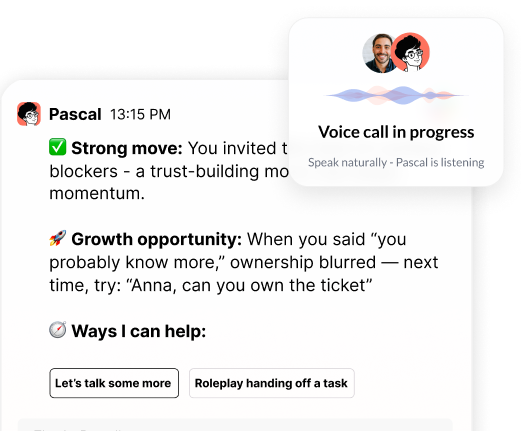
See how Pascal works inside Slack
Header photo by Jud Mackrill on Unsplash

.png)
.webp)
“Thank you for setting the great foundation for my promotion; now I have a plan!"

Curious to see how AI Coaching can 10X the impact and scale of your development initiatives. Book a demo today for: