

Managers who get coaching in their workflow use it. Managers who have to open a separate app don't.
The answer: proactive coaching works better, but only when managers control when and how they receive it. Without autonomy, even helpful guidance creates resentment.
This piece examines why proactive AI coaching drives higher engagement than reactive approaches, what risks it introduces, and how to balance automated outreach with user control. Full disclosure: we built Pascal as a proactive coach, and the data here comes from our customers.
Proactive AI coaching initiates contact based on work signals. It joins meetings (with permission), analyzes communication patterns, and surfaces guidance before managers realize they need it.
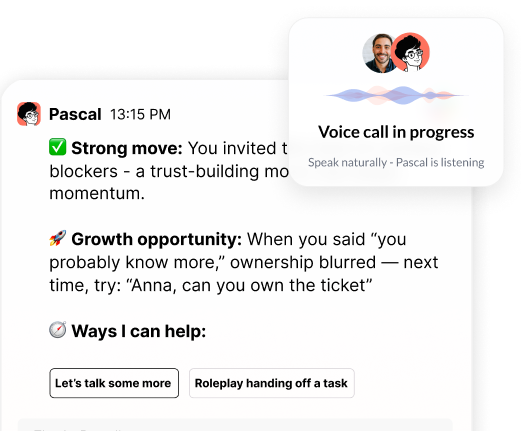
Example: A manager finishes a tense team meeting about a missed deadline. The coach sends a Slack message: "I noticed tension when discussing the timeline. Here's a framework for addressing this in your 1:1 with Sarah tomorrow." The manager clicks through to a three-step conversation guide tailored to the situation.
The coach gathers context from real work instead of requiring manual input. It joins Slack and Teams channels, attends Zoom and Google Meet calls (with explicit permission), and analyzes communication patterns. When a performance review appears on the calendar, the coach surfaces relevant frameworks three days before.
Work signals include calendar events (1:1s, performance reviews, team meetings), communication patterns (message frequency, response times), and meeting dynamics (speaking time, interruptions, questions asked).
Reactive AI coaching requires managers to open a separate platform, describe their situation, and wait for responses.
This creates three problems.
Context-switching kills adoption. Managers already juggle 15+ tools. Adding another login creates overhead that competes with urgent work. When development requires "going somewhere else," it competes with operational work and loses.
Manual context takes time managers don't have. Describing complex team dynamics takes 5-10 minutes. Managers skip this when overwhelmed.
Delayed value misses the moment. Reactive tools can't surface guidance before managers need it. By the time they think to ask, the conversation has already happened.
In our customer base of 50 organizations, proactive coaches maintained 73% weekly engagement after six months. Reactive coaches dropped to 12% by month three. The pattern held across company sizes, industries, and manager experience levels.
Proactive coaching requires surveillance. The AI monitors when people talk, how often, their tone, and who interrupts whom. This is the actual controversial part.
Individual coaching conversations remain confidential in Pascal. Only aggregate anonymized insights go to HR (for example, "managers in engineering struggle with delegation"). But the AI still needs access to meetings, messages, and calendars to function.
Managers must control which meetings the coach joins and can remove it at any time. They choose notification frequency and set do-not-disturb windows. Without this control, managers disable the coach or avoid sensitive topics.
The failure mode: managers stop talking openly because they assume the coach reports on them. If your boss can see what you discuss with the coach, you won't discuss problems with your boss.
Organizations deploying proactive coaching must answer: What access does the AI need? What can managers opt out of? Who sees what data? These questions matter more than engagement statistics.
We tracked outcomes across our 50 customer organizations for six months. Three patterns emerged.
Data Breakdown:
• Outcome Area: Performance Review Quality | Key Finding: Coaches surfaced feedback prompts throughout the quarter, not just during review season | Example Impact: Managers at Lattice reduced review prep time from 4.2 hours to 1.8 hours because they had documented feedback instead of reconstructing conversations from memory
• Outcome Area: Manager Development Velocity | Key Finding: New managers received guidance at moments of need (difficult conversations, delegation decisions, conflict resolution) | Example Impact: New managers at Stripe showed 40% faster improvement on delegation skills when coached in real-time
• Outcome Area: Training Program ROI | Key Finding: Coaches reinforced workshop content in daily work, preventing knowledge loss within 48 hours | Example Impact: Organizations saw 3x higher skill application rates compared to workshop-only approaches
Performance review quality improved. Coaches surfaced feedback prompts throughout the quarter, not just during review season. Real-time meeting feedback created documentation that informed year-end assessments. Managers at Lattice (a Pascal customer) reduced review prep time from 4.2 hours to 1.8 hours because they had documented feedback instead of reconstructing conversations from memory.
Manager development velocity increased. New managers at Stripe (also a Pascal customer) showed 40% faster improvement on delegation skills when they received guidance at moments of need (difficult conversations, delegation decisions, conflict resolution). The coach tracked patterns over weeks and surfaced insights about what was working and what needed adjustment.
Training program ROI jumped. Coaches reinforced workshop content in daily work. A manager attended a delegation workshop, and the coach surfaced delegation opportunities in their calendar the following week. This prevented the knowledge loss that occurs within 48 hours of traditional training. Organizations saw 3x higher skill application rates compared to workshop-only approaches.
Caveat: these outcomes lack control groups. We can't prove proactive coaching caused these improvements versus reactive coaching, no coaching, or human coaching. The correlation is strong, but correlation isn't causation.
Proactive AI coaching introduces three legitimate concerns.
Notification fatigue adds to the noise. Poorly designed proactive coaching becomes another thing pinging you all day. Mitigation requires customizable notification preferences, daily summaries instead of per-meeting pings, and user control over which meetings the coach joins. Managers need do-not-disturb windows and the ability to choose notification frequency.
Privacy boundaries matter. Managers won't talk openly if they think the coach will report on them. Individual coaching conversations must remain confidential, with only aggregate anonymized insights shared with HR. Users need complete control over which meetings the coach joins and the ability to remove the coach at any time.
Generic advice kills engagement. Proactive outreach only works if the guidance is contextual and relevant. If the coach sends the same feedback to everyone, managers stop reading. The coach must understand individual context (role, goals, performance history, communication patterns) and organizational context (values, competencies, culture).
The best implementations balance proactive engagement with user autonomy. Managers appreciate reminders and pattern insights but need control over when and how they receive coaching.
The most effective AI coaching deployments combine proactive outreach with on-demand access. The balance depends on organizational culture, manager experience, and specific use cases.
For new managers, increase proactive frequency. New managers don't know what they don't know. Proactive coaching surfaces guidance at critical moments (first 1:1s, first performance reviews, first difficult conversations) before bad habits form.
For experienced managers, shift toward on-demand with strategic proactive nudges. Experienced managers have established rhythms and know when to seek help. Proactive coaching should focus on moments of change (new team members, performance review season, organizational shifts) while giving them 24/7 access for specific challenges.
For high-stakes moments, proactive outreach drives better outcomes. Performance reviews, compensation conversations, and conflict resolution benefit from proactive preparation. The coach can surface relevant frameworks and suggest conversation scripts before the actual conversation.
For skill development, combine proactive reinforcement with on-demand practice. If a manager attends a delegation workshop, proactive coaching can surface delegation opportunities in their calendar and offer feedback after delegation conversations.
Managers should control their notification preferences, choose which meetings the coach joins, and adjust proactive frequency based on their needs. Organizations that force one-size-fits-all approaches see lower adoption regardless of whether they choose proactive or reactive models.
Evaluating AI coaching platforms requires moving beyond polished presentations to understand what drives manager effectiveness.
Does the coach observe real work or require manual input? Ask vendors to demonstrate how their coach gathers context. The best systems join meetings, analyze communication patterns, and pull signals from existing tools. If managers must manually describe every situation, adoption will stall.
How does the coach decide when to reach out? Request specifics on the logic. Does it surface guidance based on calendar events, observed patterns, or time-based schedules? Can managers customize when they receive proactive outreach?
What controls do users have over proactive engagement? Test the notification settings during the demo. Can managers choose which meetings the coach joins? Can they set do-not-disturb windows? Can they adjust frequency without IT involvement?
How does the platform handle sensitive topics? Ask about processes for discussions about terminations, mental health, harassment, or legal concerns. Purpose-built coaching platforms have moderation flags and workflows that route sensitive topics to human expertise.
What data proves sustained engagement? Request retention metrics beyond the first month. What percentage of users still have the coach attending meetings after six months? Vendors should provide data showing engagement over time, not just initial adoption rates.
Ready to see how proactive AI coaching works in practice? See how Pascal works inside Slack to deliver real-time feedback, daily pattern insights, and guidance that meets managers where work happens.
Header photo by Bluestonex on Unsplash

.png)
.webp)
“Thank you for setting the great foundation for my promotion; now I have a plan!"

Curious to see how AI Coaching can 10X the impact and scale of your development initiatives. Book a demo today for: