Blog article
AI Implementation Playbook: Embed AI Manager Development in Daily Tools
Learn how to embed AI manager development in Teams, Slack, email, calendars, and CRMs with governance, change management, and KPIs for adoption.


Your L&D budget is probably being spent on the wrong thing. Josh Bersin's latest corporate learning research puts a number on the problem: 76% of organizations are stalled at the lowest levels of learning maturity, still running training architectures built for a world that moved at a fraction of today's pace. Only 5% have reached what Bersin calls dynamic enablement, where learning is woven into work rather than separated from it. Those organizations are six times more likely to have the skills they need to execute on strategy, nine times more likely to be a great place to build a career, and 28 times more likely to have highly empowered employees.
That gap is a model problem, and more budget directed at the wrong model only widens it.
Organizational neuroplasticity is the capacity to sense change, reshape capabilities, and adapt continuously rather than in discrete training cycles. Bersin borrows the term from neuroscience deliberately. A brain rewires through repeated activation of new pathways, feedback applied in context, and practice anchored in real situations. The lecture is too distant from the moment to trigger that process. Organizations that learn the same way, through behavioral change in the flow of work rather than knowledge transferred in a classroom, build something qualitatively different from organizations that don't.
The companies Bersin describes as neuroplastic have restructured the relationship between learning and work entirely. Knowledge assembles in real time, at the moment of need, tailored to the individual, and connected to the actual work in front of them. That is a meaningfully different architecture, and it produces meaningfully different results.
Static training is easier to measure, easier to procure, and easier to defend in a budget cycle. Completion rates are trackable, seat time is billable, and a curriculum has a beginning and an end, which means all of it can be reported upward with confidence. These features make traditional L&D legible to finance and comfortable for program owners, even when the evidence that any of it changes behavior is thin.
"We forget 90% of what we learn unless we actively apply it or have ongoing reminders," says Alexei Dunaway, CEO of Pinnacle. "As Hermann Ebbinghaus demonstrated almost 140 years ago, memory decays rapidly after learning unless it's reinforced at the point of use. That's the case for contextual, in-the-moment support: learning that isn't activated in the flow of real work is mostly forgotten before it's ever applied. Yet most L&D investment still flows toward content libraries and structured programs rather than the kind of contextual support that meets people where the problem actually is."
The structural reason this persists: until recently, coaching at scale was cost-prohibitive, behavioral observation across entire organizations was impossible, and personalized support in the flow of work had no delivery mechanism. AI changes that calculus. The question is whether organizations use it to rebuild the same old model faster, or to do something genuinely different.
Bersin's framework maps four levels organizations move through on the way to dynamic enablement.
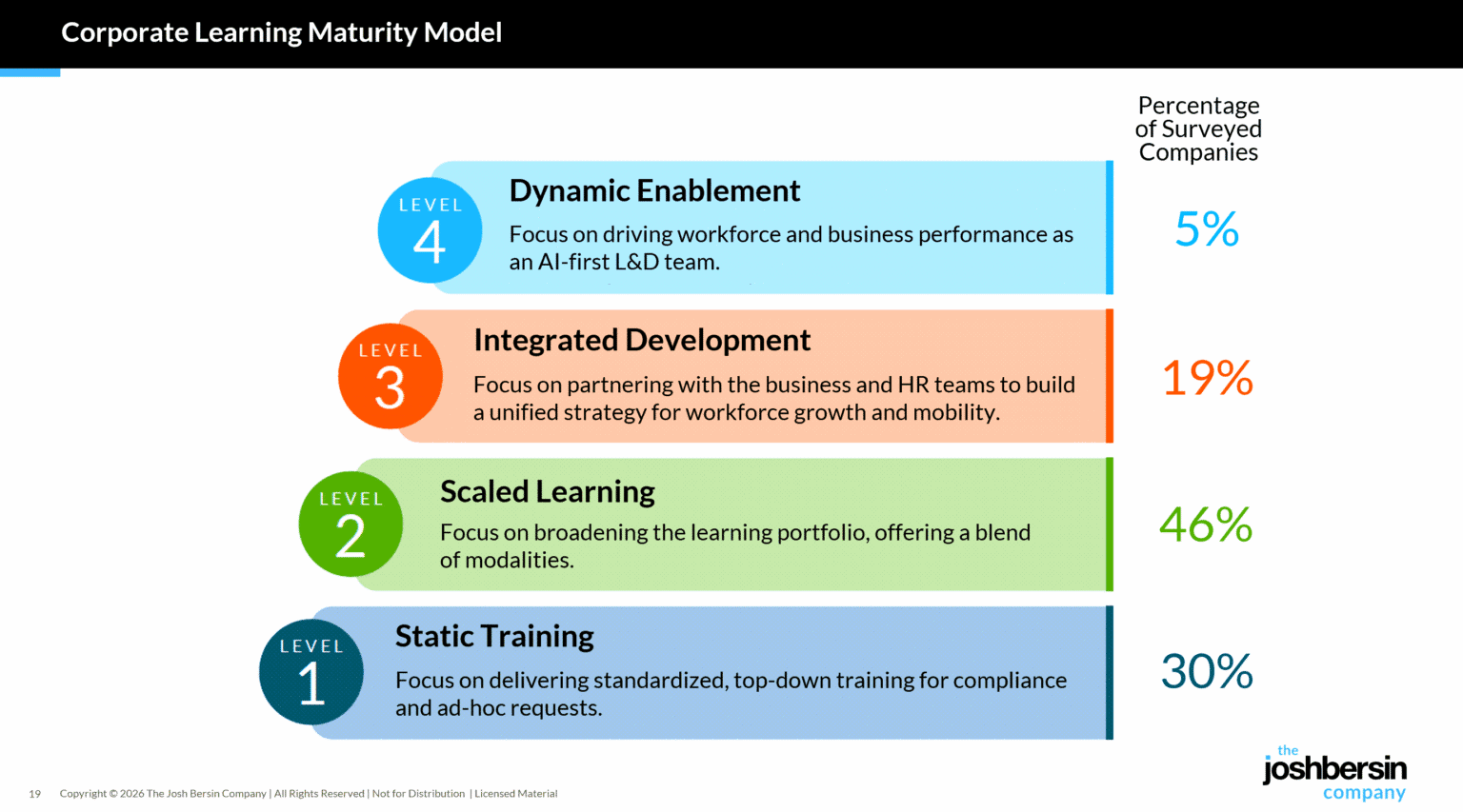
Credit: Josh Bersin
The math of management has shifted in ways most organizations haven't absorbed. Spans of control are expanding. Some managers in transforming enterprises are now responsible for 30, 50, even 80 direct reports, teams that would have been distributed across multiple layers a decade ago. AI is simultaneously changing what those teams do, often faster than anyone can document. When you have a large team, it's almost impossible for managers to remember multiple one on ones, and give meaningful feedback to each individual.
You don't learn tennis by watching the US Open, but by playing tennis with a coach adjusting you in the moment. It’s the same at work.
Managers who struggle to give hard feedback usually already know they need to give it. Employees who avoid a difficult conversation generally understand what that conversation should contain. The problem is that awareness does not reliably translate into behavior change, especially under pressure, in real situations, with specific people. Coaching needs to be anchored in the specific conversation that happened, with the specific person who was in the room. AI makes that possible at scale.
The most effective AI coaches attend the meetings, synthesize patterns across time, and give managers feedback grounded in what they actually did, calibrated to their specific patterns over time.
Bersin's 2026 research shows training has nearly doubled as a top HR priority year over year, from 5% to 9%. Budget is moving. The organizations that benefit most will be those that direct it toward infrastructure that changes behavior rather than content that gets consumed and forgotten.

.png)
.webp)
“Thank you for setting the great foundation for my promotion; now I have a plan!"


Curious to see how AI Coaching can 10X the impact and scale of your development initiatives. Book a demo today for: