
Blog article
10 HR predictions for AI in 2026: What CHROs told us
12 CHROs share what's reshaping HR in 2026: AI fluency, coaching, hiring fraud, and the end of cautious piloting.

Three of the world's largest companies are dismantling middle management at speed. The org chart is changing, so what happens to the people left behind, on both sides of the cut?
For most of the twentieth century, getting promoted into management was the signal that you had made it. The bigger the team, the more you mattered. It was the organizational grammar that everyone understood — the ladder you climbed, rung by rung, each direct report a proof point of your progress and worth.
That grammar is being rewritten, and for the tens of thousands of people who built their professional identities around it, the rewrite is personal.
The timing isn't coincidence. The work that defined the middle layer (synthesizing information upward, distributing decisions downward, tracking who's doing what, holding the context that made a team coherent) is the work AI just got good at. It's showing at a macro-level already.
Mark Zuckerberg has said it out loud, Bayer and Amazon are telling the same story in softer language. And the scaffolding employees relied on, someone who knew their work, noticed their patterns, gave them feedback in context, disappeared because AI made it economically viable to operate without it.
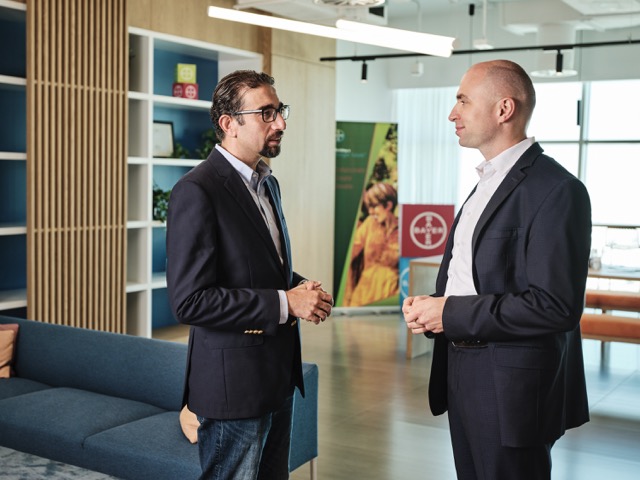
Three of the most recognized brands, Bayer, Amazon, and Meta, have all made dramatic, public commitments to flattening their management layers. Their motivations, methods and philosophies differ significantly, but the aggregate effect is the same: fewer managers, wider spans of control, and an entirely new set of expectations for everyone who remains, whether they used to have two direct reports or twenty. The throughline beneath all three is the same thesis: AI is making the coordination function of middle management economically optional, and the same technology is the only thing that can make the resulting org livable for the humans inside it.
When Bill Anderson arrived as CEO of Bayer in June 2023, he found a company with 11 to 12 layers of management, an average span of control of 6.5 people per manager, and an internal rulebook of 1,362 pages — about the length of War and Peace. More importantly, he found employees who loved the mission but felt unable to get anything done.
His diagnosis was structural, not personal. "It's not that the organization is healthy and then it gets a virus," he told Sequoia's Brian Halligan earlier this year. "The composition of the organization is what's creating bureaucracy." The layers. The functional silos. The decision gatekeepers four levels removed from the customer. Those were not symptoms of a broken system. They were the disease itself.
What followed was Dynamic Shared Ownership: a redesign built around a single proposition that the people closest to the customer should own the decisions. Layers went from 11 to 12 down to 6 to 7. Average span of control is now 14 and still rising, with some managers carrying 90 direct reports. Annual budgets were replaced with 90-day resource cycles. About 5,500 roles were eliminated, the vast majority in management. The internal rulebook was cut by 99%. (IMD's analysis of the model is worth reading in full: "How Bayer's dynamic path of shared ownership offers lessons for every leader.")
Early results are meaningful. Bayer's Chief Transformation Officer Michael Lurie reported in January 2026 that some customer teams had doubled revenues in a single 90-day cycle. A major product launch reached market a year ahead of schedule. A production line that once required 15 specialists now runs with 5, resolving in days problems that previously took six months to work through the approval chain.
But the numbers raise a question Bayer is now the first to answer at scale. A span of 6 was never an arbitrary figure, it was, roughly, the upper bound of how many people one human could meaningfully hold in their head: whose work they could understand, whose growth they could track, whose patterns they could notice in time to do something about. Spans of 14, 50, and 90 break that constraint.
At 90 reports, the role cannot be what it was. Reviewing work line by line, weighing in on every decision, knowing who is having a rough quarter, none of it is reachable through effort. So the role transforms. The manager is no longer the person rowing alongside the team or signing off on each output. They are steering the ship: making the hard escalation calls, setting priorities, deciding what gets resourced and what gets killed, and coaching the small number of people they can genuinely reach in any given week.
Everything else has to come from somewhere. This is the work an AI coach can credibly do, and at this scale, the only thing that can. Three jobs in particular:
Andy Jassy, CEO of Amazon, has been direct about what he thinks went wrong. Amazon hired aggressively through the pandemic years, layers accumulated, and the organization slowed in ways that frustrated the people inside it. "You add a lot of people and you end up with a lot of middle managers. And those middle managers, all well-intended, want to put their fingerprint on everything. So you end up with these people being in the pre-meeting, for the pre-meeting, for the pre-meeting, for the decision meeting," he told Bloomberg.
His response was a targeted campaign against organizational overhead. In September 2024, Jassy set a specific internal target: increase the ratio of individual contributors to managers by at least 15% by end of Q1 2025. Amazon hit it ahead of schedule, mostly by combining teams and demoting managers rather than through mass layoffs. A separate wave cut approximately 14,000 corporate roles in October 2025, explicitly framed around removing bureaucracy and reducing layers.
Where Amazon differs from Bayer is in what it is building toward. Jassy's stated ambition is to make Amazon "operate like the world's largest startup" fast, flat, builder-driven, with talented individuals moving quickly without interference. He also delivered a direct repudiation of the old career signal that will land differently depending on where you are in your career: "The path to a promotion at Amazon is not by taking charge of a massive team." Advancement through impact, not headcount.
For anyone who had spent a decade optimizing for the latter, that sentence carried real weight. What Amazon is implicitly betting on is that the coordination function those middle managers used to perform either isn't needed at startup speed, or can be supplied by tooling rather than headcount. Either way, the new org chart assumes a layer of capability that did not exist on it a few years ago.
Meta's flattening started as a financial correction. The company had over-hired during the pandemic boom, the advertising market softened, and Zuckerberg declared 2023 the "Year of Efficiency." Engineering managers were told they needed 20 or more direct reports and to spend at least 20% of their time coding. Thousands were given a choice: move to an individual contributor role, or leave.
By 2026 the story had shifted into something more consequential. Meta is cutting another 8,000 roles, and this time the rationale is not a correction of past excess but a deliberate reorganization around artificial intelligence.
Traditional job titles are being replaced with "AI builder," "AI pod lead," "AI org lead." The work middle managers used to perform, synthesizing information, coordinating across teams, drafting communications, summarizing decisions, is being automated. Zuckerberg has said that "projects that used to require big teams can now be accomplished by a single very talented person," and his CFO told investors the company is still evaluating what the optimal workforce size looks like in an AI-driven environment, which is another way of saying the cutting is not finished.
The clearest tell of where this is heading sits inside Meta itself. Within Meta Superintelligence Labs, the most AI-forward part of the company, where assumptions about what humans actually need to do are most aggressive, spans of control have reportedly stretched as wide as 50 to 1. That ratio is only coherent if you assume the coordination work has moved off the manager's plate and onto a system. Which is exactly the bet.
What distinguishes Meta from the other two is the underlying theory of the role itself. Bayer is redistributing decision-making to humans closer to the work. Amazon is clearing bureaucratic overhead so that talented individuals can move faster. Meta is replacing the coordination function with machines. The manager is not being redefined or redistributed, in Meta's model, for a growing category of work, the manager is being made structurally unnecessary.
Three groups are navigating the fallout simultaneously.
The urgent need looks different for each group, but it points toward the same gap: Employees who used to get regular feedback, context, and development from a manager who had time for them now need that support to come from somewhere else, and AI coaching at scale is the most credible answer, available on demand rather than rationed through a stretched manager's calendar. For the managers still in role, the challenge is not effort but signal: at 50 or 90 direct reports, you cannot track team dynamics, notice who is disengaging, or know whose work deserves recognition through human attention alone.
What they need is something that proactively surfaces where to show up, so that when they do have a conversation with someone, it is informed, timely, and genuinely useful rather than generic. The flattened org transfers real ownership to the people doing the work. The tools, like AI coaching, now need to make that ownership livable.
--
Image credit: Bayer
Sources:
Korn Ferry — Workforce 2025: Power Shifts report, survey of 15,000 professionals across 10 countries. Two figures used: 41% of employees say their company trimmed management layers in 2024–25, and 37% of employees who lost their immediate manager reported feeling directionless.
Gartner — October 2024 report: one in five businesses expected to use AI to flatten structures, cutting over half of middle management positions by 2026.
Bill Anderson — Sequoia Capital / Long Strange Trip podcast with Brian Halligan, February 2026. Quote on bureaucracy as composition, not virus.
Michael Lurie — "How Bayer's dynamic path of shared ownership offers lessons for every leader," IMD, January 2026. Revenue doubling, product launch, production line figures.
Andy Jassy — Bloomberg interview (date not specified in article). Quote on middle managers putting their fingerprint on everything.
Andy Jassy — Amazon internal all-hands / shareholder communications, 2025. Target of 15% ratio shift, October 2025 14,000 role cuts, promotion statement.
Mark Zuckerberg / Meta CFO — Public statements 2025–2026. Single talented person quote, AI role restructuring, CFO workforce size comment.

.png)
.webp)
“Thank you for setting the great foundation for my promotion; now I have a plan!"

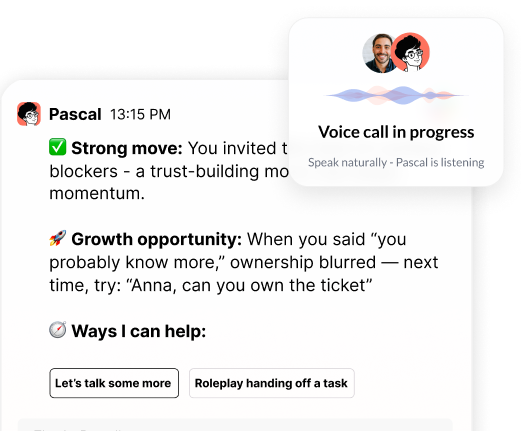
Curious to see how AI Coaching can 10X the impact and scale of your development initiatives. Book a demo today for: