Blog article
AI-generated “Workslop” is undermining productivity
AI-generated “workslop” looks polished but wastes time, erodes trust, and costs millions in lost productivity.


Insights from Pinnacle's CHRO Roundtables
AI changed the game for HR in 2025. AI became agentic and autonomous, connecting directly to business tools through new protocols, with new approaches taking hold, such as voice AI and multimodal use cases. By year's end, over 80% of business leaders said they expect to use AI agents to expand workforce capacity, and Microsoft projected 1.3 billion agents by 2028.
The human side moved just as fast. Ninety-seven percent of employees now prefer asking ChatGPT for advice over asking their boss. Shadow tool use outpaces official adoption two to one. Seventy-two percent of S&P 500 companies flag AI as a material board-level risk. And the structural effects are showing up: entry-level hiring in public tech dropped from 15% to under 7%, promotions are down 8%, and more than half of companies are planning workforce reductions this year. [will include sources in final.
.jpg)
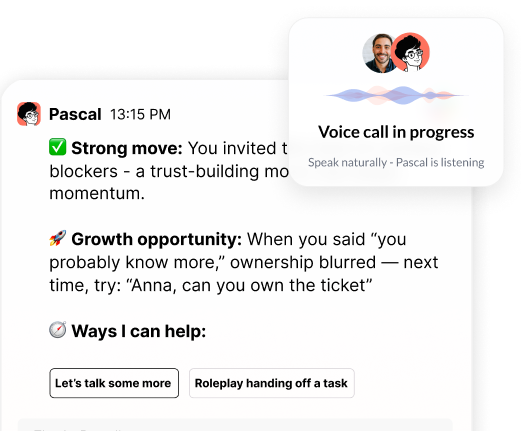
Pinnacle builds Pascal, an AI coaching platform that delivers real-time leadership coaching inside Slack, Teams, and live meetings for enterprise organizations. Sitting at the intersection of AI, talent development, and the daily realities of how managers lead, we have a front-row seat to the shifts reshaping HR and the workforce. To deepen that perspective, we hosted a series of roundtable conversations with 9 senior people executives from companies like PepsiCo, Okta, Zillow, Zapier, ZoomInfo, Royal Caribbean, and AMC Networks. They shared what they are investing in, what challenges they see on the horizon, and where they think AI will create the biggest shifts across HR and their workforces in the next twelve months.
Here is what we heard:
If there was one point of near-universal agreement, it is this: the technology is ready, but the plumbing is not. Multiple leaders identified data integrations as the single most important priority for the year ahead. These data foundations will be a prerequisite for unifying previously siloed AI teams and initiatives. Those that get it right this year will see very different results than what most companies saw in 2025
"For us, it's about integrations, because once we've integrated all of our main tools into our AI tool, it unlocks so much more productivity, different use cases, and more autonomous agents." — Satu Salminen, VP of AI Transformation, ZoomInfo
The emergence of MCP (Model Context Protocol), Agent-to-Agent (A2A) and similar connectivity standards is making this work easier, but most organizations are still early in connecting their core systems to AI tools.
A recurring theme was the problem of tool fragmentation. Companies have built chatbots and AI tools across functions, but employees do not know which one to use or where to find them.
"We have a bunch of bots that we've created. We don't have one agent to rule them all right now, so the issue is people are not going to know which bot to go to, or they won't remember." — Vijay Rao, former Chief People & Places Officer, Okta
Several leaders predicted that 2026 will see the rise of a single AI interface that acts as a routing layer, directing employees to the right tools and agents without forcing them to search through a mess of disconnected bots. Think of it as one front door to all of HR.
Just a year ago, many employees were embarrassed to admit they were using ChatGPT at work.
People weren’t saying, ‘I used ChatGPT to think through this problem or help draft something.’ Now it’s, ‘Why didn’t you just use ChatGPT?’” — Lori Stahl, CPO, Synaptics
Jordan Backman, EVP of Human Resources at AMC Networks, pointed to the next step: embedding AI expectations directly into job descriptions, candidate screening, and manager accountability. He noted that McKinsey has started including an AI test for new consulting hires, a sign that AI proficiency is quickly becoming a formal job requirement.
But leaders warned of a new problem on the other end: "AI workslop," where employees lean on AI so heavily that their work loses any original thought, or doesn’t have meaningful intention behind it. The challenge now is helping employees find the middle ground: using AI frequently, but with intention.
Every company says they want their employees to be AI-literate. Very few have defined what that means in practice.
"Companies are going to have to, at some point, define what is AI fluency in their organization. Everybody's definition of how knowledgeable they are is wildly different. And if they don't use it, the number one answer is: I don't know how it's relevant to my work." — Maggie Ruvoldt, CHRO, Learn Behavioural
The challenge runs deeper than awareness. Leaders agreed that fluency needs to be defined by role, and that even within functions like engineering and product, determining what "good" looks like is harder than it sounds. And it keeps changing. But defining fluency is only the starting point. How companies recognize, reward, and organize roles around AI will matter as much as how they teach people to use it. Multiple leaders expect 2026 to be the year AI policies finally make it into employee handbooks.
Two of the most AI-forward companies in the room, Zapier and ZoomInfo, described nearly identical approaches to AI enablement, and neither involves traditional learning and development. AI is simply moving too fast to teach with courses - experimentation and learning while you work are the dominant modalities.
"We don't do traditional L&D for AI enablement. We focus instead on practical, dynamic, and hands-on use cases. It looks like: what's the number one thing that you or your team are already accountable for, where you're good but need to be great? And then the question is, what are all the ways where AI could help us take a big step forward?" — Brandon Sammut, Chief People & AI Transformation Officer, Zapier
Satu Salminen described a similar philosophy at ZoomInfo: "We also don't really use a traditional L&D approach in our AI enablement. Our AI tools evolve so quickly with new features pretty much every week, that creating static resources would get obsolete pretty quickly." Her approach: ask people to bring their most frustrating task, and solve it together with AI tools, to learn in practice.
Erin Faverty, COO of PeopleTech Partners, connected this to a broader workforce shift: as AI automates more tasks, the value of any role is moving toward decision-making and critical thinking, and that shift is reaching further down the org chart every year. Junior employees who were once hired to execute are now expected to think strategically, and training has to keep pace.
Other organizations are taking a more structured route with certifications and gamified engagement, including daily Slackbot prompts on how to write better AI prompts.
The takeaway: there is no single right model, but the old playbook of courses and certifications is losing ground to hands-on, learning in the flow of work.
Several leaders pointed to AI-powered coaching for managers as the highest-potential application they are investing in this year. This trend mirrors Gartner research to be published later this year that 74% of HR leaders are deploying or planning to deploy digital coaching applications.
There was agreement that the best AI coaches have unmatched context. Leaders want AI coaches that understand the specific team dynamics, individual communication styles, and real relationships in the room. The most advanced coaches are even embedded in meetings or within Slack/Teams, so they gather nuance without having to rely on user input. The goal is coaching that is personalized to the actual people involved, not generic management advice.
"The biggest transformation for managers is AI coaching. Managers having a coach at their fingertips every step of the way to navigate their days is impactful. Navigating everything from tough situations, feedback conversations, role-playing, and building out profiles on their team." — Corina Kolbe, VP of Talent Success, Zillow
AI sourcing tools are good enough now that recruiters are being empowered to execute across the full recruitment cycle, from sourcing to hiring. Large enterprise organizations are shifting talent acquisition team structures accordingly. Blair Bennett, SVP of Global Talent Acquisition at PepsiCo, confirmed that AI tools are enabling recruiters to enhance their talent advisory skills through more advanced sourcing capabilities:
"We did a big org change and operating model change last year, and we anticipated that. No [standalone] sourcers in the new org structure supporting our professional hiring efforts — Blair Bennett, SVP of Global Talent Acquisition, PepsiCo
But as AI takes on more of the top-of-funnel work, leaders are drawing a clear line on where it stops. The emerging consensus: AI can move candidates forward in the process, but every rejection needs a human review.
"All the yeses can automatically move forward, but all the no's have to be reviewed by somebody. Decision-making to reject someone is still going to be part of it, and I don't think anybody's going to let it make a final hiring decision." — Maggie Ruvoldt, CHRO, Learn Behavioural
The reasoning is both ethical and practical. Nobody wants to be the test case in a state court challenge over AI-driven hiring discrimination. Regulation is still catching up and the first legal test cases have launched, but leaders are already drawing these boundaries on their own.
This one caught several participants by surprise. Fake resumes, fake candidates, and even fake job postings are growing rapidly, and few companies have a plan for it.
One leader put it bluntly: fraud is going to be huge this year. Another shared a story that shocked the group: candidates had been scammed out of thousands of dollars through fake job postings that looked identical to real company listings. Scammers created fake Indeed ads, conducted fake onboarding, and then asked candidates to purchase home office equipment with a promise of reimbursement that never came.
On the employer side, multiple leaders described fake candidates flooding their pipelines and wasting recruiters' time at unprecedented levels. Erin Faverty, COO of PeopleTech Partners, framed the stakes bluntly: in tech and other industries, this is becoming an existential threat, because some of it is not just fake bots, it is bad actors including organized fraudsters who are getting hired in and gaining access to sensitive data. Innovation is coming in these areas, but organizations need to bring in tools to solve for this new threat.
Regulation came up with a mix of resignation and anxiety. A growing patchwork of state and country-level AI regulations is emerging, and enterprise companies with global workforces are already feeling the complexity.
"It could likely end up being based on what vertical you're in. If you're in the banking space, you don't have a choice. You're gonna have to have it buttoned down. If you're in something more creative, you've got less restrictions." — Mike Theilmann, Former CHRO, Albertsons
Operating across dozens of countries means any new regulation in even a few jurisdictions creates real friction for companies trying to build responsibly. Meanwhile, companies are self-assembling internal AI governance boards and even bringing in external AI ethics committees to stay ahead of whatever rules arrive.
This is the year the CFO starts holding People teams accountable for the efficiency gains they promised. Multiple leaders said their 2026 budgets already reflect expected AI savings, with specific headcount and vendor reductions tied to AI adoption. "Not backfilling" was the most common phrase used to describe workforce planning in 2026. The pressure to show real returns on AI investment is rising fast.
But delivering those results requires answering a question most companies have been avoiding: who actually owns AI transformation? With AI touching every part of the employee experience, the question of ownership is becoming impossible to ignore. Whoever leads, they have to consider not only the technology itself but the change management.
“If somebody else is going to own it, they need to really be pushing and helping with the transformation. Getting training for people, making sure engagement is there, sharing best practices. I have been lucky at Tekion to have a great partnership with strong success, but I know that the cross-functional requirements for moving at speed towards this transformation is causing challenges at many companies right now.” — Rana Robillard, CPO, Tekion
At many companies, IT departments are not prioritizing employee engagement or training around AI, but they are also not open to HR taking full ownership. This tension will come to a head in 2026 as CFOs demand measurable progress and neither function can deliver it alone.
Across these conversations, one thing was clear: 2026 is the year AI becomes infrastructure, not just another initiative or experiment. The technology is ready. The budgets reflect it. The pressure from the C-suite is real. And the workforce is watching to see whether AI makes their work better or makes them expendable.
The window for cautious piloting is closing. CFOs are building AI savings into headcount plans. Regulators are circling. Employees have already adopted the tools on their own terms. The question is no longer whether AI will reshape HR and the workforce. It is whether people leaders will shape how it happens, or react after the fact.
As Ana Maria Sencovici, Chief Talent Officer at Royal Caribbean, put it: "AI is shining a bright light on all the gaps across our field. And that is arguably a good thing."
The leaders who will define this year are the ones who stop piloting and start building: with clear definitions of what fluency looks like, a unified technology layer, coaching and enablement that meets people where they work, and the trust of their workforce. Everyone else will spend the year catching up.
%20(2).png)
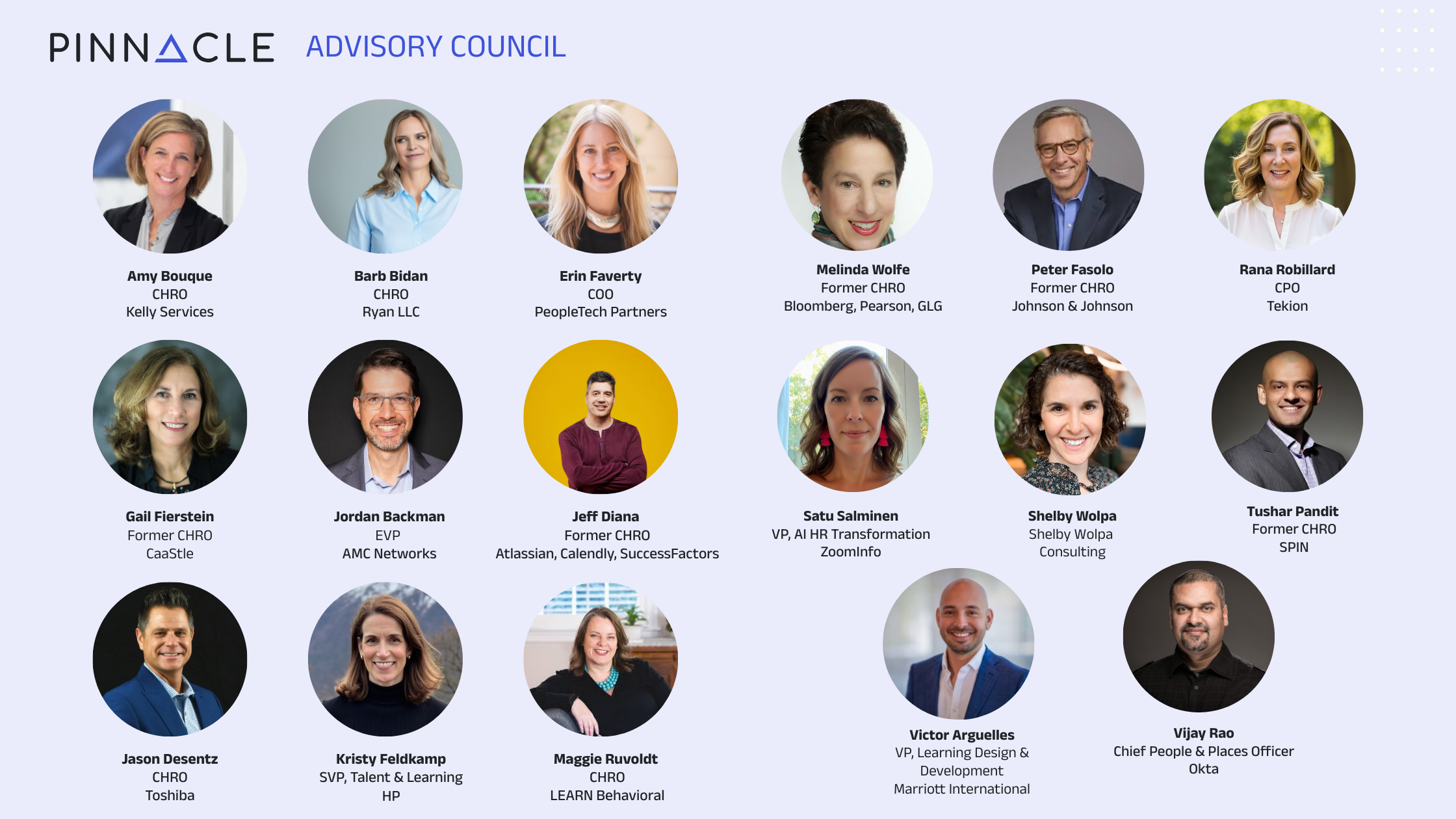
Pinnacle thanks the following leaders for sharing their time and insights:
Ana Maria Sencovici, Chief Talent Officer, Royal Caribbean
Blair Bennett, SVP, Global Talent Acquisition, PepsiCo
Brandon Sammut, Chief People & AI Transformation Officer, Zapier
Corina Kolbe, VP, Talent Success, Zillow
Gail Fierstein, Former CHRO, CaaStle
Jordan Backman, EVP, Human Resources, AMC Networks
Lori Stahl, CPO, Synaptics
Maggie Ruvoldt, CHRO, Learn Behavioural
Mike Theilmann, Former CHRO, Albertsons
Rana Robillard, CPO, Tekion
Satu Salminen, VP, AI Transformation, ZoomInfo
Vijay Rao, former Chief People & Places Officer, Okta

.png)
.webp)
“Thank you for setting the great foundation for my promotion; now I have a plan!"

Curious to see how AI Coaching can 10X the impact and scale of your development initiatives. Book a demo today for: