

AI fluency—the ability to recognize where AI adds value, use it effectively, and lead teams through AI-driven change—isn't something managers develop by attending a workshop or reading a guide. It develops through consistent, real-time practice in actual work situations, supported by guidance that meets them exactly when they need it. AI coaching platforms that integrate into daily workflows are proving to accelerate this development dramatically, turning abstract knowledge into applied skill.
Quick Takeaway: AI coaching builds genuine AI fluency through three core mechanisms: integrating into daily work where managers already operate, providing just-in-time guidance tied to real situations, and creating consistent practice loops that transform knowledge into behavior change. Organizations that prioritize contextual, proactive AI coaching see managers reaching baseline competency 2-3 times faster than traditional training approaches.
The gap between knowing about AI and actually using it effectively defines the current challenge in most organizations. Only 36% of employees feel adequately trained on AI, largely because traditional training relies on slide decks rather than experiential learning grounded in real work. Yet 79% of employees receiving more than five hours of AI training become regular users, compared to 67% with less exposure. The message is clear: time matters, but how that time gets spent matters more.
AI fluency means recognizing where AI adds value, using AI tools effectively for specific challenges, and leading teams through AI-driven change. Most managers understand AI conceptually but lack confidence born from hands-on practice in contexts that matter to their work.
The 70-20-10 learning model shows 70% of learning comes from hands-on challenges, 20% from peer relationships, and 10% from formal training. Yet most organizations invert this ratio, front-loading classroom content while managers lack protected time to actually practice with AI in their daily work. This structural mismatch explains why adoption stalls despite significant training investments.
Traditional training disconnects learning from application. A manager sits through a workshop on prompt engineering, returns to their inbox, and encounters a situation where AI could help but doesn't remember the frameworks or feel confident enough to experiment. The knowledge remains theoretical rather than becoming muscle memory. Managers develop fluency through repeated, low-stakes practice with feedback, not through workshops disconnected from their daily work.
In-the-flow learning arrives during or immediately after the triggering event—when context is fresh, motivation is highest, and application is immediate. Traditional training delivers knowledge in batches, disconnected from when managers need it.
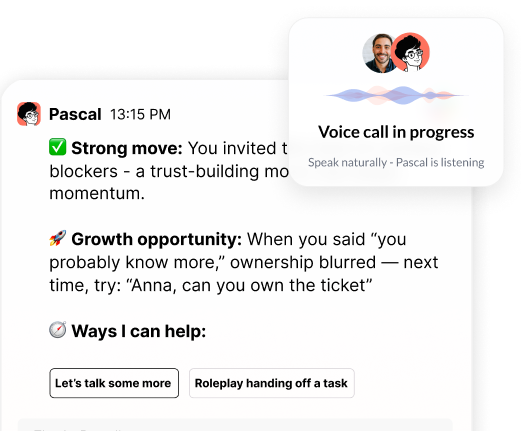
Proactive AI coaches that meet managers in Slack, Teams, and meeting tools achieve 75%+ regular usage versus 51% for on-demand tools. After a team meeting, proactive coaches deliver real-time feedback while context is fresh, creating tight feedback loops that drive behavior change faster than annual reviews.
Managers develop skills through repeated practice and reinforcement in real situations, not just when problems escalate. When a manager completes a delegation conversation and receives specific feedback within minutes—while context is still fresh—the opportunity for behavior change is immediate. This practice-feedback-iteration loop compresses the learning timeline dramatically compared to traditional approaches.
HubSpot's weekly peer sharing sessions called MondAI Minute create social proof that normalizes AI adoption across organizations. When managers see colleagues successfully using AI, the perceived barrier drops significantly.
When employees strongly agree their manager encourages AI use, their odds of being frequent AI users are 3.1 times higher. This underscores that manager fluency directly influences team adoption.
Proactive AI coaching observes real work moments—meetings, emails, team interactions—and surfaces guidance before managers realize they need it, creating consistent development habits rather than crisis-only support.
Pascal maintains 94% monthly retention with an average of 2.3 coaching sessions per week, indicating sustained habit formation rather than sporadic use. 83% of direct reports see measurable improvement in their manager's effectiveness when using contextual AI coaching. After a delegation attempt or feedback conversation, coaches deliver specific, actionable feedback within minutes while the learning moment is still fresh.
Consistent, timely intervention compresses manager ramp time from 12-18 months to significantly faster effectiveness. Rather than waiting for managers to recognize they need help and seek it out, effective AI coaching identifies opportunities and delivers relevant guidance automatically. This proactive approach creates the consistent touchpoints that build coaching relationships and reinforce behavior change.
Contextual AI coaches that integrate with HRIS, performance systems, and communication tools understand each manager's people, goals, and work patterns, eliminating friction and enabling personalized guidance that feels immediately relevant.
58% of L&D professionals believe AI enhances leadership training when it provides adaptive, contextual content delivered on-demand, according to recent research on AI coaching effectiveness. Generic AI tools provide lowest-common-denominator advice because they lack organizational context; contextual platforms integrate performance reviews, team dynamics, and company culture. When Pascal knows a manager's direct report's communication style, recent feedback, and career goals, coaching becomes tailored to that specific relationship.
Managers experience coaching as a trusted partner who already understands their situation, driving higher adoption than systems requiring data entry. This contextual depth eliminates the friction that kills adoption with lower-level solutions. Managers don't need to repeatedly explain their situation because Pascal already knows their team composition, current projects, performance challenges, and development goals.
Culture determines whether managers view AI as a threat to avoid or an opportunity to embrace; organizations that frame AI as augmentation and embed AI expectations into performance frameworks see dramatically higher fluency development.
Organizations like Zapier embed AI fluency into hiring, onboarding, and performance reviews, making coaching proficiency part of how the company defines effective leadership. Peer sharing rituals where managers demo successful AI use cases create visibility that normalizes adoption across organizations.
"With AI you can delegate the work, you cannot delegate the accountability."
When leadership explicitly positions AI as a tool that makes human judgment more valuable—not less—managers embrace it. HR teams that position themselves as enablers rather than enforcers build trust and sustained engagement.
Pascal combines purpose-built coaching expertise, contextual awareness of your people and workflows, and proactive engagement to transform managers from uncertain about AI to confident, independent users who naturally integrate AI into how they lead.
Purpose-built design means Pascal draws from 50+ leadership frameworks and people science rather than generic internet knowledge. Contextual integration with your HRIS, performance data, and meeting transcripts enables personalized guidance grounded in actual situations. Proactive surfacing of coaching moments means managers receive guidance before they realize they need it.
Guardrails that escalate sensitive topics to HR while building manager confidence for routine challenges protect both organization and employees. One technology company estimated saving 150 hours across 50 employees in their initial rollout. Workflow integration in Slack, Teams, and Zoom means coaching happens where managers already work.
| Outcome | Traditional Training | Proactive AI Coaching |
|---|---|---|
| Manager adoption rate | 20-30% engagement | 75%+ regular usage |
| Monthly retention | Drops after 2-3 months | 94% sustained engagement |
| Colleague-reported improvement | Varies widely | 83% report measurable improvement |
| Manager NPS lift | Minimal change | 20% average increase |
These outcomes stem from coaching grounded in real situations rather than abstract scenarios in training rooms.
"This was the first time I've done any leadership/management training. I thought it was helpful and the personalized touch was great."
The managers who develop real AI fluency aren't those who attend training workshops. They're the ones who practice with real-time, contextual coaching integrated into their daily work. Pascal delivers exactly that—proactive guidance in Slack and Teams, personalized to your people and culture, with escalation protocols that keep sensitive issues human-centered.

.png)
.webp)
“Thank you for setting the great foundation for my promotion; now I have a plan!"

Curious to see how AI Coaching can 10X the impact and scale of your development initiatives. Book a demo today for: