

AI coaching transforms difficult conversations from anxiety-inducing events into structured development opportunities. It provides pre-conversation preparation, real-time guidance during interactions, and behavioral feedback afterward. This continuous support loop converts every challenging moment into a repeatable learning experience that builds manager capability over time.
Most managers avoid difficult conversations because they lack confidence in handling emotional reactions and fear damaging relationships. DDI's 2023 Global Leadership Forecast found only 14% of managers feel their organizations provide adequate training for difficult conversations. Traditional training happens weeks before or after the conversation, leaving managers to navigate the actual moment alone.
The preparation gap creates the first barrier. Managers attend workshops but can't translate generic frameworks to their specific team dynamics. A two-day leadership program might teach the SBI model (Situation-Behavior-Impact), but it doesn't prepare you for the moment when your senior engineer interrupts you mid-sentence and storms out.
The confidence crisis compounds the problem. Without practice, managers either avoid conversations entirely or handle them poorly. Gallup's State of the American Manager report shows that 70% of the variance in team engagement comes down to the manager. When managers fumble critical conversations, entire teams disengage.
The timing problem exposes the fundamental flaw in traditional development. Human coaches can't be present in every meeting where learning moments occur. You might have a great coaching session on Tuesday, but the difficult conversation happens Thursday afternoon when your coach is working with someone else.
The cost barrier makes traditional coaching inaccessible. Executive coaching costs $300-500 per hour (International Coach Federation, 2023), making it accessible only to senior leaders. Your frontline managers—the ones having the most difficult conversations—get a two-hour workshop and a PDF handout.
AI coaching tools analyze relationship history, simulate specific conversations with realistic role-play, and generate personalized talking points based on communication patterns. This contextual preparation accounts for past interactions, team dynamics, and organizational values.
Contextual analysis forms the foundation. Tools like Pascal review meeting transcripts, Slack conversations, and interaction patterns to understand the full relationship context. If you're preparing to address performance issues with a team member, the system knows you've already had three conversations about missed deadlines, that the employee becomes defensive when receiving feedback in group settings, and that your last one-on-one ended with unclear action items.
Realistic simulation changes how managers practice. Advanced AI coaching can simulate the actual person based on their real communication style and behavior patterns. You're not practicing with a generic "difficult employee"—you're practicing with a simulation of Marcus, who tends to deflect criticism by bringing up unrelated projects where he performed well.
Personalized scripts align with your communication style and organizational values. The system generates talking points that sound like you, not like a corporate handbook. If your organization values direct communication, the guidance reflects that. If your culture emphasizes collaborative problem-solving, the approach shifts accordingly.
Example scenario: A manager needs to address a senior engineer's pattern of dismissing junior team members in meetings. The AI coaching tool reviews three months of meeting transcripts, identifies specific examples with timestamps, simulates the engineer's likely defensive responses, and helps the manager practice maintaining composure while delivering clear behavioral expectations. The manager enters the conversation prepared for "But I'm just trying to maintain code quality" and has practiced responding with "I appreciate your commitment to quality, and I need you to express concerns without dismissing people in front of the team."
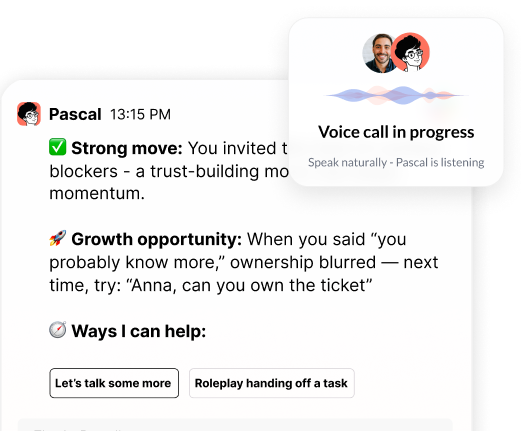
AI coaching provides discreet, real-time prompts during live conversations through meeting integrations. It suggests reframes when discussions become heated, reminds managers of key points they intended to cover, and flags moments when the conversation veers off track.
Meeting integration makes real-time coaching possible. The system joins Zoom, Google Meet, or Teams calls to observe conversation dynamics. It observes to provide support, similar to how a human coach might sit in on a difficult conversation to provide feedback afterward.
Guidance arrives via sidebar or mobile device without disrupting conversation flow. When you're in the middle of a performance conversation and the employee says "This feels like you're attacking me," the system might prompt: "Acknowledge their feeling, then refocus on specific behaviors." You maintain eye contact and conversational flow while receiving expert guidance.
Pattern recognition identifies when managers fall into common traps. Over-explaining happens when managers feel uncomfortable with silence. Getting defensive occurs when employees challenge the feedback. Avoiding the core issue shows up when managers spend 20 minutes discussing minor points before addressing the real problem. The system flags these patterns in real time.
Behavioral nudges remind managers to pause for responses, ask open-ended questions, or acknowledge emotions. These aren't scripts to read—they're gentle redirects that keep conversations productive. "You've been talking for three minutes. Ask a question" is more valuable than any feedback framework you learned in training.
This isn't about reading from a script. It's about having a trusted advisor observing the conversation and providing course corrections when needed—something human coaches physically cannot do at scale.
Post-conversation feedback from AI coaching accelerates learning by providing immediate behavioral analysis, identifying specific moments where the manager could have been more effective, and tracking improvement patterns over time.
Immediate analysis delivers feedback within minutes of conversation completion, while details are fresh. You don't wait two weeks for your next coaching session to discuss what happened. The system provides feedback before you've even left the meeting room, when you can still remember what you were thinking and feeling.
Specific examples point to exact moments with timestamps. "At 14:32, when the employee became defensive, you shifted to explaining rather than listening" is actionable feedback. "You need to listen more" is not. The system identifies the precise moment where the conversation shifted, what triggered the shift, and what alternative approach might have worked better.
Pattern tracking identifies recurring behaviors across multiple conversations, revealing blind spots managers can't see themselves. You might not notice that you consistently avoid addressing emotional reactions, but the system tracks this pattern across ten difficult conversations and surfaces it as a development area.
Competency mapping links conversation performance to organizational leadership competencies and development goals. If your company values "Develops Others" as a core competency, the system shows how your feedback conversations demonstrate (or don't demonstrate) that competency in action.
Gallup's research shows that managers who receive regular feedback on their performance are 3.2 times more likely to be engaged at work. AI coaching makes this feedback immediate and specific rather than delayed and generic.
AI coaching differs from traditional feedback training by providing practice-based learning with real-time feedback rather than content consumption. It meets managers in their actual workflow rather than pulling them into classrooms, and adapts to individual learning curves rather than delivering one-size-fits-all programs.
Practice-based learning allows managers to rehearse actual conversations repeatedly until confident. This mirrors how you'd learn a language through conversation rather than films. You don't become fluent by watching French movies—you become fluent by speaking French with someone who corrects your mistakes in real time. The same principle applies to difficult conversations.
Workflow integration brings support to Slack, Teams, or meeting tools where managers already work. There's no separate platform to remember, no login credentials to find, no switching between systems. The coaching exists where work happens, which is why managers use it rather than letting it gather digital dust.
Adaptive guidance adjusts coaching intensity based on manager experience level and conversation complexity. A first-time manager preparing to deliver critical feedback receives more structured support than a director handling a routine performance discussion. The system recognizes context and calibrates accordingly.
Continuous reinforcement happens through every interaction. Traditional training delivers content once, maybe with a refresher six months later. AI coaching reinforces concepts every time you prepare for a conversation, receive real-time guidance, or review feedback. Learning becomes continuous rather than episodic.
When evaluating AI coaching platforms, focus on three areas: technical capabilities, privacy and security, and integration with existing systems.
Technical capabilities to assess:
• Does the tool provide pre-conversation simulation with realistic role-play, or just generic scripts?
• Can it integrate with your meeting platforms (Zoom, Teams, Google Meet) for real-time guidance?
• Does it offer post-conversation analysis with specific timestamps and actionable feedback?
• How does it adapt to different manager experience levels and conversation types?
Privacy and security questions:
• What data does the system collect and store?
• Who has access to conversation recordings and transcripts?
• Is the platform SOC2 compliant?
• Does the vendor train AI models on your company's data?
• How is employee consent handled for recorded conversations?
Integration considerations:
• Does it work within tools your managers already use (Slack, Teams, email)?
• Can it connect to your HRIS and performance management systems?
• What implementation support does the vendor provide?
• How long does deployment typically take?
Start with a pilot group of managers who volunteer to participate. Collect their feedback after 60-90 days. Measure both usage rates (are managers actually using it?) and outcome metrics (are difficult conversations improving?). Scale based on demonstrated value rather than executive mandate.
• AI coaching transforms difficult conversations into learning opportunities through preparation, real-time guidance, and immediate feedback—creating a continuous development loop that traditional training cannot match.
• Managers avoid difficult conversations because they lack confidence, fear emotional reactions, and receive no support in the moment. AI coaching addresses all three barriers.
• Real-time meeting integration provides discreet prompts during live conversations, helping managers navigate defensive reactions, maintain focus, and apply coaching principles in the moment.
• Post-conversation feedback with specific timestamps and pattern tracking accelerates skill development by connecting actions to outcomes while details are fresh.
• When evaluating AI coaching tools, prioritize technical capabilities, privacy protections, and workflow integration over marketing claims.
Ready to turn every difficult conversation into a development opportunity? Explore how Pascal delivers real-time coaching where your managers work—in Slack, Teams, and live meetings.
Header photo by Vitaly Gariev on Unsplash

.png)
.webp)
“Thank you for setting the great foundation for my promotion; now I have a plan!"

Curious to see how AI Coaching can 10X the impact and scale of your development initiatives. Book a demo today for: