

AI coaching changes manager behavior because it delivers guidance at the moment of need, adapts to individual challenges, and reinforces learning through continuous practice. But it's not right for every organization. This framework helps you evaluate whether AI coaching will outperform your current training investment—or whether you should stick with what you have.
Traditional training violates how adults learn. LMS platforms see 5-15% engagement within six months. Managers who complete courses forget 70% of content within 24 hours without reinforcement. The problem is timing: training happens in scheduled blocks disconnected from real work.
The forgetting curve destroys workshop insights within days. Managers attend a two-day leadership program, return to their desk, and urgent emails erase what they learned. Without reinforcement, the investment evaporates.
Generic frameworks don't help with specific problems. A module on "difficult conversations" doesn't help when you're facing a team conflict at 3 PM on Tuesday. The gap between abstract principles and concrete application is where training dies.
The utilization crisis is worse than most CHROs realize. LinkedIn Learning and similar platforms average 8-12% monthly active usage. You're paying for content libraries that 88-92% of your managers never touch. Completion rates don't measure behavior change—they measure who clicked through slides.
AI coaching operates on continuous, contextual reinforcement in the flow of work. The difference isn't delivery mechanism—it's a shift from information provision to behavior change support.
Three mechanisms drive effectiveness. Temporal proximity delivers guidance within minutes of the triggering event (a tense meeting, a delegation challenge) when context is fresh and motivation to improve is highest. Spaced repetition replaces single 2-hour workshops with dozens of micro-coaching moments over weeks. Adaptive scaffolding adjusts difficulty and focus based on demonstrated competencies, unlike static curricula that assume uniform starting points.
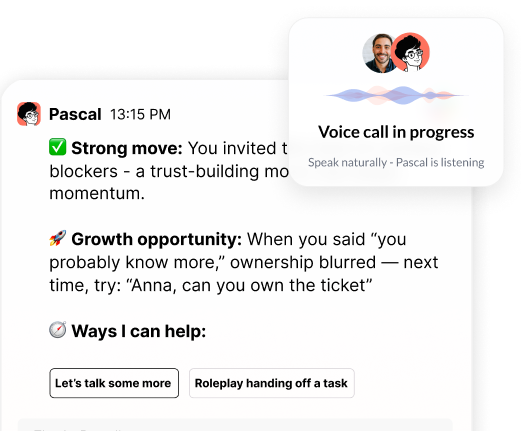
Here's what this looks like in practice: A manager finishes a difficult performance conversation at 2 PM. Within five minutes, the AI coach sends a Slack message: "I noticed you gave feedback on the project delay. Here's how you could have structured that conversation to focus on future improvement rather than past mistakes." The manager gets specific guidance while the conversation is fresh, practices the revised approach in their next 1:1, and receives follow-up coaching on their progress.
Pascal integrates with Slack, Teams, and Zoom to provide feedback after meetings, suggest conversation approaches before 1:1s, and reinforce your organization's leadership competencies in real scenarios. This isn't a chatbot waiting for questions—it observes patterns and intervenes at the right moments.
AI coaching fails in five scenarios. If any of these describe your organization, fix the underlying issue before investing in AI coaching.
You have fewer than 100 managers. The ROI math doesn't work for small populations. Traditional coaching or peer learning circles will deliver better results. AI coaching scales efficiency, but you need scale to benefit.
Your managers don't use Slack, Teams, or similar tools daily. AI coaching works in the flow of work. If your managers live in email or offline, they won't engage with an AI coach in collaboration tools. Fix your communication infrastructure first.
You lack basic performance management processes. AI coaching reinforces good management practices—it doesn't create them from scratch. If you don't have clear expectations, regular 1:1s, or feedback norms, start there. AI coaching amplifies existing practices, it doesn't replace foundational HR work.
Your executive team won't use it. If your C-suite doesn't model continuous development, managers won't adopt it either. AI coaching requires cultural buy-in from the top. Without executive sponsorship, you're wasting money.
You're looking for a compliance training solution. AI coaching develops skills, it doesn't deliver mandatory training. If you need harassment prevention, safety protocols, or regulatory compliance, you still need traditional training. AI coaching handles the "how to be a better manager" work, not the "here's what the law requires" work.
Most CHROs underestimate total costs by focusing on platform fees while ignoring utilization rates and opportunity costs. A complete cost analysis reveals where budget is wasted on solutions that don't drive behavior change.
Direct costs include LMS platform fees ($15-50 per user annually), content library subscriptions, live training delivery (instructor fees, venue, travel), executive coaching contracts ($3,000-15,000 per person annually), and HRBP time spent on routine manager guidance (150+ hours annually).
Hidden costs multiply the damage. Low utilization rates mean you're paying for unused licenses. Manager time in ineffective training represents hourly rate × training hours × percentage of forgotten content. Delayed problem resolution costs accumulate when managers wait for the next training cycle instead of getting immediate support.
Example for a 500-person tech company:
• LMS platform: $25,000/year with 12% utilization = 60 engaged managers, or $417 per engaged user
• Executive coaching: 20 leaders × $8,000 = $160,000 (leaving 480 managers unsupported)
• HRBP manager support: 3 HRBPs × 150 hours × $75/hour = $33,750
• Total: $218,750 for partial coverage and minimal behavior change
AI coaching reaches all 500 managers at approximately $50-75 per user annually ($25,000-37,500 total). Organizations report 150+ hours saved in HRBP time and measurable improvement in manager effectiveness. The cost advantage comes from scale: you pay per user, not per coaching hour.
Effective AI coaching evaluation requires specific proof points: behavior change metrics, contextual awareness capabilities, privacy protections, and integration depth. Five validation areas separate successful implementations from failed pilots.
Behavior change metrics matter more than engagement. Demand direct report feedback on manager improvement, manager satisfaction lift, specific skill development tracking (delegation, feedback quality, conflict resolution), and time-to-competency for new managers. Completion rates and login frequency are vanity metrics. Ask vendors: "How do you measure whether managers actually get better at their jobs, not just whether they use the tool?"
Contextual awareness depth separates real coaching from chatbots. Can the AI observe actual work interactions (meetings, Slack)? Does it understand your organization's competency models and values? Can it personalize based on individual manager goals and challenges? Does it integrate with your existing HR systems? If the AI doesn't see real work, it can't coach on real work.
Privacy and security standards are non-negotiable. Require SOC2 Type II compliance, clear data usage policies, anonymized aggregated insights only, and sensitive topic escalation protocols. Managers won't engage if they're worried about surveillance. Ask vendors: "What data do you access? How is it stored? Who can see individual coaching conversations?"
Named customer references prove the product works. "Organizations report" means nothing. Demand named customers, specific results with methodology, and access to CHROs who have implemented the solution. If a vendor can't name customers, they don't have proof.
Integration depth determines adoption. Surface-level integrations fail. The AI must work inside the tools managers already use—Slack, Teams, Zoom—not require them to open another app. Ask for a demo in your actual environment, not a sanitized sandbox.
The first 90 days determine whether AI coaching becomes embedded in your culture or abandoned like previous training initiatives. Focus on leading indicators that predict long-term behavior change.
Week 1-4: Adoption metrics. Track percentage of managers who complete onboarding, average sessions per week, and time-to-first-coaching-moment. If managers don't engage in the first month, they never will. Target: 70%+ of managers have at least one coaching conversation.
Week 5-8: Engagement quality. Monitor conversation depth (number of turns per coaching session), topic diversity (are managers using it for varied challenges?), and proactive vs. reactive usage ratio. Managers should be receiving proactive nudges, not just asking questions. Target: 40%+ of coaching moments are proactive (AI-initiated, not manager-requested).
Week 9-12: Behavior change signals. Measure manager self-reported confidence increases, direct report feedback on specific improvements (delegation, feedback quality, meeting effectiveness), and HRBP time saved on routine manager queries. Target: 20%+ of managers show measurable improvement in at least one skill area.
The 90-day ROI formula:
• Cost savings: (HRBP hours saved × hourly rate) + (reduced executive coaching spend)
• Productivity gains: (manager effectiveness improvement × team size × average salary)
• Retention impact: (reduced turnover from better management × replacement cost)
The challenge with this formula is quantifying "manager effectiveness improvement" in dollars. If a manager gets 10% better at delegation, what's the dollar value? Most organizations use proxy metrics: direct report engagement scores, team productivity measures, or retention rates. The formula looks scientific but requires subjective inputs.
The gap between AI coaching's promise and actual results comes down to five implementation failures.
Treating AI coaching like LMS deployment. You can't announce the tool, send a welcome email, and expect adoption. AI coaching requires change management: executive sponsorship, manager onboarding sessions, HRBP training on how to reinforce coaching insights, and ongoing communication about wins.
Failing to customize to your culture. Generic AI coaching ignores your organization's values, competencies, and leadership principles. The AI should embed your specific frameworks, training materials, and cultural norms so coaching reinforces what matters to your organization. Ask vendors: "How do you incorporate our leadership competencies into coaching conversations?"
Ignoring privacy concerns upfront. Managers won't engage if they're worried about surveillance. Establish clear policies: coaching conversations are private, aggregated insights are anonymized, sensitive topics escalate to humans, and data never trains external models. Communicate these policies before launch, not after managers raise concerns.
Measuring the wrong metrics. Login frequency and session counts don't predict behavior change. Focus on direct report feedback, manager confidence in specific skills, and observable improvements in team dynamics. If you're tracking "number of coaching sessions" instead of "percentage of managers who improved at giving feedback," you're measuring the wrong thing.
Launching without executive modeling. If your C-suite doesn't use the AI coach, why would managers? Start with leadership team adoption, share their experiences, and create a culture where continuous development is expected at every level. The CEO should be able to say: "Here's how the AI coach helped me prepare for a difficult board conversation."
• Traditional training fails because it delivers information at the wrong time. AI coaching provides guidance at the moment managers face real challenges, creating behavior change instead of forgotten content.
• AI coaching is NOT right for organizations with fewer than 100 managers, weak communication infrastructure, missing performance management basics, no executive buy-in, or compliance training needs. Fix these issues first.
• Calculate the true cost of your learning stack by including utilization rates and opportunity costs. Most organizations waste 88-92% of LMS investment on unused licenses. The real per-engaged-user cost is often 8-10x the advertised platform fee.
• Require specific proof before investing: named customer references with methodology, behavior change metrics (not engagement), contextual awareness capabilities, SOC2 compliance, and integration depth with daily tools.
• Measure 90-day ROI through adoption metrics (70%+ managers engaged), engagement quality (40%+ proactive coaching moments), and behavior change signals (20%+ managers show measurable improvement). HRBP time savings provide the clearest early ROI signal.
See how Pascal works inside Slack, Teams, and your daily workflow. Learn more about AI coaching or read how CHROs are leading AI transformation in their organizations.
Header photo by Vitaly Gariev on Unsplash

.png)
.webp)
“Thank you for setting the great foundation for my promotion; now I have a plan!"

Curious to see how AI Coaching can 10X the impact and scale of your development initiatives. Book a demo today for: