

AI coaching meets managers before a performance conversation, during a conflict, or after a difficult meeting—with personalized guidance that traditional training can't deliver.
Hard conversations include performance feedback, conflict resolution, terminations, compensation discussions, and accountability moments where stakes are high and emotions run hot. Managers delay these conversations because they lack confidence, fear damaging relationships, or don't know how to structure a discussion that feels both direct and compassionate.
The capability gap is massive. According to Gallup research, only 25% of managers are rated highly effective at delivering coaching and feedback. Three out of four managers navigate critical conversations without the skills to do them well.
The most common hard conversation types:
• Low performance discussions where results aren't meeting expectations
• Behavioral issues affecting team dynamics or culture
• Team conflicts requiring mediation and resolution
• Role changes, including demotions or lateral moves
• Compensation denials when employees expect raises
• Terminations and offboarding conversations
Why avoidance happens:
Managers lack practice with real scenarios. Traditional training provides generic frameworks but no opportunity to rehearse the specific conversation they're about to have. There's no support when the discussion goes sideways. Fear of legal exposure paralyzes decision-making. And managers don't have specific talking points tailored to the individual employee's communication style and past interactions.
The cost of delay:
Disengaged teams lose productivity while waiting for clarity. Conflicts escalate into HR investigations. Legal risks multiply when documentation is poor or conversations are mishandled. Trust breaks when employees sense their manager is avoiding reality. Melinda Wolfe, former CHRO at Bloomberg and Pearson, notes that we're asking more of managers with fewer resources—and that's not sustainable without better support systems.
Traditional training happens quarterly. Real conversations happen daily.
AI coaching provides just-in-time, personalized support during the actual workflow, not weeks before in a classroom. Pascal by Pinnacle analyzes meeting transcripts, observes team dynamics, and delivers specific feedback immediately after interactions end.
Traditional training assumes adults learn in classrooms. A workshop in January doesn't prepare you for the termination conversation you need to have in March. The context is different, the relationship dynamics have evolved, and the anxiety is real in ways that role-plays with strangers never capture.
The timing advantage:
Support arrives when managers prep for 1:1s, not during annual workshops. You can ask for help 30 minutes before a difficult conversation and get specific talking points based on that employee's communication patterns. During the conversation, if things go sideways, you can message Pascal through Slack for guidance on transitioning topics or de-escalating tension.
Personalization:
AI adapts guidance based on the specific employee's communication style, past interactions, and relationship dynamics. It's not generic advice about "difficult conversations"—it's specific coaching about how to approach this employee, given their patterns and your history together.
Practice environment:
You can role-play the exact conversation with AI responding based on meeting transcripts and communication patterns. This isn't a generic angry employee simulation—it's practice with an AI that responds the way Sarah from engineering responds when she feels criticized.
Continuous reinforcement:
Traditional training ends when you leave the room. AI coaching continues through every conversation, building skill progressively.
Data Breakdown:
• Capability: Availability | Traditional Training: Quarterly workshops | Human Coaching: Scheduled sessions | AI Coaching (Pascal): 24/7, during workflow
• Capability: Personalization | Traditional Training: Generic scenarios | Human Coaching: High, but limited scale | AI Coaching (Pascal): High, unlimited scale
• Capability: Cost per manager | Traditional Training: $2,000–5,000/year | Human Coaching: $10,000–25,000/year | AI Coaching (Pascal): $200–500/year
• Capability: Practice opportunities | Traditional Training: Limited role-plays | Human Coaching: Occasional | AI Coaching (Pascal): Unlimited rehearsal
• Capability: Real-time support | Traditional Training: None | Human Coaching: Rare | AI Coaching (Pascal): Every meeting
Pascal delivers coaching at a fraction of traditional coaching costs while maintaining 24/7 availability. That's not a replacement for human coaches—it's an expansion of who can access coaching support when they need it most.
AI coaching helps managers structure the conversation, anticipate reactions, and practice delivery with specific talking points tailored to the individual employee. Pascal analyzes past meeting transcripts to understand communication patterns, then provides guidance that accounts for how this specific person responds to feedback or conflict.
Pre-conversation prep includes:
Structured frameworks like the SBI model (Situation-Behavior-Impact) and accountability approaches. These aren't abstract concepts—they're filled in with your specific situation and the employee's context.
Employee-specific insights:
AI identifies communication preferences from past interactions. Does this employee prefer direct feedback or need more context first? Do they get defensive when surprised, or do they appreciate candor? What relationship dynamics exist between you based on previous meetings?
Role-play simulation:
You can practice the conversation with AI acting as the specific employee, responding based on their documented communication patterns. If Sarah from engineering tends to deflect with technical details when receiving critical feedback, the AI will simulate that behavior so you can practice redirecting the conversation.
Talking points generation:
AI provides specific language suggestions based on the situation and individual. Not "give constructive feedback," but "Start by acknowledging the progress on the API refactor, then transition to the missed deadlines using the specific examples from sprint 23 and 24."
Pascal provides support during live meetings by accessing the running transcript and offering guidance through Slack or Teams. If a manager gets stuck, defensive reactions emerge, or the conversation veers off track, they can message Pascal for help transitioning topics or reframing their approach.
Live transcript access:
AI understands what's happening in the conversation right now. You're not explaining the situation—Pascal already knows because it's in the meeting.
Guidance when you're stuck:
Managers can ask for help mid-conversation via Slack or Teams. "Employee is getting defensive about the feedback—how do I redirect?" Pascal provides specific transition language based on what just happened in the conversation, not generic de-escalation tips.
Transition support:
Moving from critical feedback to next steps is where many conversations fail. AI provides specific language for these transitions: "I can see this is frustrating. Let's talk about what support would help you succeed in this area."
De-escalation techniques:
When employees become defensive, shut down, or react emotionally, AI coaches managers through de-escalation based on that specific employee's patterns. The guidance accounts for whether this person needs space to process or prefers to work through emotions in the moment.
Documentation assistance:
AI captures key points and action items automatically, so managers can focus on the conversation instead of note-taking.
This live support transforms difficult moments from potential disasters into learning opportunities. Managers develop confidence because they know help is available if they need it.
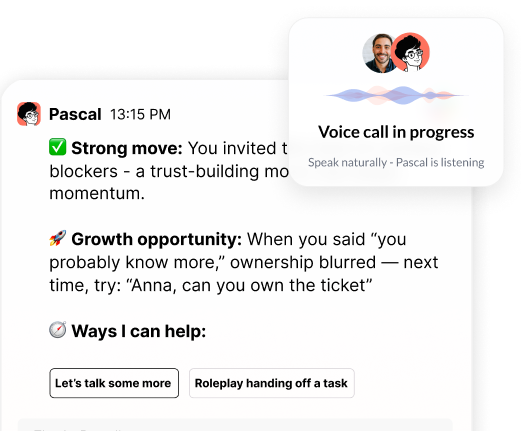
Post-conversation feedback is where AI coaching delivers behavior change. Pascal analyzes the meeting recording, identifies specific moments where the manager handled situations well or could improve, and delivers personalized coaching within hours—not weeks later in a performance review.
This feedback loop drives skill development. According to DDI research, managers who receive regular feedback show 39% higher engagement scores. The key word is "regular"—not annual, not quarterly, but after each significant interaction.
Specific moment analysis:
AI highlights exact timestamps where communication was effective or needs work. "At 14:23, you acknowledged the employee's frustration before redirecting to solutions—that built trust. At 22:17, you interrupted their explanation, which shut down the dialogue."
Behavioral pattern tracking:
AI identifies recurring strengths and development areas across multiple conversations. If a manager struggles with setting clear expectations but excels at empathy, coaching focuses on the specific skill gap while reinforcing strengths.
Follow-up coaching on action items:
Pascal checks in on commitments made during difficult conversations. Did the manager follow up on the support they promised? Did the employee complete the agreed-upon actions?
Skill progression over time:
AI tracks improvement with concrete examples. "Three months ago, your accountability conversations averaged 6.2 minutes and often ended without clear next steps. Your last five conversations averaged 12 minutes with documented action items and follow-up dates."
Escalation when needed:
AI flags situations requiring HR or legal review based on content, tone, or risk factors.
AI coaching should complement, not replace, HR support—but it extends HR's reach to managers who need help most. Small HR teams can't provide one-on-one coaching to every manager before every difficult conversation, yet that's when managers need guidance.
Pascal handles routine coaching and skill-building, allowing HR business partners to focus on complex situations requiring human judgment: legal risks, sensitive investigations, or transformational leadership development. This isn't about replacing humans—it's about using AI for what it does best so humans can focus on what they do best.
Capacity multiplication:
AI handles the high-frequency, lower-complexity coaching that would otherwise consume HRBP time, freeing capacity for strategic work.
Triage effectiveness:
AI handles routine coaching conversations. Humans focus on situations that involve complex judgment, legal exposure, or situations requiring empathy that AI can't provide. AI escalates when situations exceed its capability.
Consistency:
Every manager gets the same quality of coaching regardless of their relationship with HR or their manager's coaching ability.
Data for HR strategy:
Aggregated, anonymized insights reveal patterns across the organization. Are managers struggling with a specific type of conversation? Is there a department where difficult conversations are being avoided? This data informs training priorities and intervention strategies.
The key is integration, not replacement. Jeff Diana, former CHRO at SuccessFactors and Calendly, notes that HR leaders face a choice: shape how AI transforms work or watch other functions make those decisions for you.
• AI coaching eliminates the timing gap between training and application by providing just-in-time support when managers need help with difficult conversations
• Personalization means every manager gets coaching tailored to their specific employee's communication patterns and relationship dynamics, not generic advice
• Real-time support during conversations transforms anxiety into confidence, with managers able to get guidance when discussions go sideways
• Post-conversation feedback within hours drives behavior change, unlike traditional training that provides feedback weeks or months later
• AI extends HR capacity by handling routine coaching, allowing HR business partners to focus on complex situations requiring human judgment
Pascal by Pinnacle delivers AI coaching that meets managers in their workflow—in Slack, Teams, and meetings—with personalized guidance for every difficult conversation. See how Pascal works inside Slack to transform how your managers handle performance feedback, conflict resolution, and accountability conversations.
Header photo by Vitaly Gariev on Unsplash

.png)
.webp)
“Thank you for setting the great foundation for my promotion; now I have a plan!"

Curious to see how AI Coaching can 10X the impact and scale of your development initiatives. Book a demo today for: