

AI coaching provides managers with real-time guidance before, during, and after challenging interactions. Traditional training happens weeks before a conversation when anxiety is low and context is abstract. AI coaching meets managers in the flow of work with personalized scripts, role-play practice, and immediate feedback tailored to their communication style and team dynamics.
AI coaching provides managers with just-in-time guidance for difficult conversations by combining real-time behavioral observation, organizational context, and coaching frameworks. It eliminates the timing gap between when managers receive training and when they need to apply it.
Managers forget 70% of workshop content within weeks. AI coaching delivers guidance at the moment of need. Managers rehearse difficult conversations through AI role-play, receiving feedback on tone, word choice, and approach before the real interaction. According to TalentLMS's analysis of AI coaching platforms, these practice environments allow managers to refine their approach repeatedly without risking actual relationships.
AI coaching learns each manager's patterns and tailors guidance to their specific team dynamics and organizational culture. Instead of one-time training events, it provides ongoing support that reinforces learning through repeated practice in real situations.
A manager preparing to deliver critical performance feedback can use Pascal (Pinnacle's AI coach) to role-play the conversation. Pascal provides talking points, anticipates employee reactions, and offers post-conversation feedback on how the accountability was handled.
AI coaching delivers contextual, in-the-moment support rather than abstract classroom learning that managers struggle to apply weeks later. The difference shows up in adoption rates: AI coaching platforms maintain 75% regular usage versus the 10-20% engagement typical of traditional learning management systems, according to internal data from organizations using these tools.
As former Bloomberg and Pearson CHRO Melinda Wolfe notes, "Managers rarely need help in a workshop—they need it when preparing for a tough 1:1 or in the middle of a team conflict."
Data Breakdown:
• Traditional Training: Scheduled workshops weeks before conversations | AI Coaching: Real-time guidance at moment of need
• Traditional Training: Generic scenarios disconnected from your culture | AI Coaching: Personalized to your team dynamics and values
• Traditional Training: One-time learning event | AI Coaching: Continuous reinforcement through practice
• Traditional Training: No follow-up or accountability | AI Coaching: Immediate feedback on actual conversations
• Traditional Training: 10-20% engagement after 90 days | AI Coaching: 75% sustained usage
AI coaching platforms like Pascal build knowledge graphs of team interactions, understanding relationship dynamics that generic training can't address. Pascal joins meetings and observes actual communication patterns, providing feedback based on real behavior rather than hypothetical scenarios.
According to Gallup research cited in Fortune, 70% of the variance in team engagement comes down to the manager. AI coaching ensures every manager receives consistent, high-quality guidance at a fraction of traditional executive coaching costs.
AI coaching converts difficult conversations into growth opportunities through three techniques: pre-conversation preparation with role-play and personalized scripts, real-time observation and pattern recognition during interactions, and immediate post-conversation feedback that reinforces learning.
Pre-conversation preparation eliminates the anxiety that causes managers to avoid difficult conversations. Managers practice delivering tough feedback in a safe environment where mistakes don't damage relationships. Pascal simulates the specific employee's likely reactions based on past interactions, helping managers anticipate objections and prepare responses. This rehearsal builds confidence and reduces avoidance.
Real-time support during conversations provides managers with a safety net. When integrated with meeting platforms like Zoom or Microsoft Teams, AI coaching observes conversations and flags moments where communication breaks down. Managers receive insights on their communication patterns: Are they talking too much? Missing emotional cues? Using language that creates defensiveness?
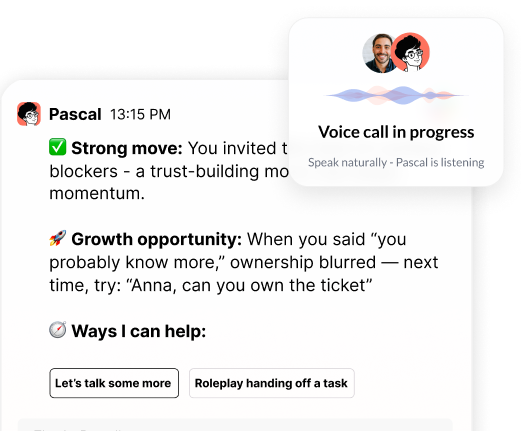
Post-conversation analysis turns every interaction into a learning opportunity. Rather than wondering "How did that go?", managers receive specific feedback on what worked and what didn't. Pascal identifies patterns over time: "You tend to soften critical feedback with too many qualifiers" or "You're strongest when you lead with specific examples." This continuous feedback loop accelerates skill development beyond what annual training can achieve.
According to research from The Edge of Work, organizations experimenting with AI coaching report that the continuous nature of feedback creates behavioral changes that stick. Managers develop habits, not just knowledge.
AI coaching reduces the emotional and cognitive load that makes difficult conversations feel overwhelming. Managers avoid tough conversations not because they don't care, but because they don't know how to navigate them successfully.
The most common reason managers avoid feedback conversations is fear of the employee's reaction. Pascal addresses this by role-playing the conversation beforehand, allowing managers to practice responses to likely objections or emotional reactions. This preparation transforms an abstract fear into a concrete plan.
Another barrier is not knowing what to say. Managers often have a general sense that something needs to be addressed but struggle to articulate it clearly. AI coaching helps managers structure their thoughts, providing frameworks for opening the conversation, delivering the core message, and closing with clear next steps.
Organizations using Pascal report that managers who previously avoided accountability conversations begin initiating them proactively. One engineering manager noted, "Pascal helped me move from being 'halfway in, halfway out' to having productive conversations that actually changed behavior."
AI coaching platforms outperform generic chatbots because they understand organizational context, maintain persistent memory of past interactions, and apply structured coaching frameworks rather than providing generic advice.
Generic chatbots like ChatGPT don't remember previous conversations or understand your team dynamics. Every interaction starts from scratch. AI coaches like Pascal maintain context across conversations, understanding the history of a manager's relationship with each team member. This persistent memory allows for meaningful, continuous coaching rather than repetitive surface-level advice.
Organizational context matters. A feedback conversation at a fast-moving startup requires different language than the same conversation at a risk-averse financial institution. Pascal can be customized to include company-specific competencies, values, processes, and training materials, ensuring guidance aligns with your culture.
Structured coaching frameworks trained by ICF-certified coaches (International Coaching Federation, the industry's leading credentialing body) ensure quality and consistency. Generic chatbots provide whatever response their training data suggests. AI coaches apply proven methodologies for difficult conversations, ensuring managers receive guidance that works.
Data protection is non-negotiable. Pascal is SOC2 compliant and never trains on customer data. Generic chatbots may use your conversations to improve their models, creating privacy and compliance risks that make them unsuitable for sensitive workplace conversations.
Managers practice difficult conversations through AI-powered role-play that simulates specific employees and scenarios, providing a safe environment to experiment with different approaches before the real interaction.
The process starts with context. A manager tells Pascal about the situation: "I need to address missed deadlines with Alex, who's been with the company for three years and usually performs well." Pascal asks clarifying questions to understand the relationship, past performance, and specific concerns.
Next comes role-play. Pascal acts as Alex, responding based on past meeting data and communication patterns. The manager practices delivering the feedback, and Pascal responds realistically—sometimes defensively, sometimes receptively, depending on what's most likely. This allows managers to experience different scenarios and adjust their approach.
After the role-play, Pascal provides specific feedback: "You led with criticism rather than context. Try opening with what you value about Alex's work before addressing the concern." Managers can immediately practice again with the revised approach, creating a rapid learning cycle.
According to TalentLMS's research on AI coaching platforms, this on-demand practice transforms skill development. Employees can rehearse difficult client conversations, leadership scenarios, or sales interactions repeatedly in a low-pressure environment, building muscle memory before the stakes are high.
After a difficult conversation, AI coaching provides immediate feedback on what worked, what didn't, and specific suggestions for follow-up actions—turning every interaction into a learning opportunity that compounds over time.
Managers can debrief with Pascal immediately after the conversation: "I just had that performance discussion with Alex. Here's what happened..." Pascal analyzes the outcome, identifies patterns, and provides guidance for next steps. Did the conversation achieve its goal? Was accountability established clearly? What should the manager do to follow up?
This immediate feedback loop is critical. Traditional coaching happens days or weeks after the event, when details are fuzzy and emotions have cooled. AI coaching captures learning while it's fresh, helping managers understand what they did well and what to adjust next time.
Over time, Pascal identifies patterns that individual conversations don't reveal. "You're consistently strong at opening difficult conversations but tend to end without clear action items." This longitudinal view accelerates development in ways that episodic training never can.
AI coaching integrates into daily workflow by living inside the tools managers already use—Slack, Microsoft Teams, Zoom—rather than requiring them to visit a separate portal.
An AI coach living in a separate portal that managers need to remember to visit will be abandoned. An AI coach embedded in Slack and Teams (where managers already work) becomes a daily habit. Pascal appears proactively when managers need guidance: before a scheduled 1:1, after a tense team meeting, or when performance review season begins.
This proactive approach drives better adoption. Proactive platforms maintain 75% regular usage versus 51% for on-demand tools, according to internal data from organizations using these systems. Managers engage consistently when coaching comes to them rather than requiring them to seek it out.
Integration with meeting platforms allows Pascal to observe actual conversations (with appropriate permissions and privacy protections) and provide feedback based on real behavior. This eliminates the gap between what managers think they said and what actually happened—a gap that traditional training can't address.
The workflow integration also enables shared development plans. Managers can share 360 feedback and synthesized development insights with their own managers, ensuring alignment and creating accountability for growth.
• AI coaching eliminates the timing gap between when managers learn feedback techniques and when they need to apply them, providing just-in-time guidance at the moment of need rather than weeks before in abstract workshops.
• AI coaching platforms outperform generic chatbots because they maintain organizational context, remember past interactions, and apply ICF-certified coaching frameworks rather than providing generic advice disconnected from your culture.
• Practice-based learning through AI role-play allows managers to rehearse difficult conversations in a safe environment, building confidence and skill before the real interaction—something traditional training can't provide.
• Proactive integration into daily tools (Slack, Teams, Zoom) drives 75% sustained adoption versus 10-20% for traditional learning platforms, ensuring managers use the coaching they're given.
• Post-conversation feedback creates sustainable behavior change by turning every difficult interaction into a learning opportunity, with longitudinal pattern recognition that accelerates development over time.
Ready to transform how your managers handle difficult conversations? See how Pascal works inside Slack and Teams to provide real-time coaching at the moments that matter most. Learn more about Pascal or schedule a demo to see it in action.
Header photo by Aleksei Zhivilov on Unsplash

.png)
.webp)
“Thank you for setting the great foundation for my promotion; now I have a plan!"

Curious to see how AI Coaching can 10X the impact and scale of your development initiatives. Book a demo today for: