

AI coaching turns performance reviews from annual events into continuous development cycles. Instead of managers scrambling to remember what happened months ago, AI observes interactions year-round, drafts initial reviews, and guides managers through difficult conversations. The result: better preparation, more specific feedback, and development plans that actually get executed.
AI coaching embeds development support into three phases: before reviews, during conversations, and after formal evaluations.
Before reviews, AI interviews managers about each direct report, then drafts initial assessments based on those conversations and observed interactions. A manager preparing 10 reviews saves 30-40 hours by starting with AI-generated drafts instead of blank templates.
During review meetings, AI suggests how to handle defensive reactions, reframe criticism constructively, or escalate sensitive topics to HR. New managers practice difficult conversations through AI role-play before facing real performance discussions.
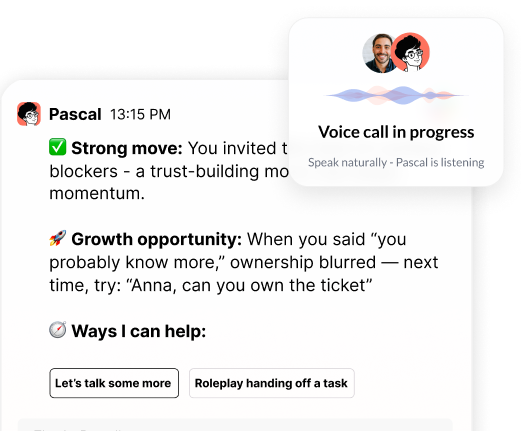
After reviews, AI translates outcomes into weekly coaching plans with specific skill-building exercises. This addresses the common failure where development plans get filed away and forgotten. Platforms like Pascal (built by Pinnacle) check in weekly to reinforce behavior change rather than waiting another year.
The shift from annual snapshots to continuous observation means reviews reflect actual workplace dynamics, not manager recall from six months ago.
Traditional reviews rely on managers remembering events from months ago, often captured in generic competency ratings. AI-integrated reviews use observed behavioral evidence from the entire review period.
Traditional vs. AI-Integrated Reviews:
Data Breakdown:
• Traditional Reviews: Annual or quarterly snapshots | AI-Integrated Reviews: Continuous performance data
• Traditional Reviews: Manager recall-dependent | AI-Integrated Reviews: Observed behavioral evidence
• Traditional Reviews: Generic competency ratings | AI-Integrated Reviews: Context-specific skill assessment
• Traditional Reviews: One-way feedback delivery | AI-Integrated Reviews: Two-way coaching conversations
• Traditional Reviews: Development plans filed away | AI-Integrated Reviews: Weekly check-ins and reinforcement
• Traditional Reviews: Subjective assessments | AI-Integrated Reviews: Pattern-based insights
The difference shows up in execution. Traditional reviews produce development plans that 70% of employees never discuss again with their manager. AI-integrated reviews include weekly follow-through, which drives sustained behavior change.
AI coaching integrates at five moments in the review cycle. Each addresses a specific failure in traditional processes.
Pascal joins Slack conversations, Teams meetings, and email threads to build a record of how managers and employees work together. This creates a performance history grounded in real interactions.
Technical implementation: The platform integrates via API with communication tools, transcribing and analyzing interactions with employee consent. Data is encrypted in transit and at rest, SOC2-compliant, and never used to train AI models.
Privacy concern: Employees control what interactions are observed. Sensitive topics (harassment, discrimination, mental health) trigger automatic escalation to HR rather than AI analysis.
AI interviews managers about each direct report, asking specific questions aligned with your competency framework. It then synthesizes 360 feedback, performance data, and observed interactions into initial review drafts.
Integration mechanics: Pre-built connectors pull data from HRIS systems (Workday, BambooHR, Lattice). Custom API integration takes 2-4 weeks for enterprise deployments.
Time savings: Managers spend 3-4 hours per review on preparation. AI-drafted starting points reduce this to 1-1.5 hours, a 60% reduction.
Managers practice delivering difficult feedback through AI role-play. The AI adapts responses based on the specific employee's communication style and past reactions to criticism.
How it works: The manager describes the feedback they need to deliver. The AI plays the employee, responding as that person typically would based on observed patterns. The manager practices reframing until they find an approach that lands.
Example: A manager needs to tell an engineer their code quality is declining. The AI role-plays the engineer's likely defensive response ("I'm just moving fast to hit deadlines"). The manager practices acknowledging the pressure while redirecting to quality standards.
During live review conversations, AI provides real-time suggestions when discussions go off track. If an employee becomes defensive, the AI suggests reframing techniques. If a topic requires HR involvement, it flags for escalation.
Guardrails: AI provides options and frameworks but never makes decisions about performance ratings or consequences. Managers retain full authority over evaluation outcomes.
AI translates review outcomes into coaching plans with weekly check-ins. Instead of "improve communication skills," the plan includes specific exercises: "Practice giving direct feedback in your 1-on-1 with Sarah this week. Focus on describing the behavior you observed, not your interpretation."
Follow-through: The AI reaches out weekly with contextual guidance. If a manager commits to delegating more, the AI notices when they're in the weeds on a project and suggests delegation opportunities.
Sustained change: 40-60% of managers maintain new behaviors at 6 months when using AI follow-through, compared to 10-15% with traditional training alone.
Yes, if your organization struggles with inconsistent review quality, manager preparation time, or translating reviews into development.
The business case centers on three factors:
Time savings: Managers save 30-40 hours per review cycle on preparation and documentation. For an organization with 100 managers, that's 3,000-4,000 hours annually.
Quality improvement: Reviews grounded in observed behavior reduce recency bias and subjective impressions. Every manager gets the same quality of preparation support, regardless of experience level.
Sustained behavior change: Weekly AI check-ins drive execution of development plans. Traditional reviews produce plans that get forgotten. AI-integrated reviews include reinforcement.
Start with a pilot: 20-30 managers, 90 days. Measure baseline preparation time, review completion rates, and employee satisfaction with feedback quality. Track the same metrics after 90 days to quantify impact before scaling.
Target organizations: 200-4,000 employees in tech, professional services, and life sciences where manager effectiveness directly impacts retention and team performance.
Track three categories: efficiency, quality, and behavioral outcomes.
Efficiency metrics:
• Manager preparation time per review
• Review completion rates
• Time-to-feedback after review conversations
Quality indicators:
• Employee satisfaction with feedback specificity (survey question: "My manager gave me concrete examples of behaviors to change")
• Manager confidence in delivering reviews (survey question: "I felt prepared to discuss performance honestly")
• HR escalations during review cycles (reduction indicates fewer mishandled conversations)
Behavioral outcomes:
• Development plan execution (measured by follow-up conversation frequency)
• Skill demonstration in subsequent quarters (does the employee actually change the behavior discussed in the review?)
• Manager NPS (do employees trust their manager more after reviews?)
Culture Amp's AI Coach integrates with engagement survey data to track whether review quality improvements correlate with engagement score increases. This connects review effectiveness to broader employee experience.
Privacy-first architecture separates individual coaching from organizational insights.
Individual level: Employees control what interactions are observed. Coaching conversations between an employee and AI are private unless the employee chooses to share them. Managers don't see AI coaching threads with their direct reports.
Organizational level: HR sees anonymized, aggregated trends (e.g., "30% of managers struggle with delivering critical feedback") without accessing individual coaching threads.
Data governance: SOC2-compliant platforms ensure customer data is never used to train AI models. Data is encrypted in transit and at rest. Retention policies delete interaction data after 12 months unless required for compliance.
Sensitive topic escalation: AI flags conversations touching harassment, discrimination, or mental health and routes them to HR. The AI doesn't attempt to handle these situations algorithmically.
Transparency: Employees know when AI is observing interactions. Consent is explicit, not buried in terms of service.
Standalone platforms (Lattice, Workday) handle review workflows, goal tracking, and documentation. They don't provide continuous coaching between review cycles.
AI coaching adds real-time development guidance inside the tools managers already use (Slack, Teams, Zoom, email) rather than requiring a separate login.
The difference shows up in sustained behavior change. Performance management platforms document what happened in the review. AI coaching ensures managers execute the development plans through weekly check-ins and contextual nudges.
Integration works best when AI coaching complements existing systems rather than replacing them. Pull competency frameworks and historical data from your performance platform, use AI to improve review quality and follow-through, then push outcomes back for documentation.
This creates a complete cycle: technology handles coaching, humans retain authority over formal evaluation decisions.
• AI coaching transforms reviews from annual events into continuous development by observing interactions year-round, drafting initial assessments, and guiding managers through difficult conversations.
• The five integration points (observation, synthesis, rehearsal, in-meeting guidance, post-review development) each address a specific failure in traditional review processes.
• Managers save 30-40 hours per review cycle on preparation. Reviews grounded in observed behavior reduce recency bias and subjective impressions.
• Privacy-first architecture with SOC2 compliance ensures data is never used to train models. Sensitive topics trigger automatic escalation to HR.
• AI coaching complements existing performance management platforms by adding real-time development support between review cycles, driving 40-60% behavior change sustainability at 6 months.
Ready to transform your performance review process from an annual event into a continuous development cycle? See how Pascal works inside Slack, Teams, and your existing review workflow to deliver coaching at the moments that matter most.
Header photo by Vitaly Gariev on Unsplash

.png)
.webp)
“Thank you for setting the great foundation for my promotion; now I have a plan!"

Curious to see how AI Coaching can 10X the impact and scale of your development initiatives. Book a demo today for: