
AI coaching connects performance reviews to daily work by automating data synthesis and enabling continuous manager preparation. Organizations using these platforms report time savings of 150+ hours per review cycle and measurable improvements in review quality.
AI coaching provides a continuous development layer between annual reviews and daily work. These platforms join meetings, observe communication patterns, and track team dynamics throughout the year. Managers retain authority over final decisions and sensitive conversations while AI handles data aggregation and skill practice.
Traditional reviews capture only what managers remember from the last 30 days. AI coaching maintains a chronological record of performance throughout the review period, surfacing specific behavioral examples from actual interactions. When managers prepare reviews, they receive prompts based on observed meeting dynamics and development conversations that happened months earlier.
This contextual foundation reduces the scrambling that precedes review season. Instead of reconstructing performance from memory, managers work with concrete data points. The AI provides raw material that makes reviews more specific and actionable.
The answer depends on your organization's size, existing manager development infrastructure, and willingness to establish clear guardrails.
Organizations with 200–4,000 employees see strong returns because AI coaching scales manager effectiveness without proportionally scaling L&D headcount. The economic case is compelling: AI coaching delivers personalized development at a fraction of traditional coaching costs while providing 24/7 availability. Performance review seasons create natural pilot opportunities when managers face high-stakes conversations and need immediate support.
But integration isn't risk-free. AI coaching can introduce bias through training data, automate subjective judgments based on historical inequities, and create privacy concerns if guardrails aren't established upfront. The technology works best as a supplement to manager training and structured feedback processes, not a replacement.
Simpler alternatives exist: structured 1:1 templates, continuous feedback tools (Lattice, 15Five, Culture Amp), quarterly check-ins, or better note-taking habits. AI coaching makes sense when these foundational practices are already in place and you need to scale personalized support across a growing manager population.
The key is avoiding generic chatbots. Platforms trained on coaching methodologies and customized to company competencies deliver better results than general-purpose AI tools. Look for vendors who can explain their bias mitigation approach, provide transparent data governance, and share customer references willing to discuss implementation challenges.
AI coaching fills the gap between annual reviews and daily work by providing continuous feedback loops. Traditional performance management systems remain the system of record for formal evaluations and compensation decisions. The two work together: AI coaches prepare managers, traditional systems document outcomes.
The data flow: AI pulls context from HRIS, performance data, and 360 feedback. Managers use AI coaching to prepare for review conversations and draft initial reviews based on accumulated behavioral examples. Finalized reviews flow back into systems like Workday or SuccessFactors as the official record.
This architecture preserves what performance management platforms do well (tracking compensation, managing review workflows, maintaining compliance) while adding continuous skill development and just-in-time coaching. Traditional systems operate quarterly or annually. AI coaching provides daily feedback that accumulates into richer annual conversations.
The skill development layer is critical. Performance systems track what happened. AI coaching develops the how—teaching managers to deliver feedback effectively, handle difficult conversations, and practice review preparation through simulated scenarios.
Start with a pilot during performance review season, focusing on managers who face the highest-stakes conversations. Select 15–25 managers who are either new to the role, managing underperformers, or have historically inconsistent review quality.
Phase 1 (Pilot, 30–60 days): Integrate AI coaching with Slack or Teams during review prep season. Measure time saved on review preparation and track review quality improvements through HR business partner assessments. Establish what success looks like before expanding.
Phase 2 (Expansion, 90 days): Roll out to broader manager population after validating pilot results. Integrate 360 feedback and company competency frameworks to personalize coaching. Track manager satisfaction and direct report engagement scores to measure impact beyond time savings.
Phase 3 (Continuous development): Embed AI coaching year-round for ongoing feedback conversations, goal-setting support, and performance improvement plans. This transforms the tool from a review-season resource into a continuous development platform.
Key success metrics include manager time saved (target: 5–10 hours per review cycle), review completion rates, quality scores from HR business partners, and direct report feedback on review conversations. Without clear metrics, you can't distinguish between tools that look good in demos and platforms that actually change behavior.
Implementation requires technical integration with existing HRIS and performance management platforms, customization with company competencies and leadership principles, manager training on when to use AI coaching versus escalate to HR, privacy and data governance protocols (SOC2 compliance minimum), and clear escalation pathways for sensitive topics like performance improvement plans or terminations.
Warning signs that integration isn't working: Managers rely on AI-generated language without customization, review quality scores don't improve after 60 days, direct reports report reviews feel generic or template-driven, managers skip HR consultation on sensitive issues because "the AI said it was fine," or privacy complaints emerge about meeting observation.
AI coaching can improve review quality through several mechanisms, though the evidence for bias reduction specifically remains limited.
Recency bias mitigation: AI maintains a chronological record throughout the review period. Instead of relying on the last 30 days, managers access behavioral data from the entire year. This temporal context ensures that strong performance in Q1 doesn't disappear from the review because of a rough Q4.
Consistency across managers: AI coaching ensures all managers receive guidance aligned with company competencies. Without this standardization, review quality varies based on individual manager skill. AI coaching creates a baseline that reduces variability in review standards.
Specificity enforcement: AI prompts managers to provide concrete examples rather than generic statements. "Improved communication" becomes "led three client presentations with clear executive summaries that reduced follow-up questions by 40%." This specificity makes reviews more actionable and defensible.
Bias detection (not reduction): Anonymized, aggregated insights can help HR identify patterns across the organization. If certain demographics consistently receive lower ratings despite similar performance data, AI coaching surfaces these patterns for investigation. The platform provides data that prompts deeper analysis, but doesn't automatically reduce bias.
The bias reduction claims require scrutiny. AI can surface specific behavioral examples from meetings, but those examples themselves may reflect biased interpretation of behavior (for example, penalizing communication styles more common among women or people of color). The technology can also automate subjective judgments based on historical inequities in performance data. Without careful monitoring, AI coaching can systematize existing biases rather than reduce them.
Real-time feedback shifts performance management from static annual reviews to ongoing development. Managers catch issues earlier and respond immediately, instead of waiting months for the next review. This continuous loop reduces the stakes of any single review conversation because development happens year-round.
Organizations like HubSpot, Zapier, and Marriott integrate AI coaching by focusing on manager enablement rather than surveillance.
HubSpot builds AI fluency among managers before deploying AI coaching for reviews. Managers practice using AI tools for lower-stakes tasks (drafting meeting agendas, preparing 1:1 talking points) before applying AI to performance reviews. This gradual adoption builds trust and competence.
Zapier focuses on workflow integration. AI coaching lives inside Slack, where managers already work, rather than requiring them to log into another platform. Managers receive coaching prompts when they're actually preparing reviews, not when they remember to check a separate tool.
Marriott prioritizes privacy and data governance. The company established clear protocols for what data AI coaching can access (meeting transcripts, 360 feedback, performance history) and what remains off-limits (compensation data, legal discussions, medical information). SOC2 compliance provides the technical foundation, but organizational policies define appropriate use.
These organizations share a common pattern: pilot during performance review season when manager pain points are most acute, measure impact through direct report feedback and manager satisfaction, and expand based on demonstrated ROI rather than vendor promises.
Effective AI coaching requires three layers of guardrails: technical controls, organizational policies, and human escalation pathways. Without all three, you risk either over-reliance on AI or such restrictive policies that the tool becomes useless.
Technical controls include flags that identify potentially problematic content, sensitive topic detection that escalates discussions about discrimination or harassment to HR, and organization-specific controls that prevent AI from making recommendations outside company policy. Ask vendors to demonstrate these controls with specific examples, not just confirm they exist.
Organizational policies define when managers should use AI coaching versus consult HR directly. Performance improvement plans, termination discussions, and legal matters require human judgment. AI coaching can help managers prepare for these conversations, but final decisions and execution remain with humans. Document these boundaries in writing and train managers on them before rollout.
Human escalation pathways ensure that when AI coaching encounters situations beyond its scope, managers know exactly who to contact. This might be an HR business partner, legal counsel, or employee relations specialist. Clear escalation protocols prevent managers from making high-stakes decisions based solely on AI guidance.
Privacy protections include SOC2 compliance as a baseline, clear data retention policies (how long are meeting transcripts stored?), employee notification that AI observes certain meetings, and opt-out mechanisms for sensitive conversations. Anonymous aggregated insights protect individual privacy while giving HR visibility into organizational patterns.
• AI coaching connects performance reviews to daily work by providing managers with behavioral data from team interactions throughout the review period, reducing reliance on memory and recency bias
• Effective implementation requires three phases: pilot during review season (30–60 days), expand to broader population (90 days), then embed year-round for continuous development
• AI coaching complements traditional performance management systems by handling skill development and manager preparation while systems of record maintain compliance and compensation data
• Guardrails must include technical controls (content moderation, sensitive topic detection), organizational policies (clear escalation pathways), and privacy protections (SOC2 compliance, employee notification)
• Bias reduction claims require scrutiny—AI can systematize existing biases through training data and automated judgments, so careful monitoring is essential
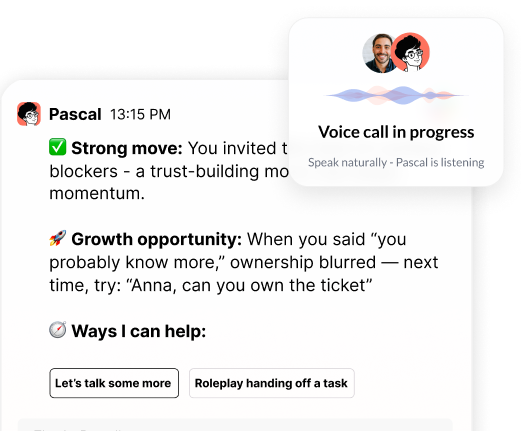
Ready to see how AI coaching can transform your performance review process? See how Pascal works inside Slack to deliver continuous manager development.
Header photo by Campaign Creators on Unsplash

.png)
.webp)
“Thank you for setting the great foundation for my promotion; now I have a plan!"

Curious to see how AI Coaching can 10X the impact and scale of your development initiatives. Book a demo today for: