

Improving manager effectiveness across large organizations requires continuous development embedded in daily work, not annual training events. The challenge: traditional executive coaching costs $15,000+ per manager annually (prohibitive for 200+ manager populations), while workshops and e-learning modules fail to change behavior.
This piece examines what works: the measurement frameworks that prove ROI, the implementation strategies that drive adoption, and the emerging tools (including AI coaching platforms) that deliver personalized guidance at scale.
Gallup research shows 70% of variance in team engagement comes down to the manager. That single statistic explains why CHROs prioritize manager development despite tight budgets. When managers excel at delegation, feedback delivery, and difficult conversations, their teams show higher engagement scores, better retention rates, and faster time-to-productivity for new hires.
The challenge is delivering consistent quality across geographies while personalizing guidance to individual strengths, team dynamics, and departmental contexts. L&D teams of 2–5 people can't provide 1:1 coaching to hundreds of managers. Budget realities mean $15,000/manager coaching would consume entire L&D spend for 100-manager populations.
"Everyone knows it's a problem. You just have to prove it's also a priority," notes Melinda Wolfe, Former CHRO at Bloomberg, Pearson, and GLG.
Traditional approaches fail because they're designed for small populations, delivered at scheduled intervals disconnected from real work, and lack the personalization required to change individual behavior.
The forgetting curve reveals the core problem: managers retain 10% of workshop content after one week without reinforcement. Generic content ignores individual manager strengths, team dynamics, and departmental contexts. Scheduled training rarely coincides with the moments managers need guidance (difficult conversations, performance issues, delegation decisions).
Access inequality compounds the problem. Satellite offices, remote managers, and night-shift leaders receive inconsistent development compared to headquarters populations. Most programs track completion rates, not behavior change or team outcomes.
Cost constraints force impossible choices between executive coaching (effective but expensive), workshops (affordable but ineffective), and e-learning (scalable but ignored).
AI coaching platforms deliver sustained behavior change by embedding guidance into daily workflows and providing contextual personalization at moments when learning sticks. Unlike scheduled workshops managers forget within a week, these platforms meet leaders where work happens with real-time feedback grounded in actual team interactions.
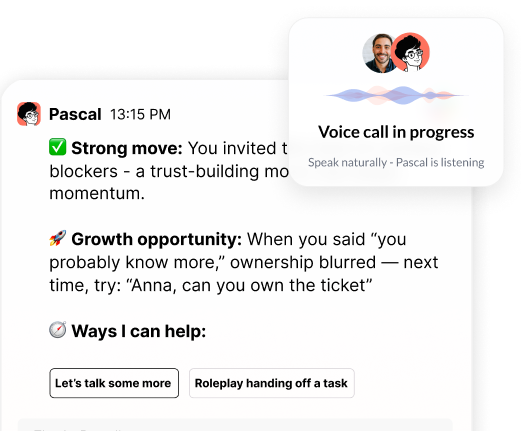
Pascal (Pinnacle's AI coaching platform) joins meetings and Slack conversations, providing feedback managers didn't know to ask for. It learns each manager's team dynamics, communication patterns, and development areas through observation. Guidance arrives during performance reviews, difficult conversations, delegation decisions (not weeks later).
The proactive approach matters. Traditional training requires managers to remember what they learned and apply it weeks later. AI coaching observes the moment a manager needs guidance and delivers it immediately. That timing difference drives behavior change.
How it works in practice: After a 1:1 meeting, Pascal sends a Slack message: "I noticed you committed to getting back to Sarah about her promotion timeline but didn't set a specific date. Here's a draft follow-up message with a concrete deadline." The manager can use it, modify it, or ignore it. The guidance is specific, timely, and actionable.
Limitations: AI coaching struggles with truly novel situations outside its training data, nuanced judgment calls that require deep organizational history, and building the kind of human relationships that come from years of working together. It works best for common management challenges (delegation, feedback, performance conversations) where patterns exist.
Data privacy concerns: SHRM reports AI coaching adoption varies by industry, with regulated sectors like financial services, healthcare, and life sciences moving cautiously. Organizations need clear policies about what data the AI accesses, how it's stored, and who can see coaching conversations. Pascal allows organizations to set guardrails: which conversations it can join, what topics trigger escalation to HR, and what data gets retained.
Data Breakdown:
• Approach: Executive Coaching | Cost per Manager: $15,000+/year | Availability: Scheduled sessions | Personalization: High (1:1 human) | Behavior Change: High (if sustained) | Scalability: Low (executives only)
• Approach: Workshop Training | Cost per Manager: $500–2,000/year | Availability: Quarterly events | Personalization: Low (cohort-based) | Behavior Change: Low (10% retention) | Scalability: Medium (100–200)
• Approach: LMS/eLearning | Cost per Manager: $50–200/year | Availability: On-demand | Personalization: None (generic) | Behavior Change: Very low (under 5% completion) | Scalability: High (unlimited)
• Approach: AI Coaching | Cost per Manager: $150/year | Availability: 24/7 in workflow | Personalization: High (individual and org context) | Behavior Change: High (continuous reinforcement) | Scalability: High (unlimited)
• Approach: Peer Coaching Circles | Cost per Manager: $200–500/year | Availability: Monthly meetings | Personalization: Medium (peer feedback) | Behavior Change: Medium (depends on facilitation) | Scalability: Medium (requires coordination)
The table shows trade-offs, not a clear winner. Executive coaching delivers the highest quality but can't scale. Workshops build community but fail to change behavior. AI coaching scales and personalizes but lacks human judgment. Most organizations need a portfolio approach: executive coaching for senior leaders, AI coaching for the broad manager population, and workshops for building community.
Effective measurement combines leading indicators (manager behavior changes) with lagging indicators (team outcomes) across multiple data sources. The goal is demonstrating ROI to executives while identifying which managers need additional support before team performance suffers.
Leading indicators:
• Direct report feedback through 360 assessments, pulse surveys, and manager Net Promoter Score (NPS)
• Manager behavior changes observed in performance reviews, 1:1 meetings, and team communications
• Platform usage data (repeat usage, conversation depth, specific coaching topics managers request)
Lagging indicators:
• Team retention rates (compare before and after manager development interventions)
• Engagement scores from quarterly surveys
• Time-to-productivity for new hires
• Performance review quality (measured by HR review of written feedback)
Organizations that tie AI coaching to existing rituals (performance reviews, quarterly check-ins, promotion pathways) see higher engagement than those treating it as standalone training.
The measurement framework should include both quantitative metrics and qualitative feedback (direct report testimonials, manager self-assessments, observed behavior changes). Organizations that measure both prove ROI to executives while identifying where to focus additional support.
The fastest adoption happens when organizations tie coaching to existing rituals and high-stakes moments rather than introducing it as standalone training. Managers engage when coaching solves immediate problems (performance reviews, difficult conversations, delegation decisions), not when it feels like extra work.
Start with a focused pilot: Target 20–50 managers during performance review season. Managers face high-stakes conversations and need immediate support. Provide clear use cases: drafting performance reviews, preparing for difficult conversations, practicing feedback delivery. Measure whether direct reports notice improvement within 90 days.
Integrate into existing workflows: Embed coaching into Slack, Teams, and meeting tools where managers already work. Connect it to quarterly check-ins, performance conversations, and management training programs. Organizations that integrate coaching into daily workflows see 3x higher engagement than those requiring managers to log into separate platforms.
Identify executive sponsors: When senior leaders use coaching and share their experiences, middle managers follow. L&D leaders who understand the platform can guide managers on specific use cases and demonstrate value.
Communicate the "why" clearly: Managers need to understand how coaching helps them succeed, not just how it helps the organization. Focus on solving their immediate problems: saving time on performance reviews, handling difficult conversations with confidence, developing their teams more effectively.
Measure and communicate early wins: Share anonymized examples of how managers used coaching to improve specific situations. Track direct report feedback, manager NPS changes, and team performance metrics. Demonstrate ROI to executives while identifying which managers need additional support.
Expand based on pilot results: Organizations that rush company-wide rollouts without proving value in pilots see lower engagement. Those that start focused, measure results, and expand based on success build sustainable adoption.
• Manager effectiveness drives 70% of team engagement variance, making it the highest-leverage investment CHROs can make, but traditional coaching costs $15,000+ per manager annually (prohibitive at scale)
• AI coaching platforms deliver personalized guidance at $150/year per manager by embedding real-time coaching into daily workflows where managers actually work (Slack, Teams, meetings)
• Proactive coaching outperforms on-demand training because it delivers guidance at the exact moment managers need it, not weeks after a scheduled workshop they've already forgotten
• Measurement must combine leading indicators (direct report feedback, manager behavior changes) with lagging indicators (retention rates, engagement scores) to demonstrate ROI and identify intervention opportunities
• Fastest adoption happens when coaching solves immediate problems (performance reviews, difficult conversations, delegation decisions) rather than introducing it as standalone training disconnected from real work
Ready to scale manager effectiveness across your organization? See how Pascal works inside Slack to deliver real-time coaching.

.png)
.webp)
“Thank you for setting the great foundation for my promotion; now I have a plan!"

Curious to see how AI Coaching can 10X the impact and scale of your development initiatives. Book a demo today for: