

Managers at headquarters get executive coaches and daily guidance from senior leaders. Managers in satellite offices wait days for a scheduled call with an overstretched HR business partner. This resource gap creates measurable damage: organizations with inconsistent leadership practices see 30% lower engagement and 23% higher turnover in remote locations (DDI's 2023 Global Leadership Forecast, surveying 13,695 leaders across 1,553 organizations).
AI coaching platforms deliver the same frameworks and feedback to every manager, regardless of location. But the technology introduces tradeoffs that organizations must evaluate carefully.
Resource concentration explains most of the problem. Executive coaches work on-site at headquarters. In-person training programs serve HQ first, regional offices last. One HRBP covering 150 employees across three time zones can't provide real-time support to everyone.
The feedback loop amplifies the gap. HQ managers get immediate course correction when they make mistakes. Remote managers discover problems months later during performance reviews, after damage has spread through their teams.
Local norms create drift. Managers attend the same workshop but apply concepts differently based on peer influence and regional culture. Without continuous reinforcement, satellite offices develop management subcultures that diverge from company standards.
The numbers show the impact. HQ managers get same-day coaching access. Remote managers wait 2-5 business days. HQ managers attend monthly workshops. Remote managers get quarterly webinars. The disparity compounds over time.
AI coaching platforms encode leadership frameworks once and apply them universally. A manager in Austin preparing for a difficult conversation receives the same guidance as their peer in Amsterdam, both aligned to company competencies and values.
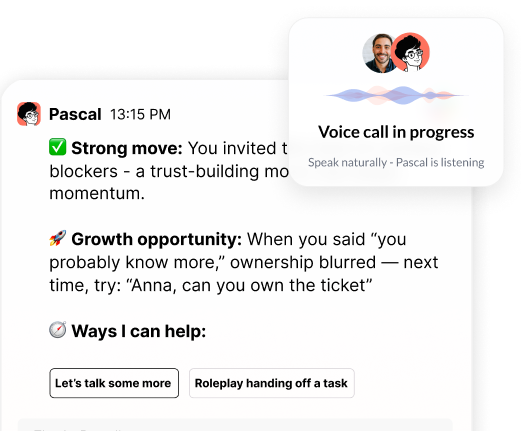
Here's what happens in practice. A manager opens Slack at 4pm on Friday, facing a performance conversation in 30 minutes. They type: "I need to tell Sarah her project missed the deadline. She's going to be defensive." The AI coaching platform responds with your company's feedback framework, suggests specific language based on Sarah's communication style (pulled from previous interactions), and flags potential legal risks if the conversation involves performance improvement plans.
The manager conducts the conversation. The AI joins the Zoom call (with Sarah's consent), transcribes the discussion, and provides feedback afterward: "You stated the problem clearly in the first two minutes. You interrupted Sarah three times when she explained her perspective. Next time, pause for five seconds after she finishes speaking."
This happens identically for every manager, everywhere, at any hour.
The consistency mechanisms work through multiple layers. Every manager receives guidance based on the same leadership frameworks. Sensitive topics (harassment, discrimination, mental health crises) trigger the same escalation paths regardless of location. Company values and policies are encoded once and applied universally.
But AI coaching can't replace human judgment in complex situations. A manager navigating a team member's grief after a family death needs human empathy, not algorithmic guidance. A first-time executive learning to influence the board needs an experienced coach who's sat in that chair. AI coaching handles routine guidance and reinforces frameworks. It doesn't replace human coaches for high-stakes or emotionally complex situations.
AI coaching provides 24/7 availability and perfect consistency. Human coaching provides nuance, empathy, and wisdom from lived experience. Organizations need both.
AI coaching costs 1% of traditional executive coaching (based on $200-500 annual per-manager AI coaching fees versus $3,000-15,000 annual executive coaching retainers). This economics allows companies to provide baseline coaching to all managers while reserving human coaches for senior leaders and complex cases.
The response time difference matters. AI coaching provides immediate guidance. Human coaches require scheduled appointments. When a manager faces a crisis at 6pm, AI coaching responds now. A human coach responds Tuesday at 2pm.
The personalization tradeoff cuts both ways. Human coaches adapt to individual personalities, reading body language and emotional subtext. AI coaching adapts to individual context (your company's competencies, your team's history, your manager's past situations) but misses emotional nuance. A human coach notices when you're burned out before you say it. AI coaching waits for you to type the words.
Scalability favors AI dramatically. One human coach serves 10-15 clients. One AI coaching platform serves 10,000 managers simultaneously. But scale without quality is worthless. The question is whether AI coaching quality meets the threshold for routine guidance, freeing human coaches to focus where they add unique value.
Invest in AI coaching when you face three conditions simultaneously: uneven manager effectiveness across locations, HRBP teams stretched too thin for real-time support, and training programs that don't change behavior.
The investment case strengthens when you calculate replacement costs. AI coaching handles routine guidance, allowing HRBPs to increase span of control from 150 to 200+ employees. Companies replace low-engagement learning platforms (15% typical completion rates per Gartner's 2023 Learning Technology research) with always-available coaching. Executive coaching serves senior leaders. AI coaching democratizes access to everyone else at 1% of traditional costs.
The ROI timeline runs 90 days. Organizations see measurable improvements within one quarter: managers report increased confidence in difficult conversations, direct reports notice better feedback quality, HR teams handle fewer escalations for routine guidance.
Data protection requires scrutiny. AI coaching platforms access sensitive conversations between managers and employees. Organizations need SOC2 compliance, commitments not to train AI models on customer data, and organization-specific controls for sensitive topics. Without these protections, the risk outweighs the benefit.
The decision also depends on your existing infrastructure. Companies using Slack, Microsoft Teams, Zoom, and Google Meet see faster adoption because AI coaching embeds in existing workflows. Organizations relying on older communication tools face longer implementation timelines and lower engagement.
Don't invest in AI coaching if your primary problem is poor leadership frameworks or toxic culture. AI coaching amplifies your existing frameworks. If those frameworks are bad, AI delivers bad guidance consistently. Fix the foundation first.
Measure AI coaching through three layers: engagement metrics, behavior change, and business outcomes.
Engagement metrics include adoption rates across locations, frequency of coaching interactions, and manager satisfaction scores. These numbers reveal whether the tool reaches remote locations as effectively as headquarters. Target 70%+ adoption within 90 days and 3+ coaching interactions per manager per week.
Behavior change shows up in 360 feedback, direct report surveys, and performance review data. The question isn't whether managers like the tool. The question is whether their teams notice improved leadership quality. Survey direct reports specifically: "Has your manager's feedback quality improved in the past 90 days?" Track changes in specific competencies like delegation effectiveness and difficult conversation handling.
Business outcomes connect to retention rates, team performance scores, and promotion readiness. Organizations with consistent management practices across locations see measurable improvements in voluntary turnover (target 15-20% reduction in regrettable attrition), internal promotion rates (target 10-15% increase in managers promoted from within), and team performance scores.
Start with baseline data before implementing AI coaching. Capture current state metrics: manager effectiveness scores by location, HRBP response times, training completion rates, employee engagement scores. These baselines reveal the size of your geographic disparity problem and provide comparison points for measuring improvement.
Track leading indicators weekly during implementation. How many managers actively use the coaching? How often do they engage with guidance? Which competencies receive the most coaching requests? These patterns reveal whether the tool is working.
After 90 days, measure behavior change through structured feedback. After six months, measure business outcomes. The full impact takes 12-18 months to materialize in retention and promotion data.
The biggest implementation challenge is cultural, not technical. Managers in locations with strong human coaching access resist AI alternatives, viewing them as downgrades. The solution requires positioning AI coaching as expansion, not replacement. Executive coaching continues for senior leaders. AI coaching democratizes access to everyone else.
Data privacy concerns surface immediately in regulated industries and European locations. Organizations need clear communication about what data the AI coaching platform accesses, how it's used, and what protections exist. Proactive communication addresses most concerns, but expect 20-30% of managers to remain skeptical.
HRBP role evolution requires careful navigation. AI coaching handles routine guidance, freeing HRBPs to focus on complex cases. But this shift threatens team members who built careers on being the go-to resource for manager questions. Successful implementations reframe HRBP roles around strategic impact rather than volume of coaching conversations. Expect 6-12 months for HRBPs to fully embrace the new model.
Change management determines success or failure. The most effective rollouts start with pilot groups in both headquarters and remote locations simultaneously, demonstrating that the technology works equally well everywhere. Early adopters become champions who help overcome skepticism in their regions. Identify 10-15 managers across locations to pilot for 60 days before full rollout.
Integration complexity varies by organization. Companies with modern tech stacks see adoption within 30 days. Organizations with older systems face 90-120 day implementations and potentially lower engagement.
• Managers at headquarters get executive coaches and daily guidance. Managers in satellite offices wait days for overstretched HR support. This resource gap creates 30% lower engagement and 23% higher turnover in remote locations.
• AI coaching platforms deliver the same frameworks and feedback to every manager regardless of location, operating inside Slack, Teams, and Zoom to provide real-time guidance at the moment decisions happen.
• AI coaching handles routine guidance and reinforces frameworks. It doesn't replace human coaches for high-stakes situations, emotionally complex cases, or senior executive development. Organizations need both.
• Invest in AI coaching when you face uneven manager effectiveness across locations, HRBP teams stretched too thin, and training programs that don't change behavior. Expect measurable ROI within 90 days.
• Measure impact through engagement metrics (70%+ adoption, 3+ interactions per week), behavior change (direct report surveys, 360 feedback), and business outcomes (15-20% reduction in regrettable attrition, 10-15% increase in internal promotions).
Ready to provide consistent coaching to every manager, everywhere? See how Pascal works inside Slack and Teams.
Header photo by Vitaly Gariev on Unsplash

.png)
.webp)
“Thank you for setting the great foundation for my promotion; now I have a plan!"

Curious to see how AI Coaching can 10X the impact and scale of your development initiatives. Book a demo today for: