

AI coaching extends professional development from 5% of executives to 100% of managers by delivering real-time, contextual guidance between scheduled learning events. Organizations that integrate AI coaching alongside human coaches and L&D programs reduce per-manager development costs from $10,000-15,000 annually to $50-200 while maintaining 24/7 availability.
AI coaching provides on-demand, personalized guidance to managers in the flow of work. Human coaches deliver deep strategic thinking and emotional support for senior leaders. The two work in tandem: AI coaching scales access to coaching principles across all managers, while human coaches focus on complex leadership challenges that require human judgment, accountability, and relationship depth.
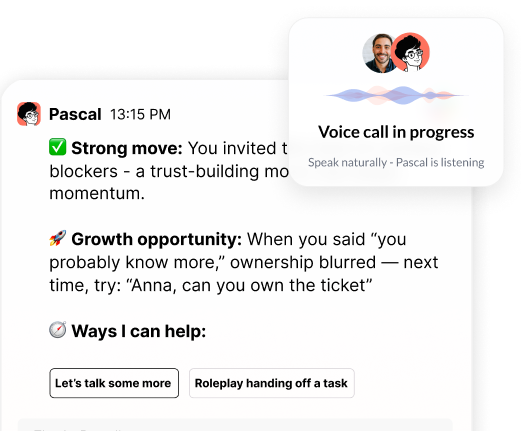
Platforms like Pascal integrate into daily tools (Slack, Teams, Zoom) to provide real-time feedback during meetings and conversations. A manager preparing for a difficult performance conversation can practice with Pascal before the actual meeting, receive live guidance during the conversation, and debrief afterward to refine their approach. The AI analyzes meeting transcripts and interaction patterns to deliver contextual prompts and frameworks at the moment managers need them.
Human coaches remain essential for executive development, career transitions, and situations requiring emotional intelligence that AI cannot replicate. The combination creates a tiered coaching model: AI for continuous skill-building across all managers, human coaches for strategic leadership development at the C-suite and VP level.
Organizations successfully integrate AI coaching through three distinct models. The choice depends on current L&D maturity, budget constraints, and strategic priorities.
Replacement Model substitutes underutilized tools with AI coaching. Organizations replace low-utilization LMS platforms or generic training programs. Budget comes from redirected learning platform spend or unfilled HRBP positions. This model works best for companies with 200-1,000 employees and lean HR teams seeking immediate ROI. A financial services firm with 600 employees replaced their $80,000 annual LMS contract with Pascal, redirecting the budget to AI coaching that managers actually used daily.
Complement Model layers AI coaching on top of existing human coaching and training programs. Human coaches focus on senior leaders while AI extends coaching to all managers. Organizations maintain their current L&D calendar while adding continuous reinforcement. This approach suits organizations with established L&D functions and 1,000-4,000 employees. A healthcare company maintained executive coaching for their 40 VPs ($400,000 annually) while deploying Pascal to their 300 managers ($60,000 annually), extending coaching coverage from 12% to 100% of leaders.
Transformation Model redesigns the entire development architecture around continuous, contextual learning. It integrates AI coaching with performance management, goal-setting, and talent reviews. This requires executive sponsorship and a 6-12 month implementation timeline. It's best for organizations undergoing cultural transformation or leadership model changes. A technology company with 2,500 employees embedded Pascal into their quarterly check-ins, performance conversations, and new manager onboarding, creating a unified development system that reinforced their leadership competencies in every interaction.
AI coaching transforms L&D programs from one-time events into continuous development systems by reinforcing training concepts at the exact moments managers need them. Traditional L&D programs suffer from the forgetting curve—without reinforcement, managers struggle to apply new skills when they return to daily pressures.
Pascal integrates company-specific competencies, values, and training frameworks to reinforce L&D content in daily work. Jeff Diana, former CHRO at Calendly, Atlassian, and SuccessFactors, emphasizes: "Real learning and value come from in-context coaching—solving problems in the moment, not in a classroom."
AI coaching provides the sustainment layer that L&D programs lack—continuous reinforcement without requiring managers to leave their workflow. Organizations embed AI coaching into quarterly check-ins, performance conversations, and management training programs to increase application rates.
A technology company with 500 employees implemented Pascal alongside their existing manager training program. Instead of a two-day workshop followed by no support, managers received real-time coaching during actual feedback conversations. Training application rates increased from 23% to 67% within 90 days, measured by manager self-reports and direct report feedback in quarterly surveys.
AI coaching delivers measurable behavior change where traditional tools fail by providing guidance at the moment of need, not weeks later in a classroom. While LMS platforms achieve 10-20% engagement rates, purpose-built AI coaching platforms like Pascal maintain 94% monthly retention because they meet managers where work happens.
The cost difference between AI coaching ($50-200 per manager annually) and traditional executive coaching ($10,000-15,000 per executive annually) allows organizations to extend coaching access from 5% of leaders to 100% of managers. This isn't a direct comparison—AI coaching and human coaching serve different purposes—but the economics enable a tiered model that was previously impossible.
Data Breakdown:
• Traditional L&D Tool: LMS platforms | Engagement Rate: 10-20% | Cost per Manager: $50-150/year | Behavior Change: Low (passive consumption) | AI Coaching Advantage: Active, contextual guidance in workflow
• Traditional L&D Tool: In-person workshops | Engagement Rate: 60-80% (event) | Cost per Manager: $500-2,000/event | Behavior Change: Medium (no reinforcement) | AI Coaching Advantage: Continuous reinforcement post-training
• Traditional L&D Tool: Human coaching | Engagement Rate: 95% | Cost per Manager: $10,000-15,000/year | Behavior Change: High (limited scale) | AI Coaching Advantage: Same frameworks at lower cost, unlimited scale
• Traditional L&D Tool: Performance management tools | Engagement Rate: 40-60% | Cost per Manager: $30-100/year | Behavior Change: Low (retrospective) | AI Coaching Advantage: Real-time, proactive feedback
The difference between organizations seeing real impact and those disappointed by AI tools comes down to five critical factors: coaching expertise (does the platform understand management principles or just generate generic advice?), contextual awareness (does it know what's happening in your organization?), proactive engagement (does it surface guidance or wait to be asked?), privacy architecture (does it protect sensitive employee data?), and integration depth (does it work inside existing tools or require managers to context-switch?).
AI coaching platforms process sensitive employee conversations, performance data, and development plans. SOC2 compliance, data residency controls, and explicit commitments never to train models on customer data separate enterprise-ready platforms from consumer chatbots.
Organizations in regulated industries (healthcare, financial services, life sciences) require additional controls. Purpose-built AI coaching platforms offer organization-specific guardrails, moderation flags for concerning content, and audit trails for compliance documentation.
The question isn't whether to use AI coaching, but which architecture protects employee trust while delivering coaching value. Generic chatbots lack the privacy controls and contextual boundaries that enterprise coaching requires. When evaluating platforms, CHROs should ask: Where is employee data stored? Who has access to individual conversations? Is data used to train AI models? What happens when sensitive topics surface?
Pascal is SOC2 compliant and never uses customer data to train AI models. All employee interactions remain within the organization's control. Sensitive topics trigger escalation protocols to human HR support. Anonymous aggregated insights protect individual privacy while giving HR leaders visibility into organizational patterns.
Organizations measure AI coaching ROI through manager effectiveness metrics, team engagement scores, retention rates, and development cost per manager. The most meaningful metrics track behavior change—how managers apply coaching insights in actual conversations and decisions.
Melinda Wolfe, former CHRO at Bloomberg, Pearson, and GLG, notes: "It makes it easier not to make mistakes. And it gives you frameworks to think through problems before you act." This translates to measurable outcomes: organizations save 150+ hours annually per manager by reducing time spent searching for guidance or waiting for scheduled coaching sessions.
Financial ROI comes from three sources: replacing expensive coaching programs, reducing HRBP headcount needs through self-service guidance, and improving retention by developing managers who would otherwise leave due to lack of support. Organizations typically see positive ROI within 90 days of deployment, measured by comparing development costs before and after implementation.
Track leading indicators (coaching session frequency, topic patterns, manager confidence scores from self-assessments) alongside lagging indicators (engagement survey results, promotion readiness rates). This combination reveals whether AI coaching drives sustainable behavior change or just creates activity without impact.
The primary implementation challenge is driving consistent adoption beyond the initial novelty period. Managers must see AI coaching as a trusted resource, not another tool competing for attention. This requires executive sponsorship, integration into existing workflows, and proof points that demonstrate value.
Technical integration takes 30-60 days depending on your technology stack complexity. Connecting AI coaching platforms to HRIS systems, calendar tools, and communication platforms requires IT collaboration and API access.
Change management matters more than technology. Managers need clear communication about what AI coaching is, how it protects their privacy, and when to use it versus escalating to human support. HR teams should identify early adopters who can model effective usage and share success stories.
Budget conversations require educating executives on the difference between purpose-built AI coaching and generic chatbots. The cost difference reflects specialized coaching expertise, contextual awareness, and privacy architecture that generic tools lack. Frame the investment as extending coaching access from 5% to 100% of managers at a fraction of traditional coaching costs.
The most common failure mode: treating AI coaching as a standalone tool rather than integrating it into existing development systems. Organizations that embed AI coaching into performance reviews, onboarding programs, and leadership training see 3x higher adoption than those that launch it as a separate initiative.
• AI coaching extends professional development from 5% of executives to 100% of managers by delivering real-time guidance at a fraction of traditional coaching costs
• The most effective organizations deploy AI coaching and human coaches strategically: AI for continuous skill-building, human coaches for transformational leadership work
• Three integration models (Replacement, Complement, Transformation) allow organizations to adopt AI coaching based on their L&D maturity and strategic priorities
• Purpose-built AI coaching platforms maintain 94% monthly retention versus 10-20% for generic LMS tools because they integrate into daily workflows
• Implementation success depends on executive sponsorship, technical integration, and embedding AI coaching into existing development systems rather than launching it as a standalone tool
Pascal delivers coaching in the tools your managers already use—Slack, Teams, Zoom, and Google Meet. We integrate with your HRIS to personalize guidance based on your competencies, values, and culture. Learn how Pascal scales coaching to every manager while maintaining enterprise-grade privacy and security.

.png)
.webp)
“Thank you for setting the great foundation for my promotion; now I have a plan!"

Curious to see how AI Coaching can 10X the impact and scale of your development initiatives. Book a demo today for: