Blog article
Josh Bersin says 76% of companies have a broken training model. He's right.
76% of companies are stuck at the lowest levels of learning maturity. Here's what the top 5% do differently, and how AI closes the gap.


Anthropic’s engineers now merge 8 times as much code per day as they did in 2024. Over 80% of the code going into their production codebase is now written by Claude. The model called Claude Mythos Preview recently found more than ten thousand high- and critical-severity software vulnerabilities across some of the world's most important systems. In weeks.
The paper “When AIbuilds itself, Our progress toward recursive self-improvement, and its implications.” an internal data release documents what is already happening inside their walls.
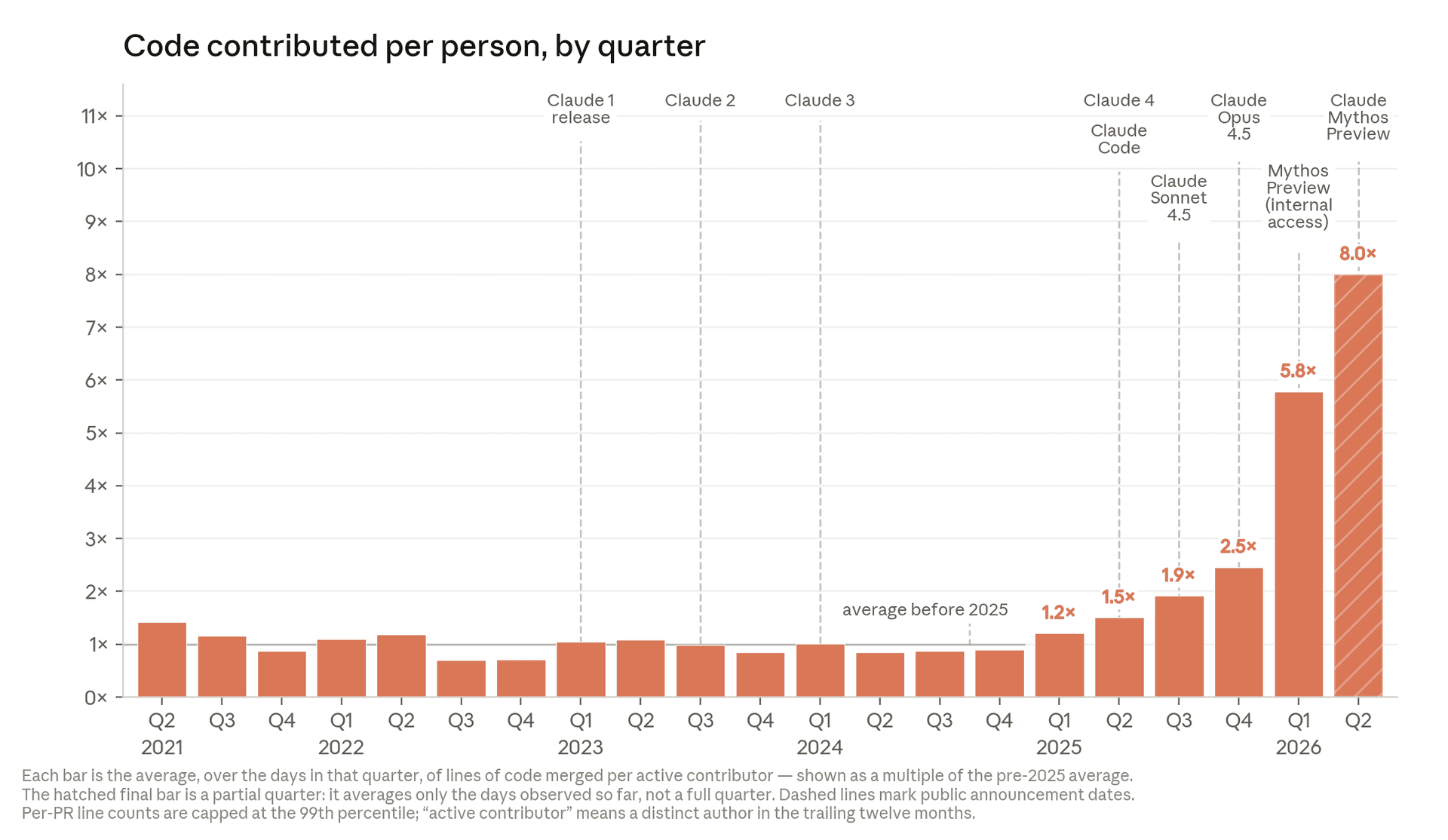
Source: Anthropic
Recursive self-improvement is what happens when AI systems become capable of designing and improving their own successors without human direction. Anthropic is not there yet. But the data they released tracks a consistent acceleration: the length of tasks AI can complete reliably on its own has been doubling roughly every four months. In March 2024, Claude could handle a task a human completes in four minutes. By April 2026, the equivalent model handles twelve-hour tasks. The current trajectory suggests tasks that take a skilled person days could come into range this year.
The human role is narrowing at each step of the AI development process. The "doing," writing code, running experiments, producing outputs, now costs almost nothing in human time, even when it carries real compute costs. What remains distinctly human, for now, is research taste: choosing which problems are worth working on, deciding which results to trust, and recognizing when an approach has hit a dead end.
One researcher put it plainly: "The shape of stuff today is roughly 'humans have ideas, and the models are able to implement, test and evaluate them an order of magnitude faster than before.'" Another reflected the harder edge of it: "On days where everything works well, I can't help but think nothing I do matters, everything is automated and better and faster than I ever will be."
The psychological dimension of working alongside AI systems that outpace human execution speed is real and underexplored. Organizations that treat this only as a productivity story miss the trust, meaning, and identity work happening in parallel.
A thread worth pulling here: if execution is no longer the bottleneck, decision-making is: knowing which ideas are worth pursuing in the first place. And that's not a skill people simply have. It requires development, the same as any other capability.
Anthropic lays out three scenarios, and their candor about which ones they consider likely is as significant as the scenarios themselves.
AI is already automating the entry-level work that has historically been how junior employees learned, with tech internship postings down 30% since 2023 and, per Gartner's May 2026 data, 74% of companies that have made AI-driven entry-level cuts having no development program to replace the lost learning.
The junior employees being cut today are the senior contributors and managers of 2030. They are losing the years of low-stakes, high-repetition work that built judgment in every generation before them. No one is replacing it. That is the talent debt organizations are taking on, and it will come due before most have thought to plan for it.
The most direct fix is putting junior employees in the room when senior decisions get made, not as note-takers but as observers who debrief afterward: what was the tradeoff, why that call, what information changed the outcome. Judgment built in the room only sticks with deliberate follow-through: a manager or a coach who debriefs what was observed, daily tools and longer term career plans to build these critical skills.
But decision-making now needs to improve faster than managers can keep up. Larger spans of control mean less time to debrief each decision with each person, and AI is only widening that gap by shortening the distance between an idea and its execution.
This is where AI can help, but only AI that actually had context. A generic assistant can't debrief a decision it wasn't there for. The AI that makes someone a better decision-maker is the one that was in the room: it heard the tradeoff, saw why one option won, and can walk someone through it afterward the way a busy manager can't. That's the real case for normalizing AI note-takers and recording, not surveillance, but real-time coaching on real decisions.

.png)
.webp)
“Thank you for setting the great foundation for my promotion; now I have a plan!"

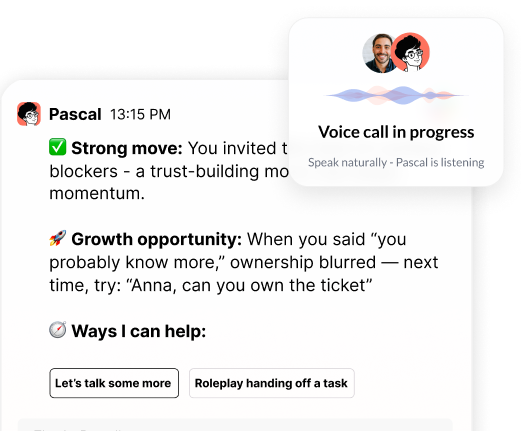
Curious to see how AI Coaching can 10X the impact and scale of your development initiatives. Book a demo today for: