
Blog article
Josh Bersin says 76% of companies have a broken training model. He's right.
76% of companies are stuck at the lowest levels of learning maturity. Here's what the top 5% do differently, and how AI closes the gap.


New McKinsey Quarterly research frames the entry-level squeeze as a design problem. Companies still need junior talent, but how that talent builds expertise has to change now that the tasks that used to teach it are disappearing. The rebuild touches four areas: knowledge management, role design, learning design, and how managers coach.
Pessimism among graduating seniors about starting a career jumped to 62%, up from 46% just two years ago, and three-quarters of that group point to one reason: firms hiring fewer entry-level workers. Judgment, context, and the ability to explain why something matters were always the scarce resource. What's shifted is how early companies now expect people to have them, and how few chances remain to build them on the job.
The first fix starts before any junior employee touches a task. McKinsey's argument: capture the frameworks, decision rules, and judgment calls your strongest performers rely on, and structure that knowledge so both AI systems and junior employees can draw on it directly.
Build in expert validation and clear feedback loops, and weight the system so accumulated judgment counts for more than one person's isolated experience. Done well, the system keeps improving with every use, continually sharpening what good actually looks like.
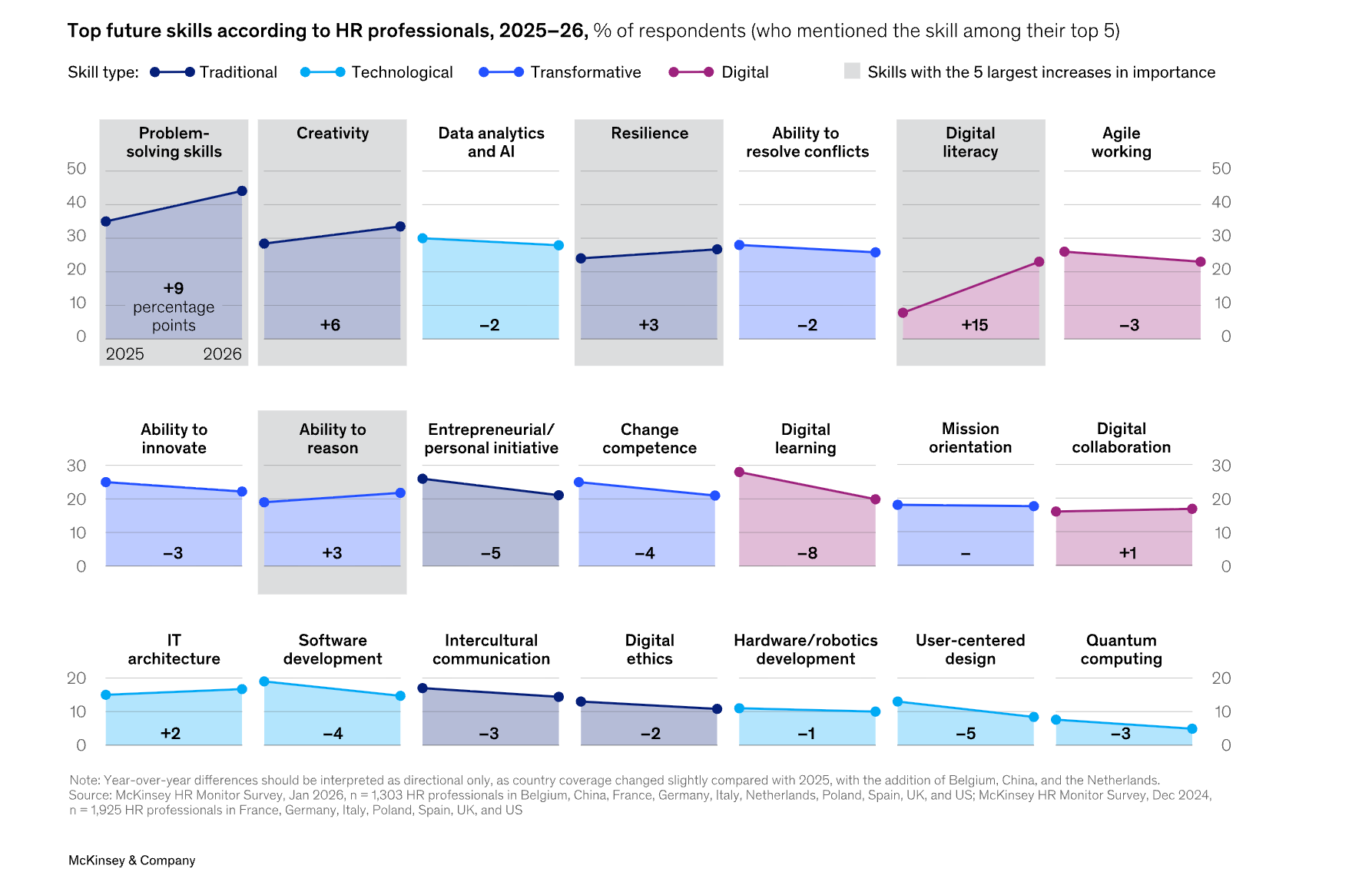
Roles that ask for AI skills are now nearly twice as likely to also demand analytical thinking, resilience, or agility alongside them. One HR leader at a Fortune 100 financial firm described hiring for "general athletes," people with strong learning instincts and baseline AI familiarity, chosen over a specific degree requirement. Bank of America is betting on that same logic at scale, holding its 2026 intern and campus-recruit class near 4,000, pulled from more than 500 schools, while redesigning those roles around AI from the first day.
One real estate firm has junior employees walk neighborhoods and build market assessments by hand before comparing their work against an AI-generated version, using the gap to teach judgment rather than handing over the answer.
Clinical research shows why that struggle matters: One group of physicians simply got an AI diagnostic tool to help them work. A second group had to reach their own diagnosis first, commit to it, and only then compare it against the AI's reasoning to see where they'd gone wrong. The first group never actually improved. Take the AI away, and their skill dropped right back to where it started. The second group did improve, and the gains held.
Struggling with the case before seeing the AI's answer is what made the feedback stick, and over time, that group's own diagnoses matched the model's accuracy without needing it in the room.
Hancock and Seiler point to a dynamic that two Microsoft engineering leaders, Mark Russinovich and Scott Hanselman, describe: agentic coding assistants give senior engineers an "AI boost," multiplying their output, while imposing an "AI drag" on juniors who don't yet have the judgment to steer or verify what the AI produces. Left unaddressed, that dynamic steadily removes the bottom rung every senior role depends on. Bank of America's head of global talent, Josh Bronstein, said, "We've got to give people the experiences in a simulated way quickly," compressing years of judgment-building into a program rather than leaving it to chance. Some organizations are formalizing that through a preceptor model, borrowed from medicine, where a senior mentors a small cohort of juniors and watches what they accept, reject, or misjudge when working with AI, shifting the job from answering questions to teaching judgment.
The skills hierarchy underneath all of this hasn't moved much. Judgment, context, and the ability to explain why a number matters were always the scarce resource. AI just raised the price of getting there without them.
Source: Bryan Hancock and Charlotte Seiler, "Building expertise in the age of AI: Who trains the next generation?" McKinsey Quarterly, July 2026.

.png)
.webp)
“Thank you for setting the great foundation for my promotion; now I have a plan!"

Curious to see how AI Coaching can 10X the impact and scale of your development initiatives. Book a demo today for: