

Insights from a Pinnacle CHRO Working Group on AI, feedback, and the future of performance
Performance management has spent the last 20 years trying to get out of its own way. Annual reviews gave way to check-ins. Ratings softened. Conversations became more frequent.
Now AI has entered the workflow. The unit of work has changed again.
We brought together seven senior people leaders in a Pinnacle CHRO Working Group to make sense of what is happening. The group included CHROs, Chief People Officers, and heads of talent from organizations ranging from a few thousand employees to well over 100,000. The question on the table was direct: How does performance management change when AI becomes part of how your people work every day? What do we measure, whose performance is it, and where does it live in the organization?
What follows are the trends emerging from that discussion, grounded in research and in what these leaders are seeing on the ground inside their companies.
Long before AI entered the workflow, performance management was carrying structural tension.
Leaders in the roundtable were unusually aligned on one point: The current system struggles to deliver what it promises. Even after years of redesign, feedback still arrives late, bias and recency effects shape outcomes. The formal cycle often functions as a forcing mechanism for a conversation, even when the quality of that conversation varies widely. It does not reliably create insight, growth, or behavior change.
Leaders in the roundtable described two shifts happening at once.
Assessment becomes continuous by default. AI can ingest unstructured data in a way performance systems never could, including calendar metadata, meeting transcripts, email and message exchanges, and work artifacts from task trackers and CRMs. That leads to a practical possibility: fewer “snapshot” reviews, and more ongoing evidence.
That is attractive because traditional assessment suffers from bias and recency. A more complete record can help. Employees also seem open to it. Gartner reported that in an October 2024 survey of nearly 3,500 employees, 87% believed algorithms could give fairer feedback than their managers.
Assessment also becomes more complex. If the work is done by a human plus AI, what exactly is being evaluated?
Roundtable participants kept circling the same tension. AI can improve output, but the employee still owns the judgment, the taste, the risk decisions, and the integrity of the final result. One participant summarized the direction of travel as moving “from doing the task to supervising the task.” That framing is showing up outside HR roundtables too.
So performance criteria are moving up the stack:
That last point matters more than it sounds. Continuous data makes it easier to see not only what shipped, but how people showed up. Did they collaborate. Did they build followership. Did they create friction in the right places, the kind that leads to transformative growth.
As one participant said, a missing component in many systems is that they do not provide “friction.” Many performance systems optimize for speed and efficiency. They track output, deadlines, and metrics. They rarely create space for “friction”, which is the harder conversation about presence, influence, and impact on others. .
The roundtable drew a clean line between what AI feedback does well and what it should never replace.
AI can deliver constructive feedback that feels less threatening. One participant described a consistent pattern in practice: “People more willing to receive feedback from AI.” The feedback feels less judgmental, so defensiveness drops. AI also excels at pattern identification, the repeated “Oh, you keep doing that thing.”
Humans are still preferred for recognition and the moments that build trust. The group repeatedly came back to human connection as a performance ingredient, not a nice-to-have. One participant framed it as “social fabric,” tied to well-being.
In an AI-augmented world, recognition becomes even more valuable as a signal of what the organization truly values. People discount praise that feels generic. They lean into praise that feels seen.
Follow-up is the part performance systems have struggled with for decades.
A manager provides feedback, then nothing happens for weeks. The employee repeats the same behavior. The manager gets frustrated. The relationship erodes.
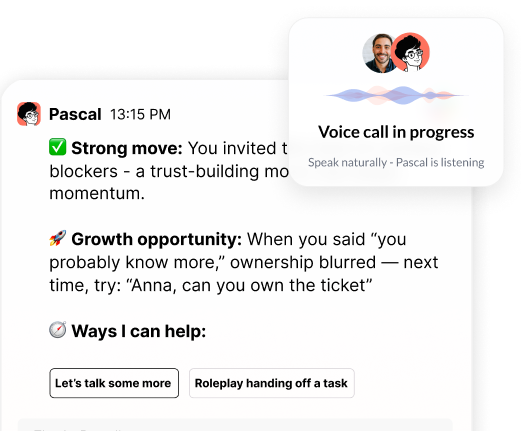
AI can change this in a surprisingly practical way. An always-available coach can prompt practice in the moment. It can remind someone before a meeting to ask two questions before offering a solution. It can surface the pattern after the meeting while the memory is fresh. That is follow-up.
This is also where “continuous” stops being a buzzword and becomes operational. Follow-up action only works when it is timed to the actual work sprint.
Which is why the roundtable kept returning to a sprint-team model.
Several participants questioned whether managers should remain the primary source of assessment. Much of today’s work happens in sprints, and the manager is often not on the sprint team. Yet they are still expected to judge sprint performance. The proposed shift is simple: Gather feedback from the collaborators who were in the sprint, then have the manager synthesize, peer feedback, add context, and turn it into a development plan.
This also addresses a core truth voiced in the room: “today, the weak link in the whole process is the manager.” If the manager is the bottleneck, the system will fail, regardless of tooling.
One of the participants offered a distinction that becomes more important as AI accelerates output.
AI can inflate the appearance of performance if criteria are purely output-based. That makes the growth lens essential. Leaders need to evaluate who is building durable capabilities, who is improving their judgment, and who is becoming more effective in ambiguous situations.
That also changes how promotion decisions work. The question becomes less “Did they produce a lot,” and more “Did they raise the quality bar, build followership, and scale impact through others and through tools.”
A big part of “performance in 2026” is whether an employee is building AI skill deliberately.
This came through in two ways.
One participant shared concrete examples of how they are using AI inside performance workflows: Managers can paste a loosely written goal into Gemini and convert it into a clear SMART goal with defined outcomes and timelines. They also use GPT to refine written feedback, tightening language, removing potential bias, and structuring it in a consistent “3 plus 3” format: three things that went well and three “even better if” suggestions.
She also described a tough conversation simulator. A manager can input a real scenario, choose how defensive or aggressive the other party might be, role-play the exchange, and receive feedback on their approach afterward.
Second, leaders are confronting the scale of upskilling required. EY research highlighted that employees with 81 or more hours of AI training per year saved 14 hours per week, compared to 3 hours for those with fewer than 4 hours.
That gap turns AI literacy into a performance factor, whether companies admit it or not. It also forces a policy decision. How much is employee ownership, and how much is organizational responsibility.
The roundtable’s most practical answer was to engineer learning into the work. Group AI learning sessions reduce fear, normalize experimentation, and keep people from silently falling behind.
Performance management is also a legal system.
One of the participants raised the question every HR leader hears from counsel: how to ensure adequate documentation for exits to mitigate risk. Legal teams still want reliable documentation, and many are not comfortable relying solely on AI-generated records.
That caution is reinforced by what is happening in adjacent domains like recruiting. Eightfold AI is facing litigation in California that alleges its tools generated “secretive reports” about job seekers, raising issues under the Fair Credit Reporting Act and related laws.
The takeaway is not to freeze. It is to design responsibly. Clear governance, transparency, and audits are now table stakes.
If a company wants a performance system that fits AI-augmented work, this is the simplest blueprint.
Performance management started as a yearly report card. It evolved into continuous conversations. In 2026, it becomes something else again.

.png)
.webp)
“Thank you for setting the great foundation for my promotion; now I have a plan!"

Curious to see how AI Coaching can 10X the impact and scale of your development initiatives. Book a demo today for: