Blog article
When boards say execute faster, they're really asking for a culture shift
A board's mandate to execute faster is really a culture mandate. See why AI coaching, not a deck or training module, is built for it.

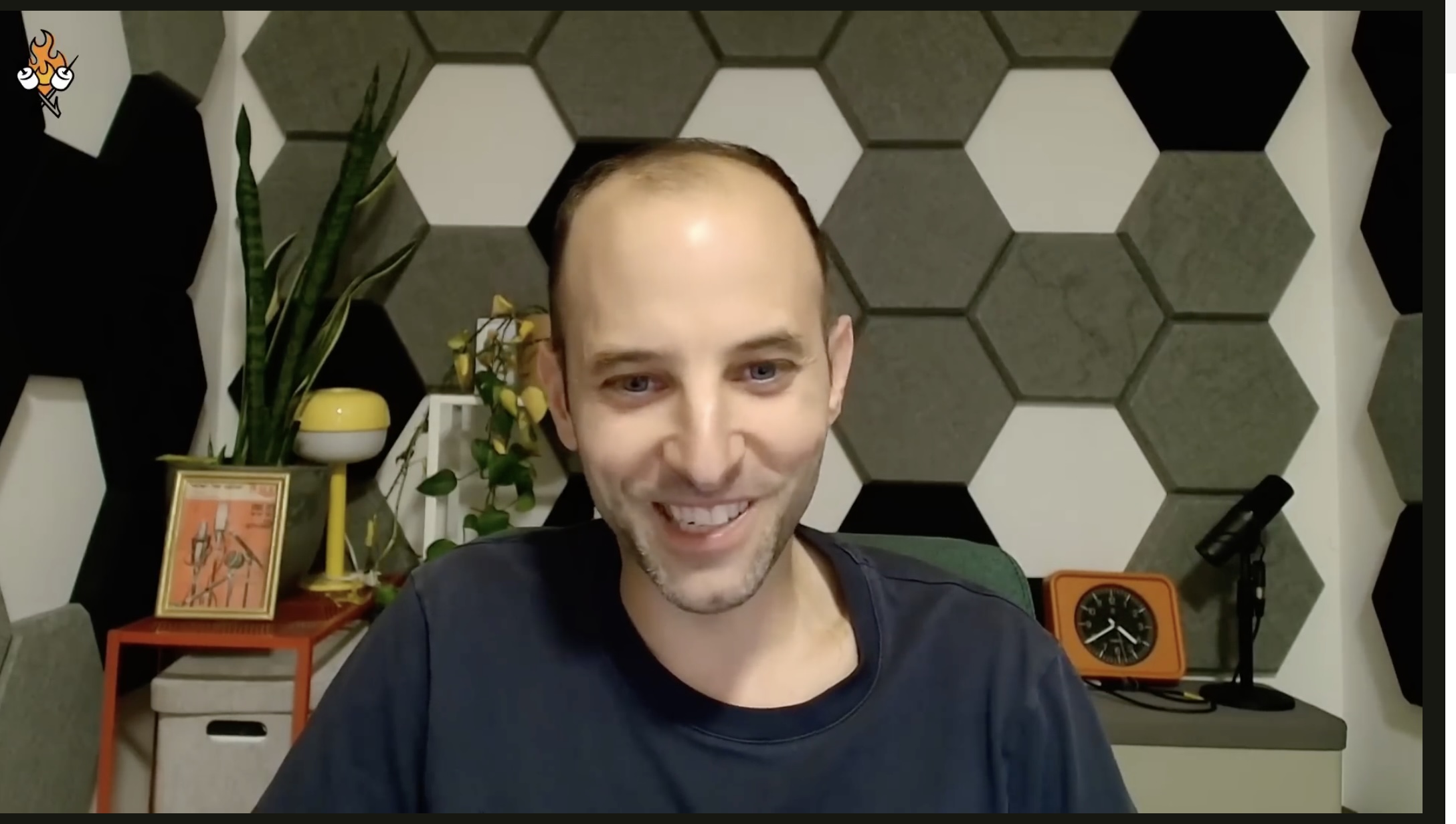
image credit: Lenny's podcast
Early on, monday.com kept a live dashboard on an office screen, tracking signups, customers, and churn in real time. They wired it to a speaker, so the whole room heard good news the second it happened instead of waiting for someone to bring it up in a meeting. A new customer got one sound. Hitting a revenue milestone got a Homer Simpson clip.
Daniel Ara, Monday.com's Chief Product and Technology Officer, told this story on Lenny's Podcast. The sound cues were just one piece of something bigger: they shared financial and product numbers with every employee, even candidates coming in for an interview.
Monday has gone from about 30 employees to roughly 3,000, and now serves over 250,000 paying customers. Revenue crossed $1 billion for the first time in 2025 and is on track to hit around $1.5 billion this year. This kind of transparency started when they were tiny, and it had to survive going public and a headcount that's grown nearly 100x since.
Ara's reasoning isn't about openness for its own sake. It's about not leaving people alone with bad news. He calls that feeling "the dark side of the moon," knowing something's wrong and carrying it by yourself. Sharing everything is how they keep that from happening to every leader in the company. "We really want everyone's brains in the challenge," he said, "not just one centralized brain and a lot of working hands."
Going public should have ended this. Lawyers told them a live financial dashboard couldn't sit at the front door anymore. Instead of dropping it, they built an internal tool with a public layer and a confidential, role-based layer, and set up standing trading plans so employees could keep seeing sensitive numbers without any insider-trading risk. That's a lot of extra work just to keep a habit alive.
Ara's bar for a PM is simple: "relentless until he gets this impact, and until he validates that this impact is in place." Sometimes the biggest impact isn't a new feature. It's making something you already built easier to actually find and use.
He listens for words like "enhance" and "augment" in a roadmap, because to him that usually means the team doesn't have a real goal yet. He gave an example: an AI feature the team was proud of, and only a few thousand of their 250,000 customers were using it. Turned out legal review was slowing the rollout. Once they pushed on it, 98% of customers had access within two weeks, instead of waiting out the quarter.
Back in 2018, the team walked in one morning to find a competitor had shipped dozens of new ways to track data overnight, things like budgets and due dates. Monday had built five of these over the past few years.
Ara doesn't frame that morning as a gut punch. "They showed us that it's possible," he said. "Now we need to think how." So they set a goal nobody knew how to hit: 25 of these in a month. They got there with a hackathon, one engineer, one build, one day each, turning a four-month process into one. Ara's point isn't "work harder" it's "think differently."
Ara calls self-imposed deadlines "traps." Give yourself three weeks to ship something, and when time runs out, cut scope instead of pushing the deadline back. "Scope it by time and not by effort," he said. "It makes you extremely focused." He even treats a warm, uncritical reaction to an early release as a bad sign, since it usually means the team spent too long guessing at what customers wanted instead of finding out for real.
He gave a recent example from an enterprise product they were building. Every instinct said wait, add more, make it comprehensive before showing anyone. They shipped an early version anyway, got back exactly the kind of "this is missing X and Y" feedback they needed, and called that a win, not a setback.
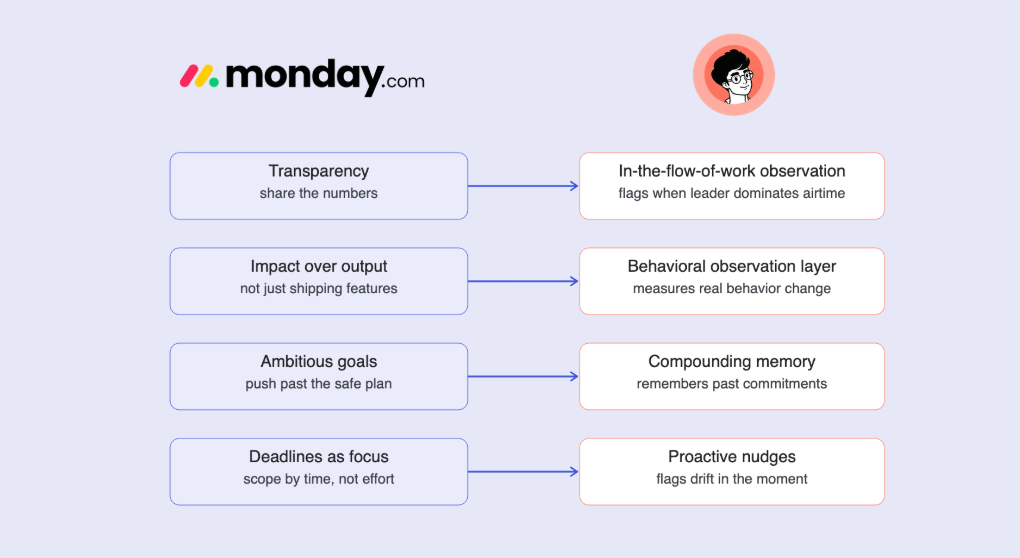
Catch the vague language early. Ara personally listens for "enhance" and "augment" in planning conversations. Pascal could flag that same language the second it shows up, in every team's meetings, not just the ones Ara happens to be in.
Push teams past the safe plan. Pascal remembers what a team committed to in past meetings. When a new plan reverts to a smaller, safer version of a goal the team already set for itself, Pascal flags the gap directly.
Give leaders a mirror on transparency. Pascal tracks who's actually talking in a meeting, not just who called it. If one person dominates the conversation while asking for everyone's input, Pascal flags that gap directly to the leader afterward.
For companies like monday.com, where transparency, ambition, and impact are daily habits, an AI coach carries those values into the one room leadership can't always watch.

.png)
.webp)
“Thank you for setting the great foundation for my promotion; now I have a plan!"

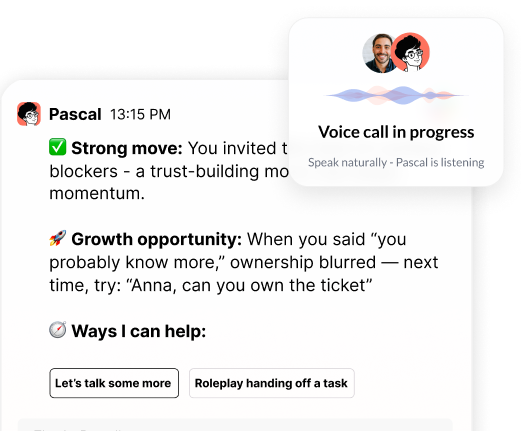
Curious to see how AI Coaching can 10X the impact and scale of your development initiatives. Book a demo today for: