Blog article
The job persists longer than the tasks: what Marc Andreessen sees coming for the workforce
Marc Andreessen's vision for how AI reshapes skills, tasks, and career strategy across the workforce.


Anthropic's Economics team has mapped out how powerful AI might change the US economy by 2030, from growth and jobs to wages and who keeps the gains. Its three highlighted scenarios put GDP anywhere from 1.6% to 32.4% higher than the same economy without AI. The analysis gets there by treating every job as a bundle of tasks, which makes this economic report a workforce planning document for CHROs.
Take a typical example: a financial analyst at a mid-size company. Her month runs from reconciling accounts to building the variance report and commentary, and then to walking budget owners through their numbers. Anthropic's approach gives each task four possible outcomes, since AI can help a person
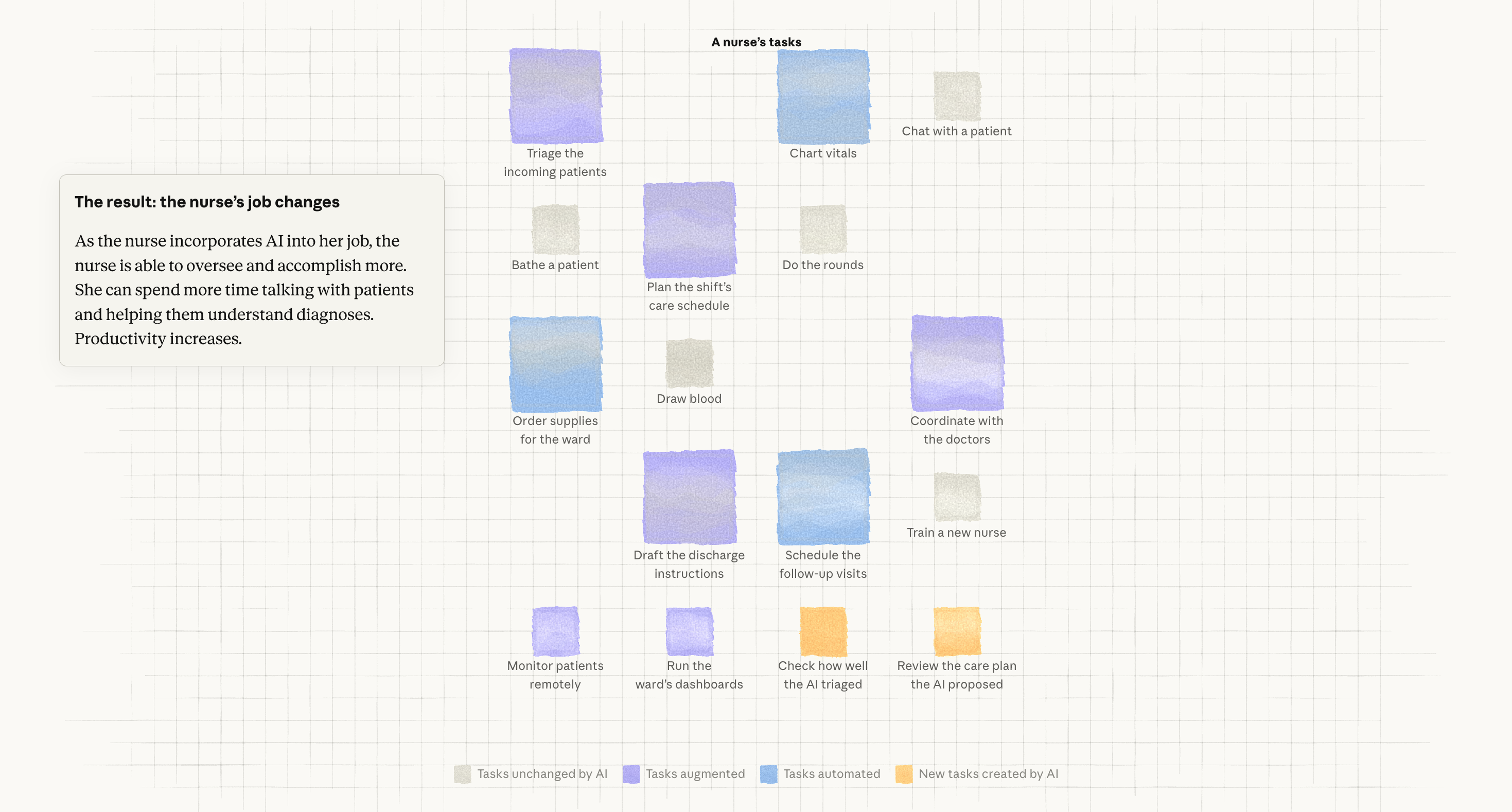
Source: Anthropic
In a role like hers, reconciliation is a likely candidate for automation, and AI can help her draft the commentary faster. The conversation with a budget owner about a missed forecast stays with her, and new work appears, such as checking an AI-drafted forecast before it reaches the CFO. Add up every task performed in the US, by people and by the machines and software they work with, and the analysis arrives at the US economy: over $30 trillion of value created over the past year.
Three futures set the range. They differ in how far AI's capabilities advance and how quickly industries and workers adopt them. Each GDP figure is for 2030 at 2025 prices:

Source: Anthropic
In August, Anthropic surveyed 10,980 Americans about where AI is headed. Their typical answers imply something close to the substantial scenario, with GDP 10% higher by 2030 and unemployment around 5%. About 10% hold views in line with the extreme one. For the analyst, that points to AI that could handle much of her reporting work, with her company deciding how much to hand over.
In the substantial and extreme scenarios, jobs in the occupations AI affects most shrink between 2026 and 2030, and switching careers, say from coder to electrician, takes many people a long time. Average wages rise in all three scenarios, with most of the gains outside knowledge work. Knowledge-worker wages stay essentially flat in the substantial scenario and fall by more than 10% in the extreme one.
Today, about 60 cents of each dollar the economy produces goes to workers. By 2030 that falls to 56.1% in the substantial scenario and 45.2% in the extreme one, as more of the gains flow to the owners of capital. In the extreme world, the economy grows by about a third while total pay to workers barely changes, so the main challenge is making sure the benefits are broadly shared. For people teams, that lands close to home: how pay, roles and career paths change for the knowledge workers whose tasks move to AI first.
Anthropic calls this scenario explorer Version 1.0, a stark simplification of a complex reality. It leaves out policy responses, business cycles and financial market disruptions, along with hyper-capable robots. Some of the economists who reviewed it questioned whether exposed occupations will shrink at all.
The 2030 economy depends on what AI can do, how companies and workers choose to adopt it, and how the gains are shared. Anthropic asks readers to weigh five forces: what AI can do, how much people use it, how much it does on its own, how much more productive it makes people, and how long it takes people to find new work. Several of those forces play out inside each company, as leaders decide which tasks move to AI and how quickly. For CHROs, much of the next four years is likely to happen there, in roles like the analyst's that get redesigned one task at a time, with the people in them moving along with the work.
Source: Anthropic Economics team, Scenarios for our Economic Future, based on the technical report by Korinek et al. (2026).



“Thank you for setting the great foundation for my promotion; now I have a plan!"

Curious to see how AI Coaching can 10X the impact and scale of your development initiatives. Book a demo today for: