

AI coaching delivers guidance inside daily workflows at the moment managers need it. Traditional training separates learning from application, causing low engagement and rapid knowledge decay.
Traditional LMS platforms see 5–15% engagement within six months (LinkedIn Learning, 2023). Managers must stop work, search for relevant material, and apply generic advice to specific situations. AI coaching meets managers in Slack, Teams, and meetings with guidance tailored to the challenge they're facing.
Companies spend millions on learning platforms employees rarely use unless required for compliance. Managers log in, search course catalogs, complete modules on their own time, then attempt to apply generic frameworks to specific situations days or weeks later.
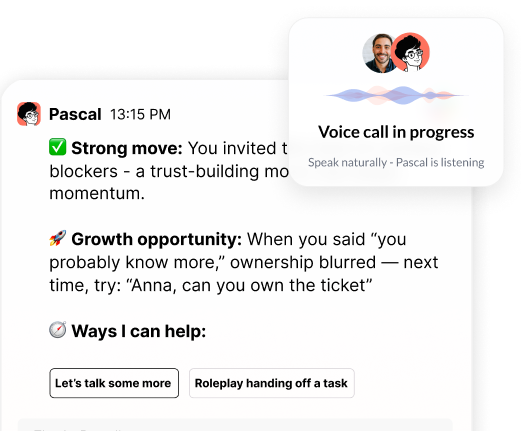
AI coaching flips this model. Guidance arrives before difficult conversations, after challenging meetings, when preparing for performance reviews. The tool lives where managers already work, eliminating the "go somewhere else to learn" barrier that kills LMS adoption.
Adults learn through practice in real work contexts. AI coaching delivers guidance when managers face actual leadership challenges, creating immediate application that scheduled training events cannot match.
The forgetting curve (Ebbinghaus, 1885) undermines traditional training. When you receive feedback on your communication patterns immediately after a 1:1 meeting, the learning sticks because it's attached to a specific, memorable experience.
Jeff Diana, former CHRO at Calendly and Atlassian, notes: "So much of the real learning and value comes from in-context coaching in the moment to drive performance and to solve problems in the moment."
Spaced repetition provides continuous reinforcement over weeks and months—the proven method for building lasting habits that one-time workshops cannot deliver. Traditional training delivers the same content to everyone. AI coaching observes your actual interactions and adapts guidance to your specific development areas.
Generic training content assumes all managers face the same challenges and learn the same way. AI coaching platforms build understanding of each manager's interactions, goals, and development areas, then deliver guidance calibrated to their specific context.
Traditional training delivers identical content whether you're a new manager struggling with delegation or a senior leader navigating organizational change. AI coaching (like Pascal) builds understanding of your values, competencies, team dynamics, and communication patterns through ongoing interactions, not one-time assessments.
Organizations can train AI coaching on specific leadership frameworks, values, and competencies, ensuring guidance reflects how the company operates, not generic best practices. Individual development paths track progress on specific goals over time and adjust coaching intensity and focus areas as managers develop.
Melinda Wolfe, former CHRO at Bloomberg and Pearson, explains: "It makes it easier not to make mistakes. And it gives you frameworks to think through problems before you act."
Traditional one-on-one coaching with human coaches costs $3,000–$15,000 per person annually (International Coach Federation, 2024), making it accessible only to senior executives. Less than 5% of managers who need development support receive professional coaching (Corporate Executive Board, 2023). AI coaching delivers professional-grade guidance at a fraction of traditional coaching costs, enabling organizations to provide every manager with 24/7 access to coaching support.
The executive-only problem leaves first-line and mid-level managers (who have the most direct impact on employee experience) without support. Most organizations reserve human coaching for VP-level and above.
Organizations can reduce spending on underutilized LMS platforms (typical cost: $50–$150 per user annually with 5–15% utilization) and low-impact training workshops to fund AI coaching that reaches every manager.
Behavior change requires repeated practice with immediate feedback. AI coaching provides continuous observation and feedback loops that reinforce desired behaviors over weeks and months. Training events offer a single exposure with no mechanism for sustained reinforcement.
Adults learn by doing, receiving feedback, adjusting, and trying again. This is why coaching works and why one-time workshops don't change behavior.
AI coaching solves the training sustainment problem by observing behavior in the flow of work after the workshop ends. When the platform is in meetings and Slack conversations, it can track whether managers are applying the skills they learned and provide coaching to reinforce those behaviors.
This gives L&D leaders concrete data on behavior change that traditional surveys and LMS metrics can't capture. Instead of asking "Did you complete the module?" organizations can answer "Are managers demonstrating the desired behaviors in actual team interactions?"
The feedback loop creates accountability without surveillance. Managers receive private, constructive guidance that helps them improve without feeling monitored.
Where your AI coach lives determines whether managers use it daily or forget it exists. AI coaching embedded in tools managers already use every day (Slack, Teams, Zoom, and Google Meet) drives higher adoption than platforms requiring them to visit another application.
The "go somewhere else" problem kills adoption. Even well-designed tools fail when they require managers to break their workflow, open a new application, and context-switch. When coaching happens where work happens, adoption follows.
Proactive engagement matters more than on-demand access. When you receive feedback immediately after your 1:1 meeting, you don't need to remember to ask for help. The guidance arrives when it's most relevant and actionable.
Real-time meeting analysis allows AI coaching to observe actual communication patterns, not self-reported assessments. It can identify when a manager dominates the conversation, misses opportunities to delegate, or needs to provide more specific feedback.
Pascal is SOC2 (Security Organization Control 2) compliant and never uses customer data to train models, ensuring enterprise-grade security while maintaining the contextual awareness that makes coaching effective.
Purpose-built AI coaching platforms like Pascal are designed for leadership development, integrating organizational context, behavioral data, and proven coaching frameworks to deliver personalized guidance in the flow of work. Generic chatbots provide reactive, disconnected advice.
Generic chatbots lack the deep contextual understanding needed for meaningful coaching. They can't observe your team interactions, understand your organization's culture, or adapt guidance to your specific development goals.
ICF-certified (International Coach Federation) coaches train Pascal's coaching models, ensuring guidance reflects proven frameworks rather than generic AI responses. This foundation matters when managers face complex situations requiring nuanced judgment: performance conversations, conflict resolution, strategic decisions.
Harvard Business Impact's 2025 Global Leadership Development Study found that 55% of organizations are prioritizing generative AI and machine learning in their leadership development initiatives. The winners won't be those who deploy chatbots. They'll be the ones who design purpose-built coaching systems trained on their culture, values, and leadership principles.
Data Breakdown:
• Dimension: Cost per manager | AI Coaching: Fraction of traditional coaching costs | Traditional Training: $3,000–$15,000 annually (human coaching); $50–$150 (LMS)
• Dimension: Personalization | AI Coaching: Adapts to individual context, communication style, and development areas | Traditional Training: Generic content for all participants
• Dimension: Reinforcement | AI Coaching: Continuous feedback loops over weeks and months | Traditional Training: Single exposure with no sustained follow-up
• Dimension: Integration | AI Coaching: Embedded in daily tools (Slack, Teams, meetings) | Traditional Training: Separate platform requiring context-switching
• Dimension: Engagement rate | AI Coaching: High adoption through proactive, contextual delivery | Traditional Training: 5–15% engagement within six months
• Dimension: Access | AI Coaching: Available to all managers 24/7 | Traditional Training: Limited to executives (human coaching) or self-directed (LMS)
• Dimension: Timing | AI Coaching: Guidance at moments of need | Traditional Training: Scheduled events disconnected from application
• Dimension: Behavioral observation | AI Coaching: Observes actual team interactions and communication patterns | Traditional Training: Self-reported assessments or no tracking
• Dimension: Cultural alignment | AI Coaching: Trained on organizational frameworks and values | Traditional Training: Generic best practices
• Dimension: Feedback mechanism | AI Coaching: Immediate, private, constructive guidance after interactions | Traditional Training: Delayed or absent feedback loops
Traditional LMS platforms separate learning from application. AI coaching embeds guidance into daily workflows where managers already work. Cost barriers limit coaching to executives. AI coaching enables organizations to support every manager, not just senior leaders.
Behavior change requires continuous feedback loops. Purpose-built AI coaching observes actual team interactions and provides reinforcement over time. Integration strategy determines adoption. AI coaching embedded in Slack, Teams, and meetings eliminates the context-switching that kills standalone platforms.
Purpose-built platforms outperform generic chatbots. ICF-certified coaching models, organizational context, and behavioral observation deliver measurable outcomes that generic AI tools cannot match.
The future of leadership development isn't about replacing human coaches. It's about scaling what they do best: helping managers think clearly, act decisively, and grow through real situations. Organizations that treat AI coaching as a strategic capability (not a chatbot experiment) will develop stronger managers faster than competitors still relying on quarterly workshops and underutilized LMS platforms.
See how Pascal works inside Slack and Teams to deliver coaching at the moments that matter most. Learn more at https://www.heypinnacle.com.
Header photo by Vitaly Gariev on Unsplash

.png)
.webp)
“Thank you for setting the great foundation for my promotion; now I have a plan!"

Curious to see how AI Coaching can 10X the impact and scale of your development initiatives. Book a demo today for: