
Most managers have tried asking ChatGPT for leadership advice. The response sounds helpful until you realize it has no idea who you are, who's on your team, or what happened in yesterday's disastrous 1-on-1.
AI coaching built for leadership development works differently. It observes your workplace interactions, understands your organization's culture, and applies structured coaching frameworks to your specific challenges.
The distinction comes down to architecture. Purpose-built AI coaches attend meetings, analyze communication patterns across Slack and Teams, and map workplace relationships. They know who you are, who you work with, and what's happening in your organization.
Chatbots respond to isolated queries with generic advice. They don't know your people, your culture, or the context that makes guidance useful.
AI coaching surfaces guidance before and during critical moments. You get preparation support for difficult conversations, real-time feedback during meetings, and post-interaction reflection—without leaving your workflow.
The methodology matters. AI coaches trained by ICF-certified coaches (the International Coach Federation's professional standard) apply proven frameworks around accountability, feedback structures, and delegation strategies. Chatbots generate conversational responses based on language patterns.
Key Comparison: AI Coaching vs. Chatbots
Data Breakdown:
• Dimension: Context Awareness | AI Coaching: Observes meetings, relationships, organizational culture | Chatbots: No knowledge of your company or team
• Dimension: Timing of Guidance | AI Coaching: Proactive, surfaces before and during critical moments | Chatbots: Reactive, waits for you to ask
• Dimension: Methodology | AI Coaching: Structured coaching frameworks from certified coaches | Chatbots: Language pattern responses
• Dimension: Integration | AI Coaching: Embedded in Slack, Teams, meetings | Chatbots: Separate platform you visit
• Dimension: Personalization Depth | AI Coaching: Adapts to your style, goals, team dynamics | Chatbots: Generic advice for everyone
AI coaching platforms ingest organizational data—your competency models, values frameworks, communication norms, and workplace interactions—to deliver guidance aligned with how leadership works in your culture.
Pascal (Pinnacle's AI coaching platform) builds a knowledge graph (a database that maps relationships between people, conversations, and organizational concepts) by observing meetings, analyzing communication patterns, and tracking workplace relationships. When a manager asks for help preparing for a difficult conversation with a specific team member, Pascal understands:
• The history of interactions between these two people
• Recent team dynamics affecting the relationship
• The manager's communication style and blind spots
• Your organization's values and how they apply to this situation
• The competencies you're developing across your management population
This depth of context grounds the coaching in actual relationships and challenges managers navigate daily.
The integration extends beyond individual development. AI coaching platforms that observe communications and meetings can aggregate anonymous data to provide enterprise-level insights. You get real-time views of company culture and performance.
Managers engage with AI coaching when it demonstrates understanding of their specific situation and provides guidance they can apply immediately. Trust builds through relevance.
Three factors drive trust. First, observation over recollection. When AI coaches attend meetings (by accessing meeting transcripts and recordings), they see what happened rather than relying on the manager's filtered memory. This creates accountability and more accurate feedback.
Second, consistency without judgment. Managers can practice difficult conversations, admit mistakes, and ask basic questions without fear of damaging their reputation. The AI coach maintains confidentiality while providing consistent frameworks.
Third, proof through results. When managers see their direct reports improving, they trust the guidance they're receiving.
Melinda Wolfe (former CHRO at Bloomberg, Pearson, and GLG) notes: "It makes it easier not to make mistakes. It gives you frameworks to think through problems before you act."
The privacy architecture matters. Pascal is SOC2 compliant and never trains its models on customer data. Managers know their conversations remain confidential and won't be used to train systems for other companies.
Purpose-built AI coaching platforms implement organization-specific controls, moderation flags for sensitive topics, and anonymous aggregated insights that protect individual privacy while delivering organizational value.
AI coaching platforms that adapt to individual communication styles, career goals, and development areas create personalized experiences by learning from each interaction. Personalization means the guidance evolves as the manager grows.
Pascal's personalization operates on multiple levels:
Individual adaptation — Learning each manager's communication patterns, decision-making style, and areas where they need the most support.
Relationship mapping — Understanding the dynamics between specific managers and their team members.
Goal alignment — Connecting daily coaching moments to longer-term development objectives and career aspirations.
Cultural calibration — Adjusting guidance based on your organization's values, competencies, and what "good leadership" means in your context.
A chatbot might produce a grammatically perfect response about delegation. An AI coach knows whether you tend to over-delegate or under-delegate, which team members are ready for more responsibility, and what delegation frameworks align with your company's leadership model.
Jason H. (a Senior Manager at a mid-sized tech company using Pascal) describes the difference: "Pascal knows the actual context of my relationships and recent interactions with specific team members. When I practice a difficult conversation, Pascal steps into the role of the actual person I need to talk to, using real information about our working relationship."
The personalization extends to role-playing capabilities. You're not practicing a theoretical difficult conversation. You're practicing the actual conversation you need to have tomorrow with Sarah from engineering. Pascal uses historical communication patterns from your Slack messages and meeting transcripts to simulate how Sarah typically responds, creating realistic practice scenarios.
AI coaching delivers value during three windows: before high-stakes interactions, during real-time conversations, and after moments that require reflection. Chatbots miss these windows because they're not present in your workflow.
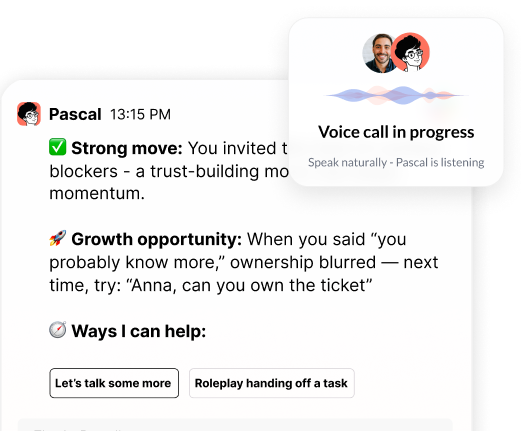
Before a difficult conversation, Pascal helps managers prepare by reviewing relationship history, suggesting frameworks aligned with organizational values, and role-playing potential scenarios. This preparation happens in Slack or Teams.
During meetings, Pascal provides real-time guidance without interrupting the conversation. Managers receive subtle nudges (via a sidebar notification in their meeting software) about communication patterns, reminders about team member goals, and alerts when conversations drift from stated objectives.
After interactions, Pascal prompts reflection with specific questions based on what happened. Rather than generic "how did that go?" prompts, you get targeted feedback: "You interrupted Sarah three times when she was explaining the technical constraints. How might that have affected her willingness to raise concerns in the future?"
This continuous coaching cycle (prepare, perform, reflect) mirrors how adults learn through practice and iteration.
Purpose-built AI coaching platforms implement multiple layers of protection to ensure guidance stays helpful, appropriate, and aligned with organizational values.
Pascal's guardrail system includes:
Moderation flags that detect potentially problematic content (profanity, harassment indicators, or advice that contradicts company policy)
Sensitive topic escalation that routes mental health, legal, or HR issues to human experts
Organization-specific controls that align coaching with company policies
Anonymous aggregated insights that protect individual privacy while delivering organizational value
The escalation framework is critical. AI coaches should recognize when situations require human expertise. Mental health concerns, legal questions, harassment reports, and complex interpersonal conflicts need human intervention.
The data architecture matters equally. Pascal never trains its models on customer data. Your conversations, meeting transcripts, and organizational information remain yours. This SOC2-compliant approach ensures that coaching insights developed for your managers don't leak into training data for other companies.
• AI coaching platforms built for leadership development integrate organizational context, behavioral observation, and proven coaching frameworks—different from chatbots that provide generic, disconnected responses
• Trust builds through relevance and results: managers engage when AI coaches demonstrate understanding of specific situations and deliver guidance that improves team performance
• Personalization means continuous learning from each interaction and adapting to individual communication styles, career goals, and team dynamics
• The coaching value comes from being present during critical moments: before high-stakes interactions, during real-time conversations, and after moments requiring reflection
• AI coaching requires guardrails (moderation systems, escalation protocols for sensitive topics, and data architectures that protect organizational privacy)
The gap between AI coaching and chatbots isn't about conversational quality. It's about whether the system understands your organization, observes your work, and applies structured coaching frameworks to help managers grow.
See how Pascal works inside Slack to deliver coaching in the flow of work—no separate platform required, no generic advice, just personalized guidance when and where managers need it most.
Header photo by Mohamed Nohassi on Unsplash

.png)
.webp)
“Thank you for setting the great foundation for my promotion; now I have a plan!"

Curious to see how AI Coaching can 10X the impact and scale of your development initiatives. Book a demo today for: