

Start with first-time and mid-level managers navigating leadership transitions. They show the highest engagement rates and fastest measurable impact. After proving value with managers, expand to high-potential individual contributors and distributed teams.
Your initial rollout population sets the trajectory for enterprise-wide adoption. The transition moment creates natural motivation. Managers in role transitions have immediate, high-stakes needs that drive engagement with new tools. Smaller, high-impact cohorts generate measurable results within 90 days that justify broader investment. Early adopters become internal champions who accelerate subsequent deployment waves.
Starting with development-focused populations reduces the perception that AI coaching is remedial. When you position AI coaching as support for growth rather than performance correction, adoption accelerates across the organization.
Population Comparison
Data Breakdown:
• Employee Population: First-time managers | Primary Use Cases: Difficult conversations, delegation, feedback delivery
• Employee Population: Mid-level managers | Primary Use Cases: Team dynamics, performance issues, coaching skills
• Employee Population: High-potential ICs | Primary Use Cases: Communication skills, stakeholder management, leadership preparation
• Employee Population: Distributed teams | Primary Use Cases: Remote communication, async collaboration, team cohesion
First-time managers face the steepest learning curve in their careers—suddenly responsible for people, not projects. Mid-level managers carry the heaviest coaching load with the least support. Both populations show immediate engagement when given accessible, real-time guidance because they're wrestling with daily challenges that traditional training programs don't address.
A 2022 Gartner study found 60% of new managers feel unprepared for their roles, creating urgent demand for support. Traditional executive coaching costs $10,000–$15,000 per six-month engagement. AI coaching platforms cost $100–$300 per user annually, making them economically viable for entire manager populations.
Managers face difficult conversations, performance issues, and team dynamics challenges weekly—sometimes daily. These frequent high-stakes moments create multiple opportunities for AI coaching to demonstrate value.
"When it comes to helping first-time or mid-level managers, the risk of doing nothing can be just as high as the risk of trying something new," notes Melinda Wolfe, former CHRO at Bloomberg, Pearson, and GLG. The preparation gap is real, and the cost of inaction compounds daily.
AI coaching platforms that integrate into existing workflows (Slack, Teams, Zoom) eliminate the friction of explaining context repeatedly. Tools that observe actual behavior in communication channels enable guidance grounded in what's happening, not abstract scenarios.
High-performers and technical specialists benefit from AI coaching, but they're better positioned as your second wave after proving value with managers. Individual contributors in client-facing roles (sales, customer success) and technical experts transitioning toward leadership show strong engagement when AI coaching is positioned as career acceleration, not remediation.
High-potential ICs engage when AI coaching is tied to promotion pathways and leadership skill development. Engineers, data scientists, and product managers value AI coaching for communication skills, stakeholder management, and cross-functional collaboration—areas where technical training doesn't help.
Sales and customer success roles benefit from real-time coaching on difficult conversations, negotiation strategies, and relationship management. Rolling out to ICs after manager success creates aspirational demand—"I want access to the tool my manager uses"—rather than skeptical resistance.
A tech company with 500 employees started with 40 first-time managers, then expanded to high-potential ICs who requested access after seeing manager results. The demand-driven expansion created momentum that formal rollout plans rarely achieve.
Distributed teams and remote workers represent a high-impact population for AI coaching because they lack the informal coaching moments that happen in office environments. Position them as a parallel track to your manager rollout.
Remote workers miss the hallway conversations, the quick desk-side coaching, the observation of how experienced colleagues handle situations. AI coaching fills that gap by providing guidance in the flow of work, regardless of location or timezone. The 24/7 availability matters more for distributed teams than any other population.
The key is ensuring the AI coach integrates into the communication platforms remote teams already use (Slack, Teams, Zoom) rather than requiring them to adopt new tools. Coaching happens where the work happens, eliminating the context-switching that kills adoption in remote environments.
Start with 40-100 first-time or mid-level managers facing active leadership transitions. Run a focused 90-day pilot that generates measurable results: manager effectiveness improvements, direct report feedback, specific behavior changes. Use those results to build internal demand before formal expansion.
Identify change agents within your pilot group. These early adopters become your internal champions who accelerate subsequent waves. Their testimonials carry more weight than any vendor case study.
Expand to high-potential ICs and distributed teams in parallel tracks, using the manager success stories to drive adoption. Position AI coaching as a career development resource, not a performance tool. Make it aspirational.
The sequencing matters as much as the populations. Starting with managers proves value within one quarter. Expanding to ICs builds momentum. The combination creates organization-wide demand for continuous development.
• First-time and mid-level managers deliver the fastest ROI from AI coaching because they face immediate, high-stakes challenges that drive daily engagement with new tools
• Start with 40-100 managers facing leadership transitions to prove value within 90 days, then expand to high-potential ICs and distributed teams using success stories to drive demand
• Distributed teams and remote workers show strong engagement with AI coaching that integrates into existing communication platforms, filling the gap left by missing informal coaching moments
• Sequencing matters: managers first for proof points, then ICs and distributed teams in parallel for momentum and organization-wide adoption
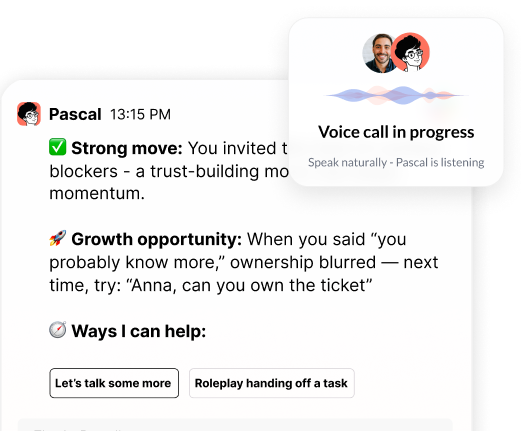
Pascal lives where work happens—joining meetings, sitting in Slack or Teams, and providing real-time guidance grounded in your organization's dynamics. See how Pascal helps managers navigate their toughest challenges in the flow of work.
Header photo by Ant Rozetsky on Unsplash

.png)
.webp)
“Thank you for setting the great foundation for my promotion; now I have a plan!"

Curious to see how AI Coaching can 10X the impact and scale of your development initiatives. Book a demo today for: