

Start with first-time and mid-level managers. They face more people decisions than any other group and show results in 60–90 days.
Your first cohort makes or breaks adoption. Managers who face people decisions daily (performance conversations, delegation, conflict resolution) build habits fast. The tool becomes a reflex, not a resource they remember once a quarter.
Visible impact builds momentum. When a director cuts performance review prep from 60 minutes to 10 minutes, other leaders ask for access. Early wins create organizational pull.
New managers face an impossible learning curve. They're navigating delegation, feedback, and conflict resolution for the first time while delivering individual contributor work. Traditional workshops provide frameworks but abandon them when decisions happen.
They're promoted for technical skills, then expected to master people leadership without training. They manage 8–12 coaching moments per week but lack experience to navigate them confidently.
New managers seek guidance actively. They don't have mental models for difficult conversations yet, so they turn to resources that meet them in real time. When AI coaching integrates into Slack or Teams, it becomes their first call.
Getting initial leadership experiences right builds confidence and prevents mistakes that damage team trust. Managers who receive real-time coaching before tough 1:1s develop better habits than those who learn through trial and error.
"Managers rarely need help in a workshop—they need it when preparing for a tough 1:1 or in the middle of a team conflict." — Melinda Wolfe, Former CHRO at Bloomberg, Pearson, and GLG
Human coaching costs $15,000+ annually and serves only executives. AI coaching meets new managers in real moments (before a difficult 1:1, during a team conflict, when preparing performance reviews) at a fraction of the cost.
Mid-level managers (directors, senior managers) represent your organizational multiplier layer. They manage other managers, influence culture across teams, and face complex people decisions daily: performance calibration, organizational design, cross-functional conflict, talent development.
They're experienced enough to recognize quality coaching but stretched too thin to access traditional resources. They face 10–15 coaching moments per week, each needing guidance that generic training can't provide.
Decision complexity escalates at this level. Matrix reporting, budget tradeoffs, talent retention, team restructuring—these situations need contextual guidance, not one-size-fits-all frameworks.
Mid-level managers shape how most employees experience company culture and leadership expectations. When this layer adopts AI coaching, the impact cascades both up (visible to executives) and down (modeled for their teams).
Time scarcity is the constant constraint. Mid-level managers who use AI coaching instead of searching for frameworks, scheduling HRBP meetings, or guessing at best practices reclaim hours for better decisions and faster team development.
Sales professionals deliver fast, measurable ROI but create expansion challenges. Representatives encounter 15–20 coaching opportunities per week: prospect calls, objection handling, deal negotiations, customer escalations.
Clear metrics make sales an attractive pilot. Conversion rates, deal velocity, customer retention—outcomes are visible in 30–45 days. Finance teams understand these metrics, which makes budget justification straightforward.
The expansion problem: sales success doesn't translate to broader adoption. Revenue outcomes matter to sales. Leadership effectiveness and team development matter to managers. Organizations that start with sales need to re-sell AI coaching when expanding to other functions. You'll run two pilots instead of one.
Choose sales if you need fast ROI proof for budget approval and plan to run a separate manager pilot in 90 days. Choose managers if you want one pilot that expands across the organization.
HR leaders and business partners should use AI coaching 30–60 days before manager rollout. This creates informed champions who can speak from experience without positioning the tool as an "HR initiative."
HR leaders who use the tool daily can answer manager questions from direct experience. They understand what works, what doesn't, and how to position the value.
Use case discovery happens during HR adoption. HR teams surface applications (accommodation guidance, complex employee relations scenarios, policy interpretation) that inform broader rollout strategy.
The approach: HR uses the tool for 30–60 days, then serves as trained guides during manager rollout. This creates informed champions without creating an "HR tool" perception that kills adoption.
Three factors matter: coaching moment frequency, measurable impact timeline, and organizational expansion potential.
Coaching moment frequency drives engagement. Populations facing daily people decisions (first-time managers, mid-level managers, sales teams) build habits faster than those with occasional needs. When users encounter scenarios multiple times per week, AI coaching becomes integrated into their workflow.
Measurable impact timeline affects budget approval and momentum. Sales teams show results in 30–45 days through conversion rates and deal velocity. Managers demonstrate impact in 60–90 days through team performance metrics and retention.
Organizational expansion potential determines long-term value. Manager pilots expand as leadership effectiveness becomes visible across teams. Sales pilots require re-selling the value proposition when expanding to non-revenue roles.
Data Breakdown:
• Factor: Coaching Moments/Week | First-Time Managers: 8–12 | Mid-Level Managers: 10–15 | Sales Teams: 15–20
• Factor: ROI Timeline | First-Time Managers: 60–90 days | Mid-Level Managers: 60–90 days | Sales Teams: 30–45 days
• Factor: Adoption Barriers | First-Time Managers: Low (actively seeking guidance) | Mid-Level Managers: Low (recognize value, time-constrained) | Sales Teams: Medium (focused on revenue metrics)
• Factor: Cost per User | First-Time Managers: Low | Mid-Level Managers: Low | Sales Teams: Low
• Factor: Expansion Potential | First-Time Managers: High (natural spread across management) | Mid-Level Managers: High (cascades up and down) | Sales Teams: Medium (requires re-selling to other functions)
• Start with first-time and mid-level managers who face 8–15 coaching moments per week and show measurable impact in 60–90 days
• Choose sales for fast ROI proof (30–45 days to results) but plan a separate manager pilot for organizational expansion
• HR should adopt 30–60 days before manager rollout to build credible advocacy without creating an "HR tool" perception
• Use this decision framework: If you need budget approval fast, start with sales. If you want one pilot that expands naturally, start with managers. If you have high turnover in first-time manager roles, prioritize that population.
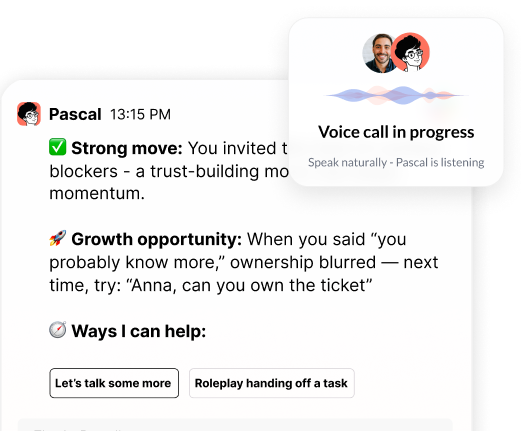
Ready to see how AI coaching works for your organization? See how Pascal works inside Slack to deliver real-time coaching at scale.
Header photo by LinkedIn Sales Solutions on Unsplash

.png)
.webp)
“Thank you for setting the great foundation for my promotion; now I have a plan!"

Curious to see how AI Coaching can 10X the impact and scale of your development initiatives. Book a demo today for: