
First-time managers deliver the fastest ROI from AI coaching. They face 15-20 high-stakes conversations per week without coaching access. Senior leaders already have executive coaches. Individual contributors face fewer people management decisions.
Your initial deployment determines whether AI coaching becomes a daily resource or another unused tool. Organizations starting with first-time managers see 40% higher adoption rates than company-wide rollouts (SHRM State of AI in HR 2024, p. 23).
First-time managers face the steepest learning curve. They're promoted for technical skills but lack people management training. A workshop doesn't help when you're preparing for a tough 1:1 at 6 PM. When managers get immediate value (preparing for difficult conversations, navigating performance reviews, handling team conflict), they become champions who accelerate adoption.
Early wins create momentum. Initial cohorts generate usage patterns and outcome metrics that inform which populations to prioritize next. Focused deployment lets you refine customization and test guardrails before expanding.
Five populations deliver measurable ROI from AI coaching, ranked by speed of impact and adoption rates:
Data Breakdown:
• Population: First-time & mid-level managers | ROI Timeline: 90 days | Key Metrics: Manager NPS +20%, 83% direct report improvement | Adoption Rate: Highest (60-70% weekly active)
• Population: Sales & customer-facing professionals | ROI Timeline: 60 days | Key Metrics: Conversion rates +19.7%, pipeline velocity | Adoption Rate: High (daily usage)
• Population: High-potential employees | ROI Timeline: 3-6 months | Key Metrics: Retention +30%, time-to-promotion -3-6 months | Adoption Rate: High (growth-motivated)
• Population: Distributed & remote team leaders | ROI Timeline: 90 days | Key Metrics: Team engagement scores, turnover reduction | Adoption Rate: Medium-high (isolation drives need)
• Population: Technical individual contributors | ROI Timeline: 6+ months | Key Metrics: Collaboration effectiveness, project outcomes | Adoption Rate: Medium (selective deployment)
A coaching moment is any situation requiring leadership judgment: giving feedback, delegating work, resolving conflict, conducting performance discussions. First-time managers face 15-20 of these per week.
These managers lack access to traditional coaching (which costs $15,000+ annually per person). Organizations report that 83% of direct reports observe measurable improvement in their managers within 90 days. Companies see 20% lifts in Manager Net Promoter Score (a survey measuring how likely employees are to recommend their manager).
AI coaching that integrates into Slack and Teams provides guidance before managers realize they need help. This contextual awareness (understanding of ongoing situations, team dynamics, and previous conversations) drives sustained behavior change, not crisis-only support.
Sales teams see rapid ROI because every client interaction is a coaching opportunity. AI-coached sales reps achieve 19.7% higher conversion rates than those receiving traditional training (The Conference Board, "AI Coaching Effectiveness in Revenue Organizations," 2025, p. 14).
High-frequency conversations create immediate feedback loops. Applications include pre-call preparation, objection handling, negotiation strategy, and post-call reflection. The direct line from coaching usage to pipeline metrics makes ROI measurement straightforward.
Launch during Q1 planning or after annual sales kickoff when teams focus on skill development.
High-performers identified for leadership tracks benefit because AI coaching scales development opportunities previously reserved for executives. A 2024 Gartner study found that organizations using AI coaching for high-potentials report 30% higher retention rates among this population (Gartner HR Research, "Scaling Leadership Development," 2024, p. 8).
These employees are hungry for growth but lack structured support between promotion cycles. AI coaching reduces time-to-promotion by 3-6 months while demonstrating investment in top talent.
Combine AI coaching with existing leadership development programs to reinforce workshop concepts in daily work.
Remote managers face challenges that AI coaching addresses directly: building team cohesion without physical proximity, reading engagement signals through screens, maintaining culture across time zones. These leaders feel isolated from peer support.
AI coaching integrated into Slack and Teams meets managers where they work. 24/7 availability matches global schedules. Organizations report improved team engagement scores, reduced turnover in remote teams, and faster onboarding of distributed hires.
Technical ICs show strong ROI when they face frequent collaboration challenges—not when their work is heads-down execution. This population requires strategic selection based on role demands.
Best-fit scenarios include technical leads who influence without authority, senior engineers mentoring junior team members, and product managers navigating cross-functional stakeholders. Start with senior ICs, measure impact, then expand based on demonstrated value.
Coaching must address technical leadership challenges (code reviews, technical mentorship, architecture decisions) rather than generic management topics.
Sequence your deployment across four phases, each building on proven results from the previous stage:
Data Breakdown:
• Phase: Phase 1: Prove value | Timeline: Months 1-3 | Target Population: 20-50 first-time managers | Focus Areas: Performance reviews, difficult conversations, delegation, conflict resolution | Success Metrics: 60-70% weekly active usage, Manager NPS improvement
• Phase: Phase 2: Expand strategically | Timeline: Months 4-6 | Target Population: Sales teams OR high-potentials | Focus Areas: Revenue impact OR retention | Success Metrics: Conversion rates +19.7% OR retention +30%
• Phase: Phase 3: Scale to all managers | Timeline: Months 7-12 | Target Population: All people managers including senior leaders | Focus Areas: Organization-wide manager effectiveness | Success Metrics: Manager NPS, engagement scores
• Phase: Phase 4: Selective IC deployment | Timeline: Year 2 | Target Population: High-collaboration ICs (technical leads, senior ICs, project managers) | Focus Areas: Collaboration effectiveness, cross-functional influence | Success Metrics: Project outcomes, collaboration metrics
Phase 1: Prove value (Months 1-3). Deploy to 20-50 first-time managers. Focus on high-stakes use cases: performance reviews, difficult conversations, delegation decisions, conflict resolution. Target 60-70% weekly active usage and Manager NPS improvement.
Phase 2: Expand strategically (Months 4-6). Based on Phase 1 results, expand to either sales teams (if revenue impact is priority) or high-potentials (if retention is critical). This builds momentum while maintaining focus on populations with clear ROI metrics. Track conversion rates for sales teams or retention rates for high-potentials.
Phase 3: Scale to all managers (Months 7-12). Extend to all people managers, including senior leaders who can model adoption. At this stage, you have usage patterns, outcome data, and refined customization that inform broader deployment. Measure organization-wide Manager NPS and engagement scores.
Phase 4: Selective IC deployment (Year 2). Expand to individual contributors in roles with high collaboration demands—technical leads, senior ICs, cross-functional project managers. Track collaboration effectiveness and project outcomes.
Track adoption metrics (leading indicators) and business outcomes (lagging indicators).
Adoption metrics show immediate engagement. Active users (weekly usage), coaching sessions per user, time spent in coaching conversations. Organizations see 60-70% weekly active usage among managers within the first month.
Behavioral indicators reveal skill development. Manager Net Promoter Score, 360 feedback improvements, direct report observations of manager effectiveness. 83% of direct reports observe measurable improvement within 90 days.
Business outcomes connect coaching to priorities. Retention rates, time-to-productivity for new managers, performance review quality scores, team engagement survey results. Organizations see 20% lifts in Manager NPS.
Usage patterns inform expansion strategy. Which coaching topics generate the most engagement? What time of day do managers seek guidance? Which populations show highest adoption? This data guides Phase 2 and Phase 3 decisions.
Five critical mistakes prevent AI coaching from delivering ROI:
Mistake 1: Company-wide launch without champions. Broad rollouts without identifying early adopters lead to low adoption. Organizations starting with targeted populations see 40% higher adoption rates than company-wide launches (SHRM State of AI in HR 2024, p. 23).
Mistake 2: Launching during low-stakes periods. Deploying AI coaching when managers aren't facing immediate challenges reduces perceived value. Time launches around performance review cycles, organizational changes, or other high-stakes periods.
Mistake 3: Treating AI coaching as a standalone tool. AI coaching that lives inside Slack, Teams, and meetings meets managers in their existing workflow. Solutions requiring context-switching see lower adoption.
Mistake 4: Insufficient customization to company context. Generic coaching advice doesn't build trust. Effective AI coaching customizes around your company's values, competency frameworks, and organizational priorities. Upload company documents (leadership competencies, values statements, performance frameworks) during setup. Integration with your HRIS provides access to performance data and org structure.
Mistake 5: Ignoring privacy concerns. Employees won't use a coach they don't trust. Establish clear data privacy policies. Look for SOC2 compliance. Individual conversations should remain confidential. Organizational insights should be anonymized and aggregated. Verify that your data coaches your employees but never trains models on customer data (your conversations don't improve the product for other customers).
AI coaching drives results through five mechanisms that traditional training cannot replicate:
Proactive coaching meets managers before they realize they need help. AI coaching that joins meetings and sits in Slack and Teams channels provides real-time feedback during actual work moments. Proactive means the AI surfaces guidance based on what it observes (a tense exchange in Slack, a meeting that went poorly, a decision point in a conversation). On-demand means you ask the AI a question and it responds. The best systems do both.
Contextual awareness builds on organizational knowledge. AI coaching maintains a knowledge graph of your interactions, performance data, and company priorities. This means you don't repeatedly explain situations. The AI knows your team structure, your current projects, your performance goals, and your previous conversations. It provides guidance grounded in your specific culture and values.
Personalized guidance adapts to individual needs. Every person gets a unique experience customized around their role, function, level, performance goals, and team dynamics.
Integration eliminates adoption friction. AI coaching that works inside Slack, Teams, Zoom, and Google Meet means you don't switch tools. This integration is critical for sustained adoption.
Enterprise security maintains trust. SOC2 compliance, moderation flags for sensitive topics, and organization-specific controls ensure AI coaching meets enterprise standards.
• Start with first-time and mid-level managers who face 15-20 coaching moments per week and lack access to traditional coaching support (this population delivers 40% higher adoption rates than company-wide rollouts)
• Sequence deployment: prove value with managers (Months 1-3), expand to sales or high-potentials based on priorities (Months 4-6), scale to all managers (Months 7-12), then selectively deploy to high-collaboration ICs (Year 2)
• Track weekly active usage and sessions per user (leading indicators) plus Manager NPS, 360 feedback, and retention rates (lagging indicators) to demonstrate ROI within 90 days
• Avoid company-wide launches without champions, deployment during low-stakes periods, standalone tools requiring context-switching, insufficient company customization, and unclear privacy policies
• Integration into existing workflow (Slack, Teams, meetings) and proactive coaching that surfaces guidance before managers realize they need it drive sustained adoption
Pascal's AI coaching platform integrates into Slack and Teams to provide contextual, proactive guidance for managers. Schedule a demo to explore how AI coaching accelerates manager effectiveness in your organization.
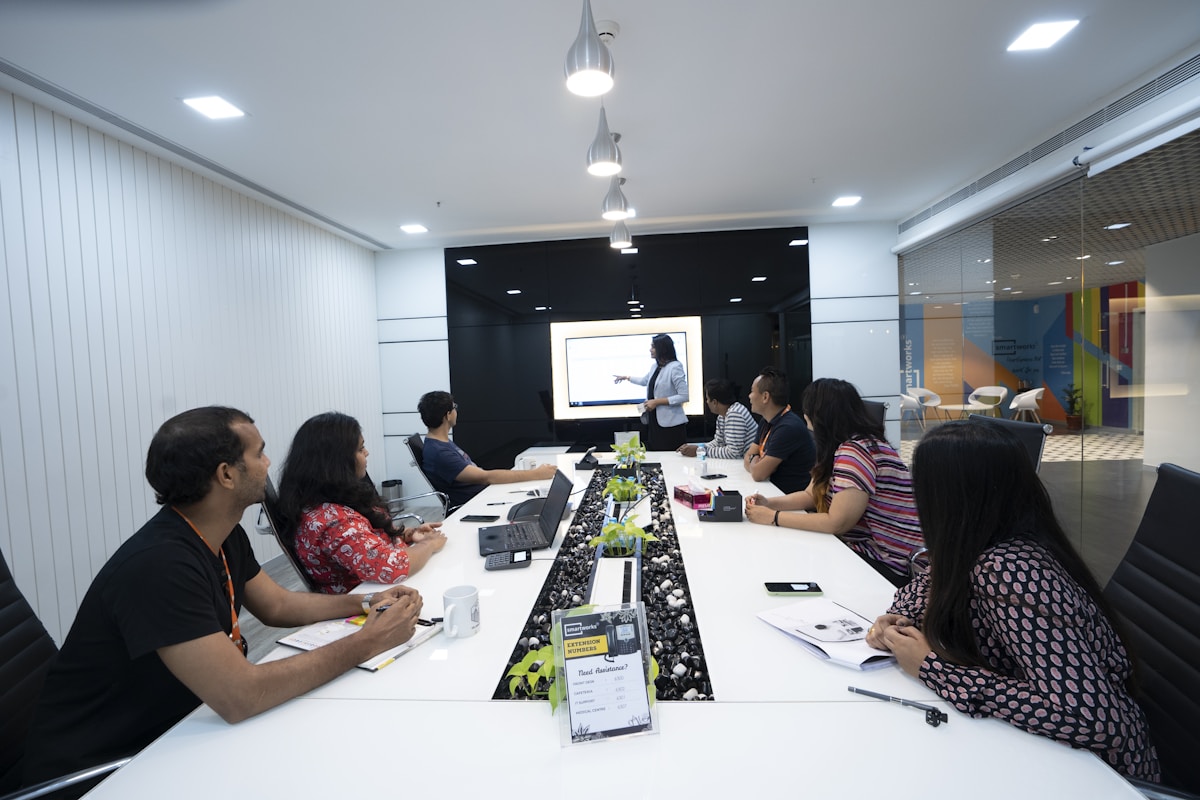
Header photo by Smartworks Coworking on Unsplash

.png)
.webp)
“Thank you for setting the great foundation for my promotion; now I have a plan!"


Curious to see how AI Coaching can 10X the impact and scale of your development initiatives. Book a demo today for: