

Start with first-time and mid-level managers. They face daily coaching moments without executive access to traditional coaching, encounter frequent high-stakes decisions where guidance compounds impact within weeks, and create measurable ROI that makes expansion defensible.
Your pilot population choice makes or breaks your AI coaching investment. Pick the wrong group (executives who already have coaches, or individual contributors without direct reports) and you'll struggle to demonstrate ROI within your decision window.
The right pilot group shows measurable behavior change within 60–90 days, creates internal advocates, and builds the business case for expansion. According to Gallup research cited in Fortune, 70% of team engagement variance traces to the manager. Pilot with populations that directly influence team performance and you create visible impact.
Most organizations overthink pilot design and lose momentum. Aim for 100+ participants—large enough to show patterns, small enough to manage closely. Your decision window is 60–90 days before organizational attention shifts.
Define success before launch: adoption rate (target 70%+ weekly active users), behavior change metrics (360 feedback improvements, direct report surveys), and leading indicators (coaching sessions per week, topics addressed). Without clear criteria, you'll debate results instead of scaling what works.
First-time managers face an impossible learning curve with minimal support. They're expected to master delegation, feedback, conflict resolution, and team motivation while delivering their own work. Traditional training offers a two-day workshop then nothing.
This population shows impact fastest because every coaching interaction addresses an immediate need. When they get real-time feedback guidance during 1-on-1s or help preparing for difficult conversations, the value is immediate. Within weeks, their direct reports notice.
First-time managers encounter 5–10 coachable moments daily: delegation decisions, feedback conversations, conflict mediation, performance discussions. Most receive zero ongoing support, making any improvement visible to their teams and leadership.
The ripple effect multiplies pilot impact. Each manager influences 5–8 direct reports, so 100 manager participants impact 500+ employees. Early manager effectiveness predicts long-term leadership success—this investment compounds over years.
Mid-level managers lack executive coaching budgets but face equally complex people challenges. They're managing managers, navigating matrix organizations, and balancing strategic thinking with operational execution—all measured on team performance.
This population becomes your internal champions. When a director sees improvement in their team's engagement scores or their own 360 feedback, they become vocal advocates. Their credibility with senior leadership accelerates enterprise adoption decisions.
Executives get $15,000/year human coaches. Mid-level managers get nothing despite similar complexity. Directors control L&D budgets and can champion expansion once they experience value.
Each director influences 3–5 managers who each influence 5–8 individual contributors. One hundred directors impact 2,000+ employees. This layer has established 360 feedback, engagement surveys, and performance data to measure impact objectively.
This approach works because high-performers adopt new tools faster, provide better feedback, and create social proof that drives broader adoption. Struggling managers resist new tools as "one more thing" and may lack the self-awareness to use coaching effectively.
High-performers de-risk your pilot. If your best managers see value, leadership trusts the tool works. If they don't, you've learned something before investing more. Starting with struggling managers creates a "remedial tool" perception that kills enterprise adoption.
High-performers try new tools within 48 hours. Struggling managers may take weeks. Top performers articulate specific use cases and improvement suggestions that shape your rollout strategy.
When your best managers share wins in team meetings, Slack channels, or leadership forums, others want access. This creates pull from other populations instead of push from HR.
Set a 90-day timeline with milestones at 30, 60, and 90 days. Define 3–5 success metrics before launch: adoption rate (target 70%+ weekly active users), behavior change indicators (360 feedback, direct report surveys), and leading indicators (coaching sessions per week, topics addressed).
Structure your pilot with an intact team or department rather than scattered individuals. When an entire engineering team or sales organization pilots together, you create network effects—managers discuss experiences, share use cases, and normalize the tool as part of daily work.
Track both quantitative metrics (usage data, session frequency, topic patterns) and qualitative feedback (user testimonials, manager interviews, direct report observations). Combine leading indicators (adoption, engagement) with lagging indicators (performance improvements, retention).
Provide light-touch training at launch: 30-minute onboarding, quick-start guide, and weekly tips for the first month. Over-training kills adoption. The best tools are intuitive enough that managers learn by using them.
Track adoption metrics first: percentage of pilot participants who activate their account, weekly active users, and average sessions per user. If adoption falls below 60% in the first 30 days, you have an onboarding or value communication problem. Fix it before measuring outcomes.
Behavior change metrics matter most for ROI. Survey direct reports at 30, 60, and 90 days: "Has your manager's feedback quality improved?" "Do you have clearer goals?" "Has communication frequency increased?" These observable changes validate that coaching translates to action.
Topics addressed (delegation, feedback, conflict, career development), session depth (single-question conversations versus multi-turn exchanges), and proactive engagement (manager initiates versus waits for prompts) reveal whether the tool is becoming a trusted resource or occasional utility.
Manager Net Promoter Score provides a simple gauge: "How likely are you to recommend this AI coaching tool to another manager?" Track this at 30, 60, and 90 days to measure sustained value.
Aggregate insights at the organizational level reveal patterns: Which topics surface most? Where do managers need additional support? What skills gaps appear across teams? These insights inform your broader L&D strategy beyond the pilot.
• Start with first-time and mid-level managers who face daily coaching moments but lack access to traditional coaching—they deliver the fastest proof of value and create visible impact within 60–90 days
• Pilot with high-performers to accelerate adoption, generate social proof, and de-risk your investment before broader rollout
• Structure pilots with intact teams (100+ participants minimum) rather than scattered individuals to create network effects and normalize AI coaching as part of daily work
• Define clear success metrics before launch: 70%+ adoption rate, observable behavior changes from direct reports, and leading indicators like session frequency and topic depth
• Track both adoption and impact: weekly active users prove engagement; direct report surveys and 360 feedback improvements prove behavior change and ROI
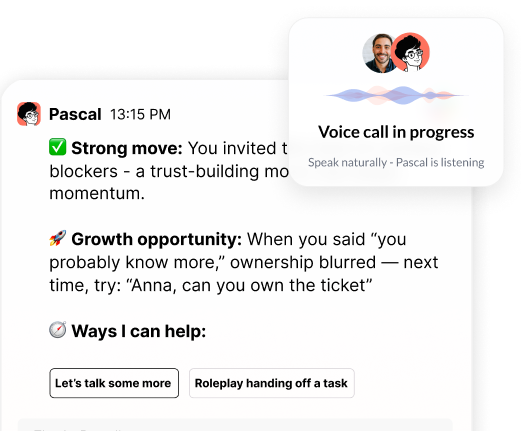
Pascal meets managers where work happens—in Slack, Teams, and meetings—delivering real-time coaching that drives measurable behavior change. See how Pascal works inside your workflow.
Header photo by Vitaly Gariev on Unsplash

.png)
.webp)
“Thank you for setting the great foundation for my promotion; now I have a plan!"

Curious to see how AI Coaching can 10X the impact and scale of your development initiatives. Book a demo today for: