

Pilot AI coaching with first-time and mid-level managers facing high-stakes transitions, supplemented by a cross-functional sample that includes high-performers, distributed team leads, and at least one senior sponsor. This combination proves value quickly through measurable behavior change while building organizational credibility for broader adoption.
Start with first-time and mid-level managers. These populations face the steepest learning curves and deliver the fastest measurable ROI because they encounter frequent, high-stakes decisions where coaching compounds advantage within weeks.
First-time managers navigate an impossible learning curve—mastering delegation, feedback, conflict resolution, and team motivation while still delivering individual contributor work. Mid-level managers (directors, senior managers) lack access to traditional coaching but face daily people challenges.
Senior leaders should participate as sponsors, not primary users. Their visible adoption signals organizational commitment, but their coaching needs differ (strategic vs. tactical). The "transition moment" predicts engagement: newly promoted leaders, people managing teams for the first time, or leaders who recently moved into new roles show the deepest appetite for support.
Data Breakdown:
• Population: First-time managers | Engagement Pattern: Daily use | Time to Value: 2–4 weeks | ROI Proof: Observable behavior change | Organizational Signal: "We invest in new leaders"
• Population: Mid-level managers | Engagement Pattern: 3–5 times per week | Time to Value: 3–6 weeks | ROI Proof: Team engagement lift | Organizational Signal: "We support the backbone"
• Population: Senior leaders | Engagement Pattern: Monthly | Time to Value: 6–12 weeks | ROI Proof: Hard to isolate | Organizational Signal: Executive buy-in
• Population: High-performers | Engagement Pattern: 2–3 times per week | Time to Value: 4–8 weeks | ROI Proof: Retention, promotion readiness | Organizational Signal: "We develop top talent"
Select pilot participants using three criteria: role-based need (managers facing frequent people decisions), transition status (newly promoted or in new roles), and organizational influence (respected voices whose adoption signals credibility). Aim for 50–200 people with at least 70% in manager roles and 30% representing cross-functional diversity.
Prioritize managers with direct reports who face daily coaching moments—1-on-1 preparation, feedback delivery, conflict navigation, performance conversations. Include 2–3 transition cohorts: new managers promoted in the last 6 months, leaders who recently joined the company, managers taking on expanded teams.
Add 15–20% influencers—respected individual contributors, senior managers, or department heads whose visible adoption accelerates peer buy-in. Ensure cross-functional representation: engineering, sales, operations, customer success. Different functions surface different use cases and validate broader applicability.
Avoid the "struggling manager" trap: don't pilot exclusively with underperformers. This positions AI coaching as remedial rather than developmental. Geographic and demographic diversity matters: distributed teams, different office locations, and varied backgrounds ensure the AI coach works across your actual employee population.
HR business partners should identify high-impact teams, nominate manager participants, and serve as pilot champions who model usage and gather qualitative feedback.
HRBPs know which managers face the highest-stakes people challenges—performance improvement plans, team restructures, conflict situations. Partner with HRBPs to identify moments where AI guidance could prevent escalation or improve outcomes.
HRBPs should use the AI coach themselves to understand the experience and credibly recommend it to managers. Create HRBP feedback loops: weekly check-ins during the pilot to surface adoption barriers, use cases, and success stories.
The most effective pilots position HRBPs as co-pilots, not gatekeepers. When HRBPs refer managers to the AI coach for routine guidance, they free up capacity for complex situations while ensuring managers get support in real-time rather than waiting days for an HRBP meeting.
Distributed teams and remote managers should represent 30–40% of your pilot population. Remote managers lack hallway conversations, informal feedback opportunities, and the ambient context that in-office leaders absorb naturally.
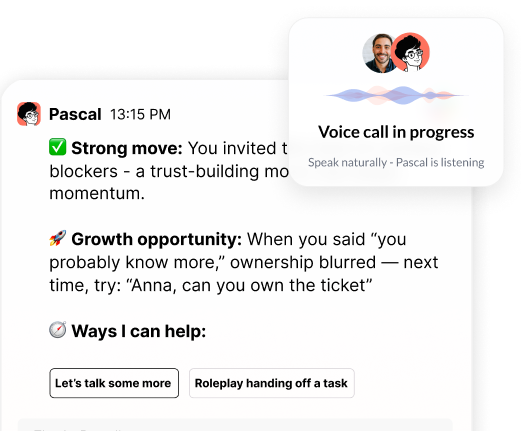
AI coaching that integrates into Slack, Teams, and video meetings becomes valuable for distributed populations. These managers can't walk down the hall to ask a peer for advice before a difficult conversation. They need guidance in the moment, wherever they're working.
Distributed teams also serve as a stress test for your AI coach's capabilities. If the tool works for remote managers across time zones, it will work for everyone. Include at least one fully remote team, one hybrid team, and one team with international presence in your pilot cohort.
Include both high-performers and managers who need development, but weight your pilot toward people who will use the tool. High-performers (20–30% of pilot population) provide credibility and surface advanced use cases, while managers facing development challenges prove the tool's impact on behavior change.
High-performers engage differently: they use AI coaching for promotion readiness, strategic thinking, and navigating complex organizational dynamics. Their participation signals that AI coaching isn't remedial—it's a competitive advantage. When your best managers visibly adopt the tool, others follow.
Don't pilot exclusively with high-performers. You need to prove the tool works for managers across the performance spectrum. Include managers who struggle with delegation, feedback delivery, or team engagement—these populations show dramatic improvements and generate compelling ROI stories.
The ideal mix: 30% high-performers, 50% solid performers facing transition moments, 20% managers with identified development needs. This distribution proves broad applicability while generating both aspiration (high-performer use cases) and transformation (struggling manager turnarounds).
Run pilots for 8–12 weeks, tracking three metric categories: adoption frequency (sessions per user per week), leading indicators (1-on-1 quality, feedback frequency), and lagging outcomes (direct report engagement, manager NPS). Pilots shorter than 8 weeks measure novelty, not habit formation. Pilots longer than 12 weeks lose executive patience.
Week 1–2: Measure activation (percentage who complete onboarding and first session). Target: 80% activation within first week. Week 3–6: Track engagement frequency. Target: 3 sessions per user per week for managers, 1–2 for individual contributors. Week 7–12: Measure behavior change through direct report feedback, 360 data, or manager self-assessment.
The strongest predictor of enterprise success isn't satisfaction scores—it's sustained engagement. If 60% of pilot participants use the tool at least twice per week by week 12, enterprise adoption will succeed. If engagement drops below 40%, investigate barriers before expanding.
Structure pilots with clear hypotheses, quantifiable metrics, and comparison groups. Define what success looks like before launch: "If 70% of pilot managers use the tool 3 times per week and their direct reports report 15% improvement in feedback quality, we'll expand enterprise-wide."
Include a control group—similar managers who don't receive AI coaching access. Compare engagement scores, 1-on-1 quality, and feedback frequency between pilot and control populations. This isolates the AI coaching impact from broader organizational initiatives.
Collect both quantitative and qualitative data. Quantitative: adoption frequency, session duration, feature usage, direct report engagement scores. Qualitative: manager testimonials, behavior changes, situations where AI coaching prevented escalation or improved outcomes.
Present results in business terms: "Pilot managers saved an average of 2 hours per week on 1-on-1 preparation, equivalent to $X in productivity gains. Direct reports reported 20% improvement in feedback quality, correlating with 15% higher engagement scores." Executives need ROI, not satisfaction ratings.
After a successful pilot, expand strategically rather than universally. Roll out to similar populations first (all first-time managers, all mid-level managers), then broaden to adjacent groups. Rapid universal deployment risks overwhelming support capacity and diluting the change management focus.
Document pilot learnings: which populations engaged most, which use cases drove value, which integrations mattered, which barriers emerged. Use these insights to refine onboarding, communication, and support for the next wave.
Promote pilot participants as champions. Their stories, use cases, and visible adoption accelerate peer buy-in more than any executive memo. Create a champions network that new users can tap for advice and encouragement.
Plan for scale: ensure your AI coaching vendor can support enterprise deployment, that IT infrastructure can handle increased load, that HR has capacity to support adoption. The transition from 100 pilot users to 1,000 enterprise users exposes gaps in vendor capabilities, technical infrastructure, and change management resources.
Maintain momentum. The window between pilot completion and enterprise decision should be 2–4 weeks maximum. Longer delays allow enthusiasm to dissipate and skeptics to regroup. Strike while the pilot success is fresh and champions are energized.
• Pilot with first-time and mid-level managers who face frequent, high-stakes people decisions where coaching delivers fastest ROI and most measurable behavior change
• Include 50–200 participants across 2–3 functions with at least 70% in manager roles, 30% cross-functional diversity, and 15–20% organizational influencers whose adoption signals credibility
• Run 8–12 week pilots tracking adoption frequency (3 sessions per week), leading indicators (1-on-1 quality, feedback frequency), and lagging outcomes (direct report engagement, manager NPS)
• Partner with HR business partners to identify high-impact teams, nominate participants, and create feedback loops that surface adoption barriers and success stories
• Structure pilots with clear hypotheses and comparison groups to prove ROI in business terms: productivity gains, engagement improvements, and behavior change that executives can quantify
• Expand strategically after pilot success by rolling out to similar populations first, promoting pilot participants as champions, and maintaining momentum with 2–4 week decision windows
Ready to see how AI coaching works inside your managers' daily workflow? Explore Pascal's platform and discover how context-aware coaching drives measurable behavior change in the flow of work.
Header photo by Christina @ wocintechchat.com M on Unsplash

.png)
.webp)
“Thank you for setting the great foundation for my promotion; now I have a plan!"

Curious to see how AI Coaching can 10X the impact and scale of your development initiatives. Book a demo today for: