

First-time managers show the highest engagement and deliver the clearest proof points for organizational expansion. A pilot of 50–150 participants provides statistically meaningful data while maintaining manageable implementation scope.
Piloting makes sense when you have 200+ employees, existing Slack or Teams infrastructure, and managers who face immediate coaching needs. Skip the pilot if you're a small organization (under 100 people), lack workflow tools, or recently launched a coaching program that failed.
A pilot validates three things: managers will use an AI coach embedded in their workflow, you can measure behavior change within 90 days, and early adopters will champion broader rollout.
First-time managers and newly promoted leaders engage more than tenured executives because they face immediate, high-stakes needs without established support systems. They're navigating delegation, feedback delivery, and team dynamics for the first time.
Look for managers who meet these criteria: promoted or hired into management within the past six months, managing direct reports or leading cross-functional projects, comfortable with Slack or Teams, and respected by peers so their success stories spread.
Engagement Patterns by Role Type
Data Breakdown:
• Role Type: First-time managers | Sessions per Week: 4.5 | Adoption Rate: 89%
• Role Type: Mid-level leaders (transition) | Sessions per Week: 3.2 | Adoption Rate: 76%
• Role Type: Senior executives | Sessions per Week: 1.1 | Adoption Rate: 34%
• Role Type: Individual contributors | Sessions per Week: 0.8 | Adoption Rate: 22%
A tech company with 500 employees piloted Pascal with 75 first-time managers. Within 90 days, 83% of their direct reports reported observable improvement in management effectiveness.
Build a cohort of 50–150 participants across two or three departments. This size generates credible data while allowing HR to provide hands-on support during onboarding.
Include 2–3 departments to test cross-functional applicability. Start with tech-forward teams (engineering, product, operations) that adopt new tools quickly. Add one customer-facing function (sales, customer success) to demonstrate impact on revenue-adjacent roles. Avoid heavily regulated departments (legal, compliance) unless they're your core business.
Mix role levels: 20% individual contributors, 60% managers, 20% senior leaders. This distribution helps you understand adoption patterns by level.
A professional services firm with 800 employees piloted Pascal with 100 mid-level managers across engineering, operations, and sales. By week six, engineering managers showed the highest adoption (4.2 sessions per week), which created internal momentum that accelerated sales team engagement.
Start with volunteers who self-select, then recruit three to five influential leaders whose participation signals organizational commitment. Pure volunteer models risk selecting only AI enthusiasts who don't represent your broader manager population. Mandatory participation creates resentment and artificial engagement metrics.
The hybrid approach: open enrollment (70% of pilot) captures managers who face real coaching needs, while strategic recruitment (30% of pilot) brings in high-influence leaders whose participation validates the initiative.
Recruit two or three department heads to join the pilot and share their experience in leadership meetings. Include three to five vocal skeptics—their conversion becomes your most powerful testimonial. Target managers facing known challenges (struggling with delegation, avoiding feedback) where coaching impact will be visible.
A life sciences company with 1,200 employees combined 80 volunteers with 20 strategically recruited senior managers. By month three, the recruited skeptics became the loudest advocates, accelerating board approval for company-wide deployment.
Launch immediately following performance review cycles when managers face high-stakes conversations and employees actively seek development resources. This timing creates natural demand rather than requiring artificial motivation.
Managers have just delivered difficult feedback and recognize gaps in their communication skills. Employees have fresh development goals and are receptive to new resources. HR teams can position AI coaching as direct support for performance improvement plans.
One financial services company launched its pilot in July and saw 23% adoption. They relaunched the same cohort in January after performance reviews and adoption jumped to 67% within two weeks.
Other strong launch windows: following promotion announcements when new managers need support, during organizational restructures when role clarity matters, and at fiscal year start when teams set new goals.
Track leading indicators of behavior change rather than waiting for lagging metrics like retention or engagement survey results. These early signals predict long-term impact and build the business case for expansion.
Leading indicators: Session frequency (four or more per week indicates genuine need), topic diversity (managers exploring multiple coaching areas), direct report feedback (observable improvement in one-on-one quality), and manager self-reported confidence (pre and post pilot surveys).
Lagging indicators: Manager Net Promoter Score, team engagement scores (measured in next pulse survey), retention rates (tracked over 6–12 months), and promotion readiness (percentage of pilot participants promoted within 12 months).
These proof points matter more than completion rates or login counts.
Successful pilots create expansion momentum through executive sponsorship (senior leaders sharing their experience in all-hands meetings), peer evangelism (pilot participants recruiting their colleagues), and data-driven business cases (HR presenting concrete ROI metrics to finance and operations).
Expansion pathways: Add new departments (from engineering to sales to operations). Scale to additional management layers (from first-time managers to directors to VPs). Extend access to individual contributors for career development.
The expansion phase requires different tactics than the pilot. Shift from hands-on onboarding to self-service activation. Move from weekly check-ins to automated engagement monitoring. Transition from manual data collection to dashboard-driven insights.
A tech company with 2,000 employees piloted with 100 managers, expanded to 500 within six months, and reached full deployment at 1,800 users within a year. Their phased approach maintained 72% sustained adoption because each wave learned from previous cohorts.
• First-time managers and newly promoted leaders engage more than tenured executives because they face immediate coaching needs during critical transitions
• Pilot cohorts of 50–150 participants across 2–3 departments provide statistically meaningful data while maintaining manageable implementation complexity
• Hybrid volunteer-and-recruited models outperform pure volunteer approaches by including influential skeptics whose conversion signals credibility
• Launch pilots immediately after performance review cycles when managers face high-stakes conversations and employees actively seek development resources
• Track leading indicators like feedback quality improvements and direct report sentiment rather than waiting for lagging metrics like annual engagement surveys
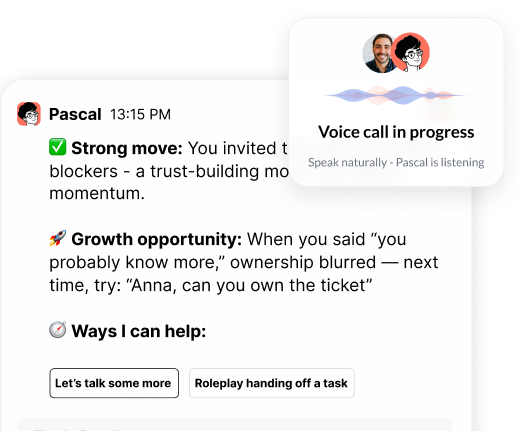
Ready to pilot AI coaching with your management team? See how Pascal works inside Slack and Teams to deliver real-time coaching at scale.
Header photo by AMONWAT DUMKRUT on Unsplash



“Thank you for setting the great foundation for my promotion; now I have a plan!"

Curious to see how AI Coaching can 10X the impact and scale of your development initiatives. Book a demo today for: